A child turning over two cards is doing more than searching for a match: they are showing you how they notice, remember, wait, and respond when an attempt does not work. The Role of Play in Learning course  Buy Now $16.00 offers a deeper foundation for connecting playful moments with children’s development, while the The Best Promotion is Play course Buy Now $35.00 explores practical ways to support meaningful play in your setting. Read on to see how a simple memory game can help you observe children’s approaches to challenges and plan responsive next steps.
Why can a memory game offer a meaningful glimpse into a child’s thinking?
A memory game creates a small, understandable challenge: children must look carefully, hold a detail in mind, make a choice, and see what happens. That sequence offers providers a natural opportunity to observe strategies in action—not to test or rank children, but to understand what kinds of support may help each child participate and persist.
When a child turns over two cards, they may recall a picture’s location, compare images, wait for a peer’s turn, and decide whether to try a different approach. These actions draw on attention, working memory, flexible thinking, and self-regulation. The NAEYC discussion of playful learning describes games and guided play as contexts where children can actively engage with goals while retaining curiosity and agency.
The game also makes challenge visible in a low-pressure way. A child might pause before choosing, narrate a plan, guess quickly, ask for help, or step away. None of these behaviors tells the whole story about ability. They are useful observations in context, shaped by familiarity, interest, language, fatigue, and the difficulty of the materials. The key is to notice what the child is trying and respond with encouragement rather than judgment.
- Notice the strategy, not only whether a pair is found.
- Look for how the child handles waiting, uncertainty, and an unsuccessful turn.
- Remember that one game is a snapshot—not a complete assessment.
What skills and approaches might you notice during play?
A matching game brings several processes together. Children attend to the cards’ images and positions, briefly retain information, compare new and remembered details, and adjust their choices after a mismatch. They may also practice social skills such as turn-taking, listening to shared rules, and communicating an idea. These capacities develop over time and may appear differently from one child or play session to another.
Pay attention to the route a child takes through the task. Does the child scan the whole layout or focus on one area? Do they remember where a picture appeared? Do they describe a plan aloud, use gestures, or watch a peer before joining? Does a mismatch lead to another attempt, a request for support, or a change in strategy? Those details reveal more than the final number of pairs.
Keep interpretations modest and specific. Instead of writing “has a poor memory,” record an observable action: “After two turns, Maya pointed to the card she remembered near the top row.” A brief, neutral note gives you useful information for planning and family conversations without turning a playful moment into a label.
- Attention: noticing relevant images and their locations.
- Working memory: holding a visual detail in mind while searching.
- Flexibility: changing a guess or strategy after new information.
- Persistence: returning to the challenge after a mismatch.
For another perspective on memory games and focus, see ChildCareEd’s article why memory games support attention and working memory.
How can you set up the Summer Time Memory Game as a supportive challenge?
The Summer Time Memory Game Buy Now $0.50 is a seasonal matching resource for preschool, kindergarten, mixed-age, and school-age groups. Its familiar game structure gives children a clear starting point, while its pictures can invite conversation and connection to what children know. Introduce it as shared play—not a measure of who is smartest or fastest.
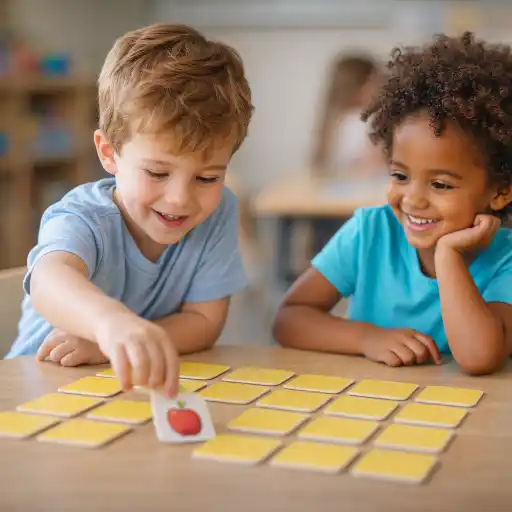
Model the routine: choose a card, look closely, turn over another, and compare. If the pictures differ, return them to their places and let the next player try. Start with a small set of pairs so children can learn the rules without holding too much information in mind at once. As confidence and interest grow, add cards gradually or invite children to explain what they remember.
- 🧩 Begin with a few pairs and demonstrate a calm, unhurried turn.
- Use the same simple language for the routine: “Look, remember, compare, and try again.”
- Offer roles such as card arranger or turn-taking helper to widen participation.
- Keep the activity brief and pause if children lose interest or show frustration.
Prompts can make children’s thinking visible without supplying an answer: “What do you remember seeing?” “Where might that picture be?” or “What could you try next?” Give children time to respond. They may speak, point, gesture, or watch quietly before taking a turn. The aim is a meaningful opportunity to engage, not identical participation from every child.
How can you adjust the challenge so every child can participate?
Developmentally responsive play depends on finding a workable level of challenge. If a child is overwhelmed, reduce the number of pairs, reveal cards face up first, or play cooperatively to find all the matches together. If the game feels too easy, add a few pairs, invite the child to recall a location after a short pause, or ask them to describe a picture’s features. Change one element at a time so you can see what helps.
Consider access as well as difficulty. Large, clear images, an uncluttered playing surface, adequate time, and a stable arrangement may help children attend to the cards. Children can respond by pointing, naming a picture, using a communication system, or partnering with an adult or peer. For multilingual children, name images in a familiar home language when possible and welcome the child’s own words.
Watch the child’s cues. Looking away, pushing materials aside, or becoming upset may indicate that the pace, group size, or level of difficulty needs adjustment; these behaviors are information, not defiance. Head Start guidance emphasizes observing children’s cues and responding in ways that support their needs and participation. Keep expectations flexible and offer a genuine choice to continue, watch, or take a break.
- Simplify: use fewer pairs, face-up matching, or a cooperative goal.
- Extend: add pairs gradually or invite children to describe a strategy.
- Include: adapt image size, response options, seating, and turn length.
State requirements vary - check your state licensing agency when determining whether training or documentation meets local expectations.
How can staff observe learning without turning play into a test?
Use brief observation to understand the child’s approach and decide what invitation might come next. Focus on what happened in the activity: the child’s actions, words, supports used, and response to challenge. For example: “Leo watched two turns, then matched a pair after an adult reminded him to look at the top row.” This is more actionable than a general judgment because it describes both participation and helpful support.
One game session should not be treated as proof of a broad ability or difficulty. A child may be tired, unfamiliar with the rules, distracted by the group, or simply uninterested in the theme. Look for patterns across different activities and days before drawing conclusions. If a concern persists, document the supports tried and follow program procedures for collaboration with families and appropriate professionals.
Common pitfalls are manageable. Avoid making the activity a race, increasing the card set too quickly, correcting every unsuccessful choice, or praising only winning. These approaches can make children feel evaluated instead of supported. Instead, model the process, allow thinking time, and acknowledge effort: “You looked carefully and remembered where you saw that one.”
- Record a specific action or quote rather than an ability label.
- Use observation to adjust materials, prompts, or turn length.
- Share strengths and useful strategies with colleagues and families.
For added professional learning, explore Play, Learn, Grow Online Version Buy Now $16.00 for child development and developmentally appropriate practice, DAP for Preschool Buy Now $24.00 for preschool-focused practice, and Preschool Assessments & Observations Buy Now $24.00 for observation and assessment foundations.
Conclusion: What does a memory game ultimately reveal?
A memory game can reveal how a child approaches a manageable challenge: how they focus, remember, make choices, respond to a mismatch, and engage with others. It does not provide a definitive measure of development. Its value lies in the chance to notice a child’s strategies in a familiar, playful setting and use those observations to offer a better-fitting next step.
Start with a few cards from the Summer Time Memory Game, model the routine, and keep the experience warm and flexible. Adjust the challenge, offer different ways to participate, and recognize careful thinking and persistence rather than speed or winning. The central question is not whether children find every pair; it is whether the game gives each child a supported opportunity to think, try, and grow through #play, #memory, #attention, #persistence, and #learning.
- Bienvenido! Welcoming All Families
- CDA Bridge Bundle: Preschool
- CDA Bridge Bundle: Family Child Care
- CDA Bridge Bundle: Family Child Care without Portfolio Review
- CDA Bridge Bundle: Infant/Toddler without Portfolio Review
- CDA Bridge Bundle: Preschool without Portfolio Review
- CDA Bridge Bundle: Infant/Toddler
- Texas Director Credential
- Access for All: Inclusion and the ADA
- CDA Certification en Español: Recursos y Consejos para Educadores Bilingües
- 🤯 ¿Por qué este niño está teniendo un comportamiento difícil de repente?
- Cómo Abrir Una Quardería En Casa Sin Dinero?
- Regulaciones de Licenciamiento de Cuidado Infantil en California para Centros y Hogares de Cuidado Infantil Familiar
- Normas de Licenciamiento de Cuidado Infantil en Virginia para Centros Diurnos Infantiles y Hogares Diurnos Familiares
- Proporciones de Cuidado Infantil y Tamaños de Grupo por Edad en Maryland (Guía Rápida para Centros y Hogares)
- Lista para Abrir una Guardería en Casa en Virginia: Cómo Empezar
- Lista para Guardería en Casa en Illinois: Cómo Iniciar una Guardería en el Hogar
- Lista para Guardería en Casa en California: Cómo Iniciar una Guardería en el Hogar
- Ejemplos de Crianza Respetuosa vs. Crianza Permisiva
- Apoyo en Preescolar para Retrasos del Habla: Estrategias Simples que Ayudan
- Retraso del Habla en la Guardería: Cómo Pueden Ayudar los Proveedores
- Celebrando la amistad en el cuidado infantil durante el Día de los Mejores Amigos
- Canciones, juegos y preguntas de círculo para niños
- What Does the Science of Peekaboo Reveal About Infant Learning?
- How Can Sound Bingo Sharpen Listening Skills in Preschoolers?
- Why Do Memory Games Support Attention and Working Memory?
- How Can You Choose the Right Level of Challenge in a Preschool Matching Game?
- What Does a Memory Game Reveal About How Children Approach a Challenge?
- What Do Children Enjoy About Screens—and How Can Their Answers Inspire Better Alternatives?
