Introduction
As a child care provider, you often hear children say the same word or line over and over. That can feel surprising or even a little frustrating. This article explains simple, practical reasons children repeat themselves and what repeat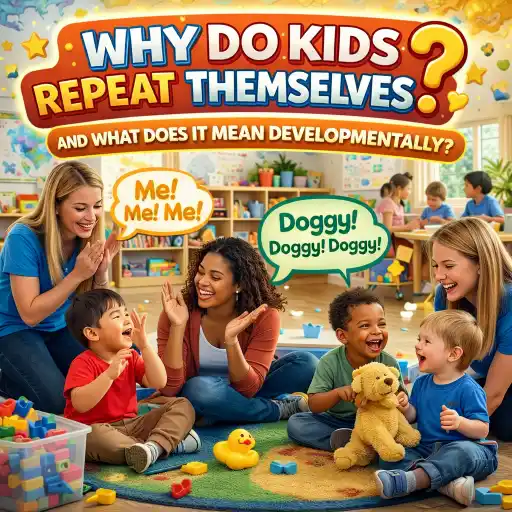 ing usually means for their #language, #development, and #communication. We use research and practical classroom tips from trusted sources like ChildCareEd (Language Explosions) and other child development resources.
Why this matters: Repetition is a normal way children learn. It helps them practice sounds, learn new words, and feel safe. Knowing when repetition is typical and when to share concerns with families helps you support every child with confidence.
1) Why do children repeat words and phrases?
Children repeat words for many good reasons. Here are the main ones, in a simple list:
- 🔁 Practice: Repeating helps children learn how to say a word or sentence correctly. As Nemours explains, repetition strengthens brain connections for reading and talking.
- 👂 Hearing and copying: Babies and toddlers copy sounds they hear. This echoing (echoic imitation) helps some children build language fast and can predict how well early intervention will work for kids with delays, according to recent studies (research on echoic imitation).
- 🧩 Understanding: Repeating a phrase helps a child connect the sound to what it means. ChildCareEd’s piece on talking, reading, and singing shows how repeated words in songs and routines build meaning.
- 💬 Social play: Sometimes repetition is play. Saying the same silly line makes friends laugh or join in.
- 🛡 Comfort: Repeating a favorite phrase can soothe a child when they are tired or upset. The behavior gives them control and predictability.
These reasons are tied to normal growth. Many children go through a phase of repeating during a #language "explosion," when words and sentences rapidly grow in number and variety (see ChildCareEd).
2) When is repetition a healthy part of development?
Repetition is usually healthy. You can watch for these signs that repetition is helping the child learn:
- 🙂 The child tries new words after repeating (they expand: "ball" → "big ball"). ChildCareEd shows how adults can expand a child’s words to teach new grammar and vocabulary (expand and extend).
- 📈 You see steady progress over weeks: more different words, clearer sounds, or longer phrases. Use milestone guides like the ChildCareEd milestones and the CDC milestone lists to check growth.
- 🎵 Repetition happens in songs, books, and routines. These repeated moments are learning gold—short songs and repeated read-alouds help, as shown by ChildCareEd’s guidance on infant language (How Your Words and Songs Help Infants Learn).
- 🤝 The child uses repeats to join play or talk with others. Repetition that builds social connections is a strong sign it’s positive.
Remember: many children show a lot of repeating during a language surge. Keep using simple phrases, model new words, and pause to let them respond. These small steps support healthy #children growth.
3) When should providers be concerned and what steps should you take?
Most repetition is normal. But sometimes repeating can be a sign to watch more closely. Here are clear warning patterns and steps to take:
- ⚠️ Red flags to notice:
- No new words or gestures over months.
- Repeating the same phrase without using it to communicate (long echolalia), or repeating to the point of distress.
- Loss of skills the child used to have.
- Very limited eye contact or very little play with others.
- ✅ Steps to take (practical and kind):
- Document specific examples and dates—short notes help a referral later.
- Talk with the family using strengths-first language: "I notice X; here’s what helps." ChildCareEd has suggestions for respectful family conversations (Typical & Atypical).
- Suggest a pediatric check or developmental screening. If concerns remain, families can contact early intervention (state programs) or ask the pediatrician for a referral. Keep in mind: state requirements vary - check your state licensing agency.
- Use classroom supports while waiting: visuals, simple signs, choices, and extra wait time. These help communicate and lower frustration (language strategies).
If a child shows signs of autism, apraxia of speech, or other communication disorders, early and coordinated referrals improve outcomes. Research about echoic imitation suggests early imitation skills can predict response to intervention (study).
4) How can teachers respond to repetition in ways that help learning and avoid pitfalls?
Use simple, classroom-ready actions. Below are practical steps you and your team can try tomorrow. Each step is short and easy to repeat during daily routines.
- 📣 Slow down and expand: When a child repeats a word, model a small addition.
- Child: "Car!"
- Adult: "Yes, red car! Roll the red car."
- 🧭 Use routines and repetition on purpose:
- Repeat short songs and phrases at the same time each day.
- Read the same short book often; point to pictures and name them.
- 🔧 Provide supports that lower frustration:
- Offer choices (two options) so the child can use words rather than just repeating.
- Use picture cards, simple signs, or a feelings chart to add ways to communicate (ChildCareEd tools).
- 🚫 Common mistakes to avoid:
- Correcting too quickly. Instead, model the right phrase gently.
- Interrupting a child mid-repeat without giving time to finish—pauses are part of learning.
- Only using supports for one child. Make visuals whole-class tools so using them feels normal.
Training and teamwork help make these steps routine. ChildCareEd courses like Language Development in Early Childhood  Buy Now $16.00 and Building Bridges for Dual Language Learners Buy Now $16.00 give staff shared language and strategies.
Conclusion
Repetition is usually a normal and helpful part of how children learn speech and play. Most of the time it is practice, comfort, or copying. As providers, we can support learning by modeling small additions, using short routines, and adding visual supports. Watch for clear red flags (no progress, losing skills, or harmful isolation) and work with families and specialists when needed. Keep short notes, share strengths-first observations with families, and remember: small, repeated steps help children grow.
Helpful next reads: ChildCareEd’s Typical & Atypical Development, Language Explosions, and the CDC milestone pages (3 years, 15 months).
- Lesson Planning for Preschoolers
- Bienvenido! Welcoming All Families
- CDA Bridge Bundle: Preschool
- Pediatric RSV First Aid & CPR/AED
- CDA Bridge Bundle: Family Child Care
- CDA Bridge Bundle: Family Child Care without Portfolio Review
- CDA Bridge Bundle: Infant/Toddler without Portfolio Review
- CDA Bridge Bundle: Preschool without Portfolio Review
- CDA Bridge Bundle: Infant/Toddler
- Texas Director Credential
- Party Hats and Emotional Regulation: Helping Little Ones Navigate Big New Year Feelings
- Cómo Abrir Una Quardería En Casa Sin Dinero?
- Recursos en Español sobre el Sueño Seguro del Bebé
- ¿Cómo puedo usar escenarios de juego de roles de primeros auxilios en mi aula?
- Capacitación en Salud y Seguridad Preventiva en Línea para Proveedores de Cuidado Infantil
- Lista para Abrir una Guardería en Casa en Virginia: Cómo Empezar
- Lista para Guardería en Casa en Texas: Cómo Iniciar una Guardería en el Hogar
- Capacitación Previa al Servicio para Proveedores de Cuidado Infantil en Dakota del Norte
- Easy Ways to Add STEM to Your Preschool Classroom
- How can I create developmentally appropriate activities for every child?
- How to Teach Diversity to Preschoolers Through Play
- Cómo simplificar la capacitación para sus empleados de daycare
- Grace and Courtesy Activities for Montessori Classrooms
- How can Michigan child care programs introduce new foods and prevent picky eating?
- How can I teach Black history to young children year-round?
- How Can Child Care Providers Plan Infant Activities Around Developmental Milestones?
- What Is Purposeful Play—and Why Is It Replacing Worksheets?
- How Can Meaningful Juneteenth Vocabulary Support Early Writers?
- How Can Preschool Teachers Build Independence Without Giving Too Much Help?
