Outdoor movement can turn an ordinary playground period into a powerful opportunity for children to build strength, balance, coordination, and confidence. For practical guidance on creating active routines, explore Balancing Active Play in Child Care  Buy Now $16.00, which can help you plan structured and unstructured movement while earning professional development hours; providers should confirm applicability with their state licensing agency.
For programs that want to deepen their outdoor environment, Creating the Natural Outdoor Classroom Buy Now $16.00 offers ideas for bringing textures, sounds, colors, and natural materials into children’s daily learning. Together, these courses provide a more complete foundation for intentional outdoor play.
Why does outdoor play matter for gross motor development?
Gross motor development involves coordinating the large muscles of the arms, legs, torso, and core. Skills such as running, jumping, climbing, throwing, and balancing support children’s independence and participation in everyday routines.
Outdoor spaces are especially valuable because they offer room, varied surfaces, and naturally occurring challenges. A grassy slope, a low balance beam, a garden path, or playground steps invites children to adjust their bodies, judge distance, and solve movement problems. These experiences strengthen not only muscles but also motor planning, spatial awareness, attention, and persistence.
The CDC notes that outdoor play gives children opportunities to run, jump, climb, test limits, and practice skills connected to developmental milestones (outdoor play and safety in ECE). For providers, the goal is not to create a competitive sports program. It is to offer frequent, joyful opportunities for children to move at their own developmental level.
- Running and jumping build endurance, leg strength, and body control.
- Climbing and crawling strengthen the core, shoulders, arms, and legs.
- Throwing, catching, and kicking develop timing and coordination.
- Balancing supports posture, stability, and confidence.
Which outdoor activities build balance, strength, and coordination?
The most effective activities are flexible enough to repeat and adapt. A single setup can provide different levels of challenge, allowing children to practice without feeling pressured.
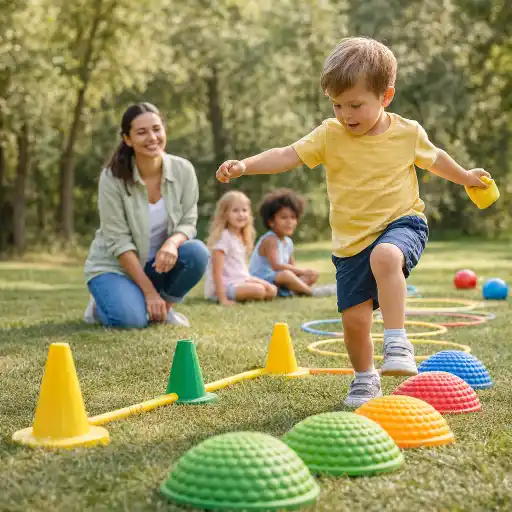
- Nature obstacle course: Arrange cones, hoops, stepping stones, low logs, tunnels, and chalk lines. Invite children to crawl under, step over, jump across, and balance along the route.
- Animal walks: Children can bear crawl, crab walk, waddle like penguins, or hop like frogs. These movements promote core strength, bilateral coordination, and imaginative engagement.
- Chalk movement paths: Draw zigzags, circles, footprints, and hopscotch squares. Add instructions such as “tiptoe,” “jump with two feet,” or “walk backward with help.”
- Ball and target games: Use soft balls or beanbags to practice rolling, tossing, kicking, and aiming. Begin with large targets placed nearby, then gradually increase distance or reduce target size.
- Follow-the-leader: Lead a sequence of marching, stretching, spinning, or stopping. Later, invite children to lead short sections.
- Garden movement: Carrying lightweight watering cans, digging, pushing a small wheelbarrow, and transporting soil provide purposeful resistance and coordination practice.
- 🌿 Nature scavenger movement: Ask children to walk, squat, reach, and carry as they search for safe items such as leaves, smooth stones, or sticks.
These activities reflect recommendations found in ChildCareEd’s gross motor activities for balance, coordination, and strength. Keep directions brief, demonstrate first, and repeat familiar activities so children can notice their own progress.
How can providers adapt outdoor activities for different abilities?
Inclusive gross motor planning begins with the assumption that every child can participate, although not every child will participate in the same way. Offer multiple pathways toward the same developmental goal rather than requiring one “correct” movement.
- Change distance: Move a target closer, shorten a running route, or widen a balance path.
- Change equipment: Use larger, softer balls, lighter beanbags, low platforms, or textured markers.
- Offer choices: Say, “Would you like to hop or step?” or “Would you like to throw or roll?”
- Provide supported options: Children may hold a railing, use a wall for balance, or complete an upper-body version from a seated position.
- Use visual cues: Footprints, picture cards, arrows, and taped pathways can reduce the need for lengthy verbal instructions.
- Build in peer connection: Buddies can model movements, celebrate effort, and practice cooperation without turning play into comparison.
Adaptations should preserve challenge while making success possible. A child who cannot yet cross a balance beam independently might walk beside it, hold an adult’s hand, or step across wide markers on the ground. A child who avoids catching may begin by trapping a large ball against the body or rolling it back and forth with a partner.
Observe what children can do, what interests them, and what supports help them persist. If concerns about development remain, document specific observations and follow your program’s referral procedures. Developmental variation is expected, but persistent concerns deserve thoughtful collaboration with families and qualified professionals.
How can outdoor play strengthen learning beyond physical skills?
Outdoor gross motor activities are also opportunities for language, science, mathematics, social-emotional learning, and self-regulation. Intentional teaching does not require interrupting children’s play with constant questioning. Instead, educators can add brief prompts that extend children’s thinking.
- Language: Describe movement with words such as over, under, beside, fast, slow, heavy, steady, and stretch.
- Mathematics: Count jumps, compare distances, sort natural materials, or create repeating movement patterns.
- Science: Ask what changes when children move on grass, mulch, pavement, or a slope.
- Social learning: Practice turn-taking, cooperative obstacle courses, shared goals, and respectful negotiation.
- Self-regulation: Alternate energetic games with breathing, stretching, slow walking, or quiet observation.
For example, a “river crossing” course can invite children to jump between hoops, count the “stones,” describe how they kept their bodies steady, and help a peer choose a safe route. The activity remains playful while supporting multiple developmental domains.
Nature-based spaces can add sensory richness and open-ended possibilities. Research on nature-based outdoor environments for children under three emphasizes that natural elements can provide sensory experiences, physical challenges, curiosity, and opportunities for motor development (nature-based outdoor play and learning environments). A natural outdoor classroom does not need to be elaborate; logs, gardens, loose parts, shade, and varied ground surfaces can offer meaningful affordances when carefully supervised. For a broader look at supporting children’s natural development through play, including opportunities to build fine motor skills, see guidance on supporting children’s natural development.
How should programs plan safe, consistent outdoor movement?
Safety and challenge are not opposites. Children benefit when adults create environments that are secure enough for exploration and responsive enough to prevent foreseeable harm. Before outdoor play, inspect equipment, check surfaces, remove hazards, confirm boundaries, and position adults so all children remain visible and audible.
The CDC recommends attention to heat, sun exposure, hydration, insects, playground surfacing, age-appropriate equipment, helmets for wheeled toys, and constant supervision near water. Water play requires particular care because drowning can happen quickly and quietly. Follow your center’s policies, obtain required permissions, and never substitute an activity for active supervision.
Build movement into the daily rhythm rather than treating it as an occasional event:
- Morning: Offer five to ten minutes of animal walks, chalk paths, or a balance route.
- Midday: Provide an outdoor block with free play, climbing, ball games, and child-directed exploration.
- Transitions: Use marching, stretching, or “move like an animal” cues while waiting or lining up.
- Afternoon: Repeat a familiar target game or cooperative obstacle course, then transition gradually to quieter activities.
Avoid common pitfalls: overly difficult challenges, long lines, unclear boundaries, excessive competition, and adult positioning that leaves blind spots. Small-group stations keep children active and make supervision more manageable. State requirements vary - check your state licensing agency.
How can educators observe progress and keep activities engaging?
Progress is best understood through repeated observation, not a single performance. Choose one or two skills to notice, such as stepping over an obstacle, balancing for several seconds, hopping, throwing toward a target, or stopping safely when given a cue.
- Record what the child attempted, not merely whether the child succeeded.
- Note the level of support required and whether support decreases over time.
- Document interests, preferred equipment, and conditions that encourage participation.
- Share meaningful progress with families using notes, conversations, or photographs when permission has been provided.
Keep activities engaging by rotating materials while preserving familiar movement patterns. Children often enjoy repeating an obstacle course because repetition gives them a chance to master the sequence. Add one new element at a time: a different pathway, a new animal movement, a farther target, or a cooperative mission.
Celebrate effort and strategy rather than speed. Comments such as “You looked carefully before stepping,” “You found a way to keep your balance,” and “You kept trying after the ball rolled away” reinforce confidence and a growth-oriented view of learning. This approach is especially supportive for children who are cautious, developing at a different pace, or rebuilding confidence after difficulty.
Conclusion: Which outdoor play activities best boost gross motor development?
The strongest outdoor activities are simple, repeatable, adaptable, and joyful. Obstacle courses, animal walks, chalk paths, ball games, climbing, balancing, gardening, and nature exploration give children meaningful practice with strength, coordination, endurance, body awareness, and confidence.
Effective providers combine intentional planning with child-led discovery. Offer an appropriate challenge, adapt the materials, supervise actively, connect movement to learning, and observe individual progress. When outdoor play becomes a consistent part of the daily routine, small moments of movement accumulate into substantial developmental opportunities for every child.
For continued professional learning, consider ChildCareEd’s Balancing Active Play in Child Care Buy Now $16.00, Creating the Natural Outdoor Classroom Buy Now $16.00, CDA: Creating the Outdoor Classroom Buy Now $16.00, Effective Supervision in Child Care Buy Now $25.00, and Inclusive Lessons for Preschoolers Buy Now $16.00. Each course addresses a complementary aspect of designing active, safe, and inclusive experiences.
- CDA Home Visitor Subject Area 3 Part 3 Birth to 5
- CDA Home Visitor Subject Area 2 Part 3 Birth to 5
- Birth to Five CDA Credential with Portfolio Review
- 24 Hour Texas Pre-Service
- CDA Bridge Bundle: Family Child Care without Portfolio Review
- CDA Bridge Bundle: Infant/Toddler without Portfolio Review
- CDA Bridge Bundle: Preschool without Portfolio Review
- Sensitive Periods in Montessori: Guiding Natural Learning
- Wellness in Action: Teaching Healthy Habits to Children
- Mindful Supervision: Balancing Safety & Independence in Montessori
- Bye Bye Winter: The Role of Outdoor Play in Early Childhood Development
- Exploring the Cognitive Benefits of Movement in Early Childhood Classrooms
- How motor skills shape child development and creative ways educators can foster them.
- Gross Motor Spring Activities for Kids: Fun Ways to Build Strength and Coordination
- Gross Motor Activities That Build Balance, Coordination, and Strength
- Actividades de Motricidad Gruesa que Desarrollan el Equilibrio, la Coordinación y la Fuerza
- How can I use beach and ocean-themed summer activities in my California early childhood classroom?
- Learning Through Creative Daycare Activities
- How can child care programs boost physical activity for young children?
- How can we teach children through play?
- Pumpkin, Leaves, and Apples: Fall Activities for Preschoolers
- Daycare Activities That Support Child Development
- Superhero Examples for Kids: Learning About Helpers, Safety, and Kindness
- Gross Motor Skills Activities for Balance, Coordination, and Strength
- Indoor and Outdoor Activities for School-Age Children
- How can we plan fun, safe outdoor activities for school-age daycare programs?
- How can I build gross motor skills indoors and outdoors for the children in my program?
- How Can Child Care Providers Support Gross Motor Development in Every Child?
- Which Outdoor Play Activities Best Boost Gross Motor Development?
