New experiences can feel overwhelming when children do not know what will happen next. A thoughtfully designed social story gives children concrete information, supports #confidence, and creates opportunities to practice before the event; for broader classroom strategies, explore Effective Approaches for Autism and Inclusion  Buy Now $55.00, which can strengthen your professional knowledge and help you earn applicable training hours while improving inclusive practice.
For child care providers, preparation is not about making every experience perfectly predictable. It is about giving children enough information, choice, and emotional support to participate in ways that are meaningful for them. Social stories can help with a first day of school, a fire drill, a field trip, a substitute teacher, a doctor visit, or a change in the daily schedule.
They are especially useful when a child communicates differently, processes language slowly, experiences sensory differences, or becomes anxious during transitions. At the same time, social stories are not exclusively for autistic children. Any child who benefits from visual information and rehearsal may find them helpful.
Why do social stories help children approach unfamiliar experiences?
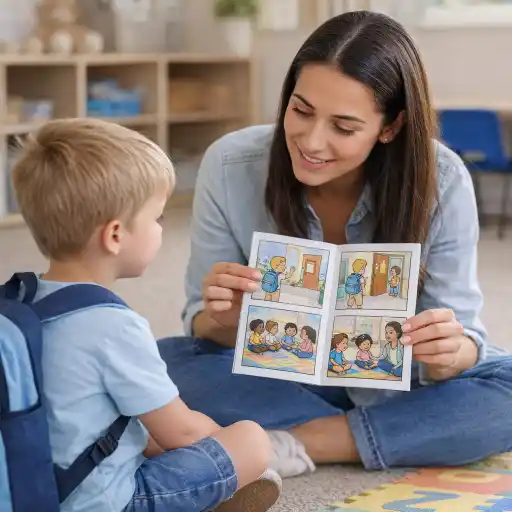
A social story is a short, descriptive narrative about a situation, event, skill, or concept. It explains what a child may see, hear, do, and experience, often using photographs, illustrations, symbols, or simple written language. The goal is not to demand a particular performance. Rather, the story makes important information visible before the child enters an unfamiliar situation.
New experiences can combine several challenges: unfamiliar people, altered routines, sensory input, waiting, movement between locations, and expectations that adults may assume are obvious. A story breaks those demands into manageable pieces. It can also introduce coping options, such as asking for help, holding a trusted adult’s hand, wearing headphones, taking a break, or looking at a visual schedule.
Evidence-informed guidance emphasizes that predictable routines and visual supports can reduce uncertainty and increase participation. The CSEFEL brief on routines and classroom schedules explains that picture and object schedules help children understand expectations and become more independent. Similarly, the CDC describes Social Stories as simple descriptions of what to expect in a social situation.
Used respectfully, social stories communicate: “You belong here, and we will help you understand what is happening.” That message matters. Preparation should increase agency, not pressure children to hide distress or imitate neurotypical behavior.
How should providers choose the experience and gather information?
Begin with a specific experience rather than a broad goal. “Going on a field trip” may be too large; “boarding the bus, sitting in a seat, and arriving at the museum” is more teachable. Identify the parts of the experience that are genuinely new or difficult and determine what information the child needs in order to participate.
Before writing, consult families and colleagues. Families may know the child’s preferred communication, calming strategies, sensory needs, interests, and prior experiences. Staff can map the sequence of events, identify likely waiting periods, and arrange accommodations. When appropriate, collaborate with speech-language pathologists, occupational therapists, or inclusion specialists.
Ask practical questions:
- What will happen first, next, and last?
- Who will be present, and what will they do?
- What sounds, smells, textures, or movements might occur?
- Where can the child go for a break?
- How can the child communicate “help,” “stop,” or “finished”?
- Which parts of the plan can include choice?
Keep the child’s strengths central. A child who loves vehicles might explore a photo of the bus; a child who enjoys music might use a song to mark the beginning of the routine. Personalization improves relevance without turning the story into a reward or compliance exercise.
Remember that state requirements vary - check your state licensing agency, particularly when the experience involves transportation, medication, field trips, or formal individualized plans.
What makes a social story clear, positive, and individualized?
Effective stories use concrete language and show the sequence without overwhelming the reader. Use short sentences, familiar vocabulary, and one idea per page when possible. Pair each key sentence with a meaningful image. Real photographs of the classroom, entrance, teacher, bathroom, bus, or activity area may be more understandable than generic clip art.
The Indiana Resource Center for Autism guidance on social stories cautions providers to treat story writing as a complex, individualized process. A story should be based on accurate information about the situation and the child’s purpose, communication, and support needs. It should not rely on shame, guilt, or strongly directive language.
A useful structure includes:
- Context: Identify where the experience will occur and who may be there.
- Sequence: Describe what happens in a logical, observable order.
- Options: Explain choices and appropriate ways to communicate needs.
- Reassurance: State that trusted adults can help and that different feelings are acceptable.
- Closing: Describe how the experience ends and what comes afterward.
For example: “On Friday, our class will visit the library. We will walk with our teacher. We may see other people and hear quiet voices. I can look at my picture card or ask for help. I can choose a book. When library time is finished, we will return to school.”
Avoid promises that cannot be guaranteed, such as “The visit will be quiet” or “I will not feel worried.” Instead, offer truthful flexibility: “There may be unexpected sounds. An adult will help me find a quieter place.” Review the story with another knowledgeable adult when possible, especially if language comprehension is a concern.
When and how should a team introduce and practice the story?
Introduce the story while the child is calm, not immediately before a crisis or while rushing out the door. For a significant event, begin approximately one to two weeks beforehand; for a routine change, even a few days may help. The appropriate timeline depends on the child, the complexity of the experience, and how often the story can be revisited without becoming burdensome.
Read the story briefly and consistently. Pause to observe the child’s response rather than quizzing constantly. Invite the child to point, turn pages, select a picture, act out a step, or add a preferred communication symbol. Repetition should feel supportive, not like a test.
Practice through play and real environmental exposure:
- 😊 Role-play entering the room, greeting a person, or waiting.
- Visit the location when it is quiet, if feasible.
- Take photographs of important spaces and people.
- Pair the story with a visual schedule, first–then board, timer, or object cue.
- Practice requesting a break, help, more time, or a different option.
- Rehearse the ending so the child knows what happens afterward.
The National Center for Pyramid Model Innovations family-engagement resources recommend modifying scripted stories so they are meaningful for the individual child and the unique context. Share the story or a brief summary with families so home and school can use compatible language. Consistency across adults reduces processing demands.
During the actual event, use the story as a support, not a script the child must perform perfectly. Follow the child’s communication, adjust the plan, and prioritize safety and regulation.
How can providers evaluate effectiveness and avoid common pitfalls?
Evaluate whether the story improves access and participation, not merely whether the child appears quiet or compliant. A successful outcome might be entering the new space, communicating a need, staying near the group, recovering after a surprise, or using a break appropriately.
Choose one or two observable indicators and collect brief information before, during, and after implementation. For example, record the number of adult prompts needed to enter a room, the time required to transition, or whether the child independently uses a help card. Review the information with the family and team, then revise the story.
Common pitfalls include:
- Writing too much: Use the fewest pages and words needed to convey essential information.
- Using abstract language: Replace “behave appropriately” with observable descriptions such as “I can walk beside my teacher.”
- Focusing on compliance: Include communication, consent, breaks, and choices.
- Ignoring sensory needs: Describe available accommodations and practice using them.
- Using a generic story: Adapt names, places, images, language, and cultural context.
- Relying on the story alone: Pair it with environmental changes, adult support, communication tools, and instruction.
The Indiana guidance stresses that social stories may be one component of a broader positive-support plan. If distress persists, investigate what the behavior communicates and whether the environment, task, timing, or sensory conditions need to change. Do not interpret an unsuccessful story as a child’s failure.
For directors, a short team checklist can support consistency: identify the purpose, review the story, assign who will introduce it, prepare accommodations, communicate with the family, and schedule a follow-up review.
Conclusion: How can social stories prepare children for new experiences?
Social stories prepare children by making unfamiliar experiences more understandable, visible, and manageable. The strongest stories are accurate, brief, positive, individualized, visually supported, and paired with real accommodations. They describe what may happen while preserving the child’s right to communicate, pause, refuse, or seek help.
A practical implementation plan is simple:
- Choose one upcoming experience and map its essential steps.
- Gather family input and identify sensory, communication, and mobility supports.
- Create a short story with photographs or meaningful visuals.
- Introduce it calmly, practice through play, and revisit it consistently.
- Observe participation, revise the plan, and celebrate self-advocacy.
Providers who want deeper preparation for inclusive practice can explore Coaching for Success: Inclusive Strategies to Support Children with Autism Buy Now $55.00$45.00, which focuses on individualized scaffolding, daily routines, family collaboration, and staff coaching. Additional relevant learning options include Play with Purpose: Supporting Children with Autism Buy Now $55.00$40.00, Self-Regulation & Change: Helping Children Cope Buy Now $16.00, and Every Moment Matters: Schedules and Transitions Buy Now $55.00.
Preparation is most effective when it communicates possibility rather than perfection: “This is new, and we can find ways for you to participate.”
- CDA Home Visitor Subject Area 3 Part 3 Birth to 5
- Bienvenido! Welcoming All Families
- Pediatric RSV First Aid & CPR/AED
- CDA Bridge Bundle: Family Child Care without Portfolio Review
- CDA Bridge Bundle: Infant/Toddler without Portfolio Review
- The Best Promotion is Play
- CDA Bridge Bundle: Preschool without Portfolio Review
- Emergent Learning & Development
- Texas Director Credential
- Anxiety: Signs & Strategies
- Tiny Tots, Big Learning: Crafting Curriculums for the Littlest Learners!
- The Family Day Care Chronicles: Tales of Laughter, Learning, and Unexpected Adventures
- CDA Certification en Español: Recursos y Consejos para Educadores Bilingües
- 💛🧩 ¿Cómo puedo hacer que mi enseñanza sea inclusiva para los niños con autismo?
- Proporciones de Cuidado Infantil y Tamaños de Grupo por Edad en Nueva Jersey (Guía Rápida para Centros y Hogares)
- Proporciones de Cuidado Infantil y Tamaños de Grupo por Edad en Virginia (Guía Rápida para Centros y Hogares)
- Canciones, juegos y preguntas de círculo para niños
- Getting to Know You Activities for Preschoolers When a New Child Joins the Class
- How Can Social Stories Prepare Children for New Experiences?
- How Can Take-Home Books Strengthen the Home-School Reading Bond?
- Why Do Predictable Books Help Preschoolers Feel Like Readers?
- What Are Age-Appropriate Ways to Teach Gratitude Before Thanksgiving?
- How Much Structured Learning Do Preschoolers Really Need?
- What Is Purposeful Play—and Why Is It Replacing Worksheets?
- How Can Child Care Programs Build an Effective Social-Emotional Curriculum?
- What Should a 4-Year-Old Know Before Pre-K?
- How Can Child Care Providers Help Children Understand How Community Helpers Contribute?
- How Can Predictable Ocean-Themed Text Build Reading Confidence?
- How Can You Teach a New Word So Children Use It Beyond the Activity?
- How Can Child Care Providers Help Children Tell Their Own Stories About Family Life?
