A playground sign that tips over in a breeze is a practical engineering puzzle—and a chance for children to turn everyday observations into design thinking. Explore the Building Early Science Foundations  Buy Now $16.00 course to strengthen your approach to children’s questions, experiments, and discovery, then use the challenge below to bring wind science into your program.
Why is a wind-ready sign a meaningful design challenge?
Children see wind’s effects even though air itself is invisible: leaves scatter, ribbons flutter, and lightweight objects move. Designing a sign that stays upright gives them a concrete problem to investigate. They can explore how a broad panel catches moving air, how a base affects balance, and how materials and connections influence stability.
This is engineering in an early childhood setting: children identify a need, imagine possibilities, plan, build, test, and revise. NAEYC describes a preschool design process that includes finding a problem, imagining and planning, creating, and improving. The goal is not to produce identical signs or to arrive at one “correct” design. It is to help children make their reasoning visible through conversation, drawings, and hands-on trials.
The playground context also makes the work relevant. A sign might welcome families, label a garden, or point visitors toward a play area. Children can consider the people who will read it and the outdoor conditions it needs to withstand. This authentic purpose can encourage engagement, cooperation, and thoughtful attention to both form and function.
How can providers introduce the challenge and plan the investigation?
Begin by inviting children to observe signs, flags, or other objects outdoors on a breezy day. Ask what they notice and what might make an object wobble or tip. Then present the design problem: “Can we make a playground sign that stays standing when moving air pushes it?” Keep the wording simple, and invite children to explain what they think a sturdy sign needs.
Offer a manageable selection of safe, age-appropriate materials. For example, gather cardboard or heavy paper for sign panels, craft sticks or paper tubes for supports, modeling clay or reusable putty for bases, and tape for joining parts. Choose materials in line with children’s ages, abilities, and program policies; inspect them before use and supervise tools closely.
- Ask children to sketch or describe a possible sign before building.
- Invite them to choose a message or symbol that would help someone on the playground.
- Agree on a fair test, such as placing each model at the same distance from a fan on the same setting for the same amount of time.
- Identify what counts as success: the sign remains upright, its message is visible, or it withstands more than one test.
Children may change their plans as they work. That is expected: design is a flexible process, not a worksheet sequence that must be followed perfectly.
What design features might help a sign resist wind?
Wind pushes against a surface. A large, solid sign panel may catch more moving air than a smaller or perforated one, while a low, wide base can help resist tipping. The connection between the panel and its support matters too: a loosely attached panel may bend or separate even if the base is stable. These observations give children useful starting points without dictating a final design.
Invite children to compare features one at a time. They might test a narrow versus wide base, a tall versus short support, or a solid panel versus one with openings. To make comparisons meaningful, keep other conditions as consistent as possible. A fan can provide a repeatable breeze indoors; outdoors, use a naturally breezy area only when conditions are suitable and supervision is adequate.
- Base: Try a broader or heavier base to lower the chance of tipping.
- Panel: Compare different sizes or shapes, or consider whether openings allow some air to pass through.
- Support: Explore how adding or repositioning supports changes bending and stability.
- Connections: Check whether tape or another permitted joining material holds the pieces together through repeated tests.
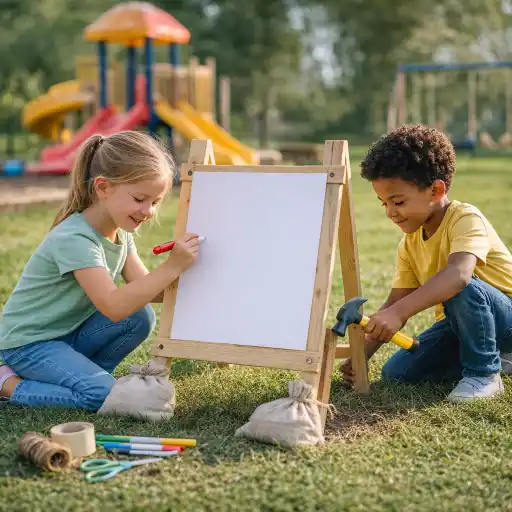
Frame each idea as a question rather than a promise: “What do you predict will happen if we make the base wider?” Children develop #engineering thinking by making a prediction, testing it, and revising their explanation in response to what they observe.
How should children test, revise, and document their designs?
Give each group time to test its first model and notice what happens. Does the sign stay upright, lean, bend, or fall? Which part moved first? Ask children to describe the result before suggesting a fix. A model that falls is not a failure of learning; it provides evidence that can guide the next attempt.
Keep the test consistent. Mark the fan’s position and the model’s starting point, use one fan setting for each comparison, and test models for equal amounts of time. For a simple record, children can draw the design, place a mark beside “stood,” “leaned,” or “fell,” or dictate an observation for an adult to write. Older preschoolers may count how many seconds a sign remains upright or compare results in a simple chart.
- Test one design feature at a time where possible.
- Invite children to identify the part they would change and explain why.
- After revising, repeat the same test and compare the outcomes.
- Photograph the model before and after a change, and capture a child’s words.
- 🌬️ Celebrate a new observation or a thoughtful redesign, not only the sign that stays up longest.
This cycle aligns with NAEYC’s emphasis on creating and improving prototypes, as well as the iterative approach described in NAEYC’s build-and-test activities. Documentation does not need to be elaborate; a photo, a short quote, and a note about the change can help educators plan the next investigation.
How can providers make the challenge inclusive, safe, and engaging?
Offer different ways for children to participate. One child may draw a plan, another may select materials, and another may observe or describe what happens during the test. Use picture prompts, clear short steps, larger pieces, adapted grips, and additional time where helpful. Children can explain ideas through words, gestures, drawings, building, or a home language. The design task should be flexible enough for children with varied communication, sensory, and motor needs.
Safety planning is essential, particularly if the finished sign will be placed on the playground. Treat classroom prototypes as learning models, not as outdoor fixtures. Do not install a child-made sign where it could fall, create a tripping hazard, obstruct supervision, or interfere with playground equipment. Any permanent or temporary sign used in the outdoor space should be reviewed by program leadership and maintained according to applicable safety procedures.
For fan testing, secure the fan so children cannot reach the blades or cord, position it away from water, and keep loose materials from blowing into faces. Use low settings and adult supervision. Outdoors, avoid testing during severe gusts, storms, or conditions that make the area unsafe. State requirements vary - check your state licensing agency.
Help children connect the project to broader preschool engineering design practices and to the real-world idea that structures need to account for the forces acting on them. The Basic Science in Early Childhood Buy Now $25.00 course offers another focused learning option for providers who want to develop everyday investigation and scientific reasoning in their classrooms.
Conclusion: What helps a playground sign stay standing?
A wind-ready playground sign emerges through observation, planning, building, testing, and revision. Children can investigate how panel size and shape, the width and weight of a base, supports, and connections affect whether a model stands. The clearest learning comes from fair comparisons: change a feature, keep the test consistent, and discuss what the evidence shows.
For providers, the central task is to create a safe, welcoming investigation without taking over the design. Offer accessible materials, invite predictions, make space for more than one solution, and value the information children gain from a model that tips or bends. A simple photo and child quote can capture the process and guide a meaningful follow-up.
So, how can children design a playground sign that stays standing in the wind? They can investigate the forces acting on it, make a plan, test a prototype, and improve the design together. That process makes a small playground problem a rich opportunity for #science, creativity, communication, and problem-solving.
Five relevant ChildCareEd courses
- CDA Subject Area 2
- What Makes Me Special: An Overview of Autism and ADHD
- Pediatric RSV First Aid & CPR/AED
- CDA Bridge Bundle: Family Child Care without Portfolio Review
- CDA Bridge Bundle: Infant/Toddler without Portfolio Review
- CDA Bridge Bundle: Preschool without Portfolio Review
- Building Early Science Foundations
- Enhancing STEM Education for Infants and Toddlers
- Environments That Inspire Independence and Exploration
- Montessori Cultural Activities: Exploring the World Through Play and Learning
- CDA Certification en Español: Recursos y Consejos para Educadores Bilingües
- Texas Weather & Outdoor Time at Daycare
- California Weather & Outdoor Time at Daycare
- 10 Ejemplos de Cómo la Cultura Influye en el Desarrollo Infantil
- ¿Qué Temperatura Es Demasiado Fría para Jugar al Aire Libre en el Cuidado Infantil?
- Consejos de Supervisión Activa para Salones de Preescolar y el Juego al Aire Libre
- Retraso del Habla en la Guardería: Cómo Pueden Ayudar los Proveedores
- Canciones, juegos y preguntas de círculo para niños
- What’s Happening Outside? Fall Science Adventures for Preschoolers
- Playground Safety Checklist for Daycares: 10 Hidden Hazards Staff Often Miss
- Can You See the Wind? 8 Outdoor Spring Activities That Help Children Explore It
- What Should Child Care Staff Check Before Outdoor Play?
- How Can Child Care Providers Ensure Every Child Can Participate in Outdoor Play?
- Why Does the Wind Feel Different on Opposite Sides of the Playground?
- How Should You Check a Family Child Care Yard After Heavy Rain or Wind?
- How Can Children Design a Playground Sign That Stays Standing in the Wind?
- How Can Child Care Providers Teach Fall in Warm Climates Without Red Leaves or Cold Weather?
- How Cold Is Too Cold for Preschoolers to Play Outdoors Safely?
- What Is Hiding Under Those Leaves? How Can Child Care Teams Refresh Fall Playground Inspections?
- How Cold Is Too Cold for Outdoor Play in Childcare Settings?
