Fall offers a ready-made science lab: seeds drift, cling, float, and scatter just beyond the classroom door. Explore practical ways to help preschoolers investigate these journeys, build early science skills, and turn curiosity into meaningful learning; the Basic Science in Early Childhood Buy Now $25.00 training can help you plan inquiry-rich experiences and strengthen your classroom practice. For an easy starting point, pair the investigation with the Traveling Seeds Investigation Pack Buy Now $0.00.
Why is seed travel a meaningful science topic for preschoolers?
Seeds make an abstract idea visible: plants have ways to move offspring away from the parent plant. When seeds land too close together, young plants may compete for sunlight, water, nutrients, and room to grow. Dispersal helps plants reach new places, and seed features often provide clues about how they travel. A light, feathery seed may catch the wind; a hooked burr may cling to fur or fabric; and a buoyant seed may move with water.
For preschoolers, the goal is not to memorize every botanical term. It is to notice, wonder, compare, and explain using evidence. Children might observe a maple seed spinning down, find a burr attached to a sock, or wonder why some seeds remain inside fruit. These real encounters connect science to familiar fall experiences and invite children to participate as capable investigators.
Inquiry-based exploration also supports language, early math, collaboration, and fine-motor development. Children describe textures, sort by features, make predictions, and listen to classmates’ explanations. As early childhood science guidance emphasizes, children’s curiosity can become a foundation for inquiry when educators provide meaningful materials, time, discussion, and thoughtful support.
How can educators prepare a safe and engaging investigation?
Begin with a small collection of locally available seeds or seed-bearing plant materials, such as maple samaras, pinecones, milkweed fluff, or burrs. Choose examples that are large enough to handle easily and appropriate for your group. Avoid unknown or toxic plants, and check for allergies, choking risks, and local outdoor hazards. Children should not taste or put seeds in their mouths; supervise closely, especially with small items.
Set up a discovery table with magnifiers, trays, picture cards, paper, crayons, and a few simple testing materials. If collecting outdoors, establish boundaries, maintain active supervision, and follow your program’s procedures. When outdoor exploration is not practical, bring in safe, clean samples or photographs.
- Invite children to look closely: What do you notice about the seed’s size, shape, weight, or surface?
- Ask for a prediction before testing: How might this seed move?
- Offer more than one way to respond, such as talking, pointing, drawing, sorting, or dictating an observation.
- 📒 Keep a shared observation chart so the group can revisit ideas and compare what happened.
Prepare a few open-ended prompts rather than a long explanation. Questions such as “What makes you think that?” and “What could we test?” leave room for children’s ideas and help keep the investigation playful and purposeful.
Which seed-travel methods can young children investigate?
Introduce three common routes first: wind, water, and animals. Some plants also release seeds when pods open or burst; this can be added as an extension with safe, teacher-prepared examples. Explain that real seeds may use more than one route, so a child’s observation can be a thoughtful possibility rather than a single right answer.
- Wind: Compare a lightweight paper seed model with a heavier one. Drop them from the same height and notice which stays in the air longer or moves farther with a gentle breeze.
- Water: With adult supervision, place large, safe seed examples or teacher-made models in a shallow tub. Observe which float and discuss how floating could help a seed move along water.
- Animals: Press burr-like plant materials or safe hook-and-loop models against a piece of fabric. Notice what catches and discuss how seeds may hitch a ride on fur or clothing.
- Seed pods: Examine a dry, teacher-prepared pod or use a paper model to show how seeds can be released outward. Keep any handling age-appropriate and supervised.
Hands-on testing helps children connect form and function: fluffy fibers, wings, hooks, and buoyancy are not just interesting details; they can support movement. PLT’s seed-dispersal activity similarly encourages observing, identifying, and modeling how seeds spread. Keep the explanation grounded in what children actually observe, and avoid implying that every seed travels in only one way.
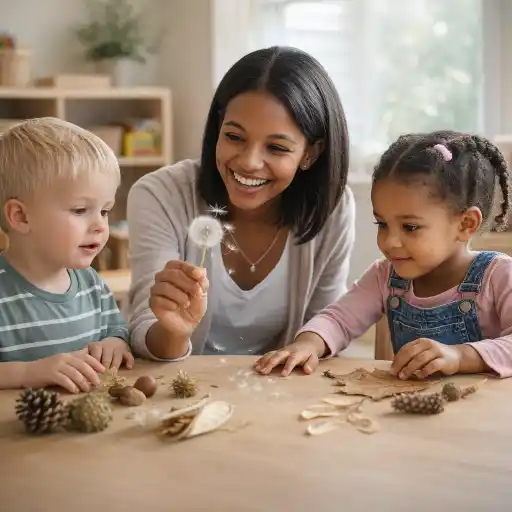
How can educators guide observation, prediction, and discussion?
A strong investigation follows a simple cycle: notice, predict, test, describe, and revisit. First, give children unhurried time to examine seed features. Invite them to share what they already know, including ideas from walks, gardens, food, or stories. Record their words without correcting every early guess; predictions are useful starting points for learning.
Next, choose one test at a time and change as few conditions as possible. For example, compare two paper seed models by dropping each from the same height, or test whether different models float in the same container. Ask children what they observed rather than whether their answer was right. “What happened when the fan moved the air?” is more productive than “Which one is the wind seed?”
Documentation can be simple and inclusive. Children may draw a seed, place a picture card in a category, dictate a sentence, or use gestures to show movement. A teacher can add a brief note: “Mina predicted the winged model would spin; it turned as it fell.” This makes thinking visible and gives the group a basis for comparison.
Use precise but accessible vocabulary—seed, disperse, float, attach, drift—and model it naturally. Invite children to explain their reasoning to peers: “I think it travels with animals because it stuck to the fabric.” A printable observation chart or sorting activity can support this process without replacing conversation and direct exploration.
How can this fall investigation support learning across the day?
Seed dispersal offers meaningful connections across developmental domains. Sorting examples by visible features supports classification and early mathematics. Measuring how far a paper model travels introduces comparison and distance. Drawing a seed’s shape supports representation, while retelling how it moved strengthens oral language and sequencing. Children can work in pairs to share materials, negotiate a prediction, and decide how to test an idea.
Keep the learning active and flexible. A short investigation may be enough for one day; revisit it later with new seeds, weather observations, or a classroom plant. Invite children to look for safe examples on a supervised walk, then compare what they find with the class collection. If local seeds are scarce, photographs and teacher-made models still provide a rich starting point.
For a structured extension, children can design a simple paper seed that travels through the air, then change one feature—such as wing size or shape—and compare results. The purpose is not to create a perfect model, but to help children notice how design can influence movement. PLT’s STEM activity encourages seed observation and modeling, while child-centered early science practice reminds educators to allow time for children to explore, represent, and discuss their ideas.
Across these experiences, educators can extend learning without turning play into a lecture. Follow children’s questions, offer new materials when interest persists, and connect observations to the natural world they know.
What common pitfalls should educators avoid?
One common pitfall is giving children the answer before they have a chance to observe. A quick explanation may seem efficient, but it can close down the very questions that make investigation engaging. Offer a concise idea, then invite children to look for evidence and revise their thinking.
Another is treating sorting categories as absolute. A seed may be carried by wind and water, or animals may transport seeds externally on fur and internally after eating fruit. Preschoolers do not need every exception, but they benefit from language such as “often,” “might,” and “one way.” That language models scientific thinking as evidence-based and open to revision.
- Too many materials at once: Present a few clear examples, then add more if children remain interested.
- Unsafe collecting or testing: Screen materials, supervise closely, avoid tasting, and follow program safety policies.
- Expecting written answers: Accept talking, drawing, pointing, sorting, and adult-recorded comments as valid ways to share understanding.
- Rushing the process: Leave time to repeat a test or return to an earlier prediction; a surprising result is a reason to investigate again.
Keep activities developmentally appropriate and accessible to the children in your group. State requirements vary - check your state licensing agency for applicable rules on outdoor supervision, materials, and activity planning.
Conclusion: How can we help preschoolers discover how seeds travel?
Preschoolers can explore seed travel by observing seed features, making predictions, testing simple models, and discussing what the evidence suggests. Wind, water, and animals offer accessible starting points, while seed pods and other dispersal strategies can extend the inquiry. The key is to support curiosity with safe materials, open-ended questions, and time to notice and revisit ideas.
These fall investigations are more than a seasonal activity: they create opportunities for early scientific reasoning, language, math, and collaboration. Start small, use what is available, and let children’s questions guide the next step. The Traveling Seeds Investigation Pack Buy Now $0.00 can provide a practical structure for comparing seed models and sorting dispersal methods. To deepen your planning skills, explore the Basic Science in Early Childhood Buy Now $25.00 course, which focuses on meaningful opportunities for young children to explore, investigate, question, and experiment.
Related ChildCareEd courses
- Basic Science in Early Childhood Buy Now $25.00 — strategies for meaningful early science learning.
- Creating the Natural Outdoor Classroom
 Buy Now $16.00 — ideas for connecting children with outdoor environments.
- CDA: Creating the Outdoor Classroom Buy Now $16.00 — planning considerations for outdoor learning spaces.
- Children at the Wheel: Emergent Curriculum Buy Now $25.00 — using children’s interests to guide inquiry and planning.
- Building Early Science Foundations Buy Now $16.00 — supporting inquiry and discovery through developmentally appropriate experiences.
- What Makes Me Special: An Overview of Autism and ADHD
- From Tantrums to Triumphs: Equipping Preschoolers with Self-Regulation Skills
- From Tantrums to Triumphs: Equipping Preschoolers with Self-Regulation Skills
- Art from the Heart for Preschoolers: Open Ended Art Projects that Build Self-Esteem
- Building Early Science Foundations
- Building Vocabulary
- Montessori Cultural Activities: Exploring the World Through Play and Learning
- Enhancing STEM Education for Infants and Toddlers
- Environments That Inspire Independence and Exploration
- Supporting Families and Caregivers in Language and Literacy
- CDA Certification en Español: Recursos y Consejos para Educadores Bilingües
- ❄️ ¿Qué actividades al aire libre funcionan bien para los niños de Illinois en cada estación? 🌷🍂
- Cómo ser director de cuidado infantil en Maryland
- 10 Ejemplos de Cómo la Cultura Influye en el Desarrollo Infantil
- Capacitación en Salud y Seguridad Preventiva en Línea para Proveedores de Cuidado Infantil
- Proporciones de Cuidado Infantil y Tamaños de Grupo por Edad en Maryland (Guía Rápida para Centros y Hogares)
- Lista para Abrir una Guardería en Casa en Dakota del Norte: Cómo Empezar
- Actividades de Otoño Fáciles para Preescolares esta Temporada
- Consejos de Supervisión Activa para Salones de Preescolar y el Juego al Aire Libre
- Las Mejores Ideas de Excursiones para Guarderías en Texas
- Calabazas, hojas y manzanas: actividades de otoño para preescolares
- Celebrando la amistad en el cuidado infantil durante el Día de los Mejores Amigos
- Canciones, juegos y preguntas de círculo para niños
- Cómo simplificar la capacitación para sus empleados de daycare
- Fall Detectives: 10 Questions Pre-K Kids Can Investigate This Season
- How Can You Plan an Engaging Fall Curriculum for Preschoolers?
- How Can Simple Fall Activities Support Kindergarten Readiness Through Play?
- How Can You Plan Fall Activities for a Mixed-Age Family Child Care Group?
- How Can One Fall Activity Work for Three Age Groups in Family Child Care?
- How Can Preschoolers Explore the Ways Seeds Travel in Fall?
