A block tower tumbles, a ball rolls, and a child immediately wants to try again: these everyday moments are the beginnings of causal reasoning. Child care providers can turn ordinary play into meaningful learning with simple, safe experiences and language that helps children notice what their actions do. For practical guidance on planning play-based science exploration, explore Building Early Science Foundations  Buy Now $16.00; it can strengthen your understanding of how to support young children’s curiosity and inquiry.
Why does cause-and-effect learning matter in early childhood?
Cause and effect is the developing understanding that an action or event can lead to a result: pushing a button makes a sound, water poured into a cup changes its level, or a tower falls when it is bumped. Children build this understanding through real experiences, repetition, and responsive interactions—not by memorizing definitions. Their repeated experiments are often purposeful: they act, observe, and try again to find out whether the result will happen once more.
This kind of exploration supports early reasoning, problem-solving, prediction, and communication. When an educator names what happened, children also hear useful words such as “because,” “when,” “after,” “more,” and “less.” In social play, they begin noticing how actions affect peers, which can contribute to empathy and cooperation. Play is a central way young children develop intellectual, physical, social, and language skills, as explained in Supporting Children’s Learning Through Play.
Children’s understanding develops gradually and varies from child to child. Some infants show early awareness by repeating an action that creates a sound or movement; toddlers may begin anticipating familiar outcomes; preschoolers may make predictions and explain what they observed. These are broad developmental patterns, not a test or a rigid timetable. Offer time, access, and encouragement so each child can investigate in their own way.
How can everyday play make actions and outcomes visible?
The clearest activities have a simple action and an observable result. Use materials children already enjoy, and let them repeat the experience. The aim is not to produce a perfect answer; it is to make the connection noticeable and invite children to explore.
- Build a block tower and invite children to add blocks, move one, or gently knock it down. Notice together what makes it steadier or more likely to fall.
- Roll a ball across a flat surface or down a low, stable ramp. Try a different starting point or surface and observe what changes.
- Offer supervised water play with sturdy cups, scoops, and containers. Pouring, filling, and squeezing a sponge create visible changes in water movement and level.
- Explore sound with child-safe drums, rattles, or sturdy kitchen items. Compare what happens when a child shakes, taps, or pauses.
- During art, let children try crayons, washable paint, or large brushes on paper. Their movements leave different marks and colors.
For infants and toddlers, select safe, age-appropriate materials and supervise closely, especially when children mouth objects. Avoid small pieces and unsecured homemade sensory containers. Adapt the setup to children’s access needs: a child might watch, reach, point, activate a switch, or use a communication method to participate. 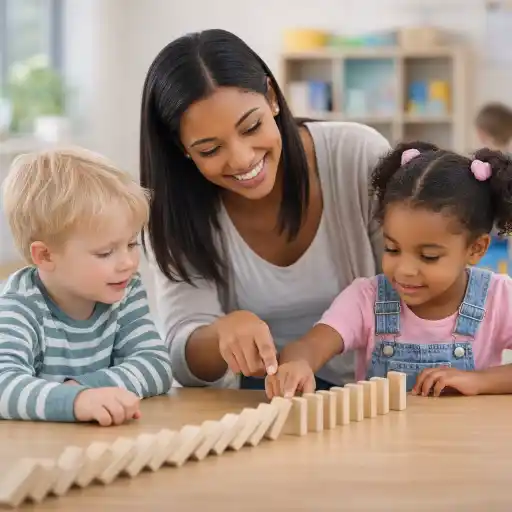
What can educators say to scaffold children’s thinking?
Brief, descriptive language helps children connect an action to its outcome without taking control of the discovery. Narrate what you see: “You pushed the car, and it rolled,” or “When you poured more water, the cup filled.” Such comments make the relationship audible and give children vocabulary they can use in their own explanations.
Open-ended questions can invite prediction and reflection, especially with toddlers and preschoolers. Ask, “What do you think will happen if…?” before a familiar action, and “What changed?” afterward. Pause long enough for a response. A young child may answer with a word, gesture, look, or another experiment. Treat these as meaningful participation rather than insisting on a verbal explanation.
- Describe the action and result neutrally: “The blocks moved when the ball touched them.”
- Invite a prediction: “What might happen if we use the bigger ball?”
- Help children compare: “This ramp is higher. Did the car travel farther?”
- Follow their interest and offer one manageable variation at a time.
Repeated play is not a sign that children are “not getting it.” Repetition lets them test whether a result is consistent and refine their actions. Keep your tone curious rather than evaluative; “You tried it again” supports persistence more than “That’s wrong.” For further professional learning about science inquiry and developmentally appropriate activities, consider Tomorrow’s Einsteins: Infant and Toddler Science Buy Now $16.00.
How can routines, stories, and nature extend the learning?
Cause and effect does not need a special lesson slot. Daily routines offer concrete sequences children can observe. During handwashing, narrate that turning the faucet makes water flow and using soap helps clean hands. While gardening, children can notice that soil becomes damp when watered and observe changes in a plant over time. At snack, discuss how mixing or spreading ingredients changes what they look like. Keep explanations accurate, simple, and connected to what children can see.
Books and songs make it easy to revisit a sequence. Pause during a story to ask what led to an event or what might happen next. Nursery rhymes with repeated actions—such as clapping, tapping, or bouncing—let children experience how a movement produces a sound or response. Picture cards or children’s drawings can also help them arrange “first” and “then” events.
Outdoor experiences invite observation of changes in the environment. Children can notice wind moving leaves, sunlight creating shadows, or rain forming puddles. Rather than supplying an explanation immediately, invite them to look closely and share what they think happened. Simple science demonstrations can also make prediction and observation tangible; ChildCareEd describes a supervised activity that makes cause-and-effect visible through a soap-and-pepper science activity.
Balance adult-planned invitations with time for child-led exploration. A little unstructured time can give children room to choose materials, test ideas, and follow their curiosity. Use routines and materials familiar to the group, and connect new experiences to what children have already noticed.
How can providers keep exploration safe, inclusive, and meaningful?
Plan for children’s ages, abilities, interests, and individual access needs. Check materials before use, remove choking hazards and damaged items, and supervise water, tools, and any sensory materials closely. Use non-toxic, suitable supplies, and follow program procedures for cleaning and sanitation. If an activity involves ingredients or materials that could be tasted, put clear safeguards in place and choose a safer alternative when needed. State requirements vary - check your state licensing agency.
Make participation flexible. A child who does not want to touch water may watch a peer pour; another child may need a stable surface, adapted tool, extra time, or adult support to activate a toy. Observe how each child engages rather than expecting everyone to respond in the same way. This is especially important for children with disabilities or sensory differences: the ECE Resource Hub notes that some children may need adaptations that make an action and its result accessible through touch, movement, sound, or another sensory pathway.
Common pitfalls are easy to avoid: over-explaining before children can explore, changing several things at once, asking questions that have only one acceptable answer, or rushing to fix a structure that falls. Keep the setup simple and let children repeat, revise, and observe. Document a brief quote or note about what a child tried, noticed, or predicted; use that observation to plan a thoughtful next step. For a focused professional-learning option on classroom science, see Basic Science in Early Childhood Buy Now $25.00.
Conclusion: What simple approach helps children understand cause and effect?
Children understand cause and effect through active exploration of actions and their results. Providers can support this learning with familiar materials—blocks, balls, water, sound-makers, art supplies, stories, and nature—and by making time for children to repeat and vary what they do. The most helpful adult role is to keep experiences safe, notice children’s ideas, describe what happens, and ask thoughtful questions without taking over.
Remember the practical sequence: offer a clear opportunity, let the child act, observe the outcome together, and allow another try. Adapt the activity so every child can participate, and use what you observe to guide the next invitation. Small, playful moments can strengthen curiosity, language, persistence, and early reasoning—one experiment at a time.
- Moving About the Classroom: Effective Transitions for Everyday
- CDA Home Visitor Subject Area 3 Part 3 Birth to 5
- Bienvenido! Welcoming All Families
- CDA Bridge Bundle: Family Child Care without Portfolio Review
- CDA Bridge Bundle: Infant/Toddler without Portfolio Review
- The Best Promotion is Play
- CDA Bridge Bundle: Preschool without Portfolio Review
- Sensitive Periods in Montessori: Guiding Natural Learning
- Texas Director Credential
- Professional Integrity in Child Care
- CDA Certification en Español: Recursos y Consejos para Educadores Bilingües
- 🤯 ¿Por qué este niño está teniendo un comportamiento difícil de repente?
- ❄️ ¿Qué actividades al aire libre funcionan bien para los niños de Illinois en cada estación? 🌷🍂
- Recursos en Español sobre el Sueño Seguro del Bebé
- ¿Cómo empiezo mi certificación CDA en Florida en línea?
- Capacitación en Salud y Seguridad Preventiva en Línea para Proveedores de Cuidado Infantil
- Regulaciones de Licenciamiento de Cuidado Infantil en California para Centros y Hogares de Cuidado Infantil Familiar
- Lista para Guardería en Casa en Illinois: Cómo Iniciar una Guardería en el Hogar
- Apoyo en Preescolar para Retrasos del Habla: Estrategias Simples que Ayudan
- Consejos de Supervisión Activa para Salones de Preescolar y el Juego al Aire Libre
- How Do Art Activities Support Cognitive Growth in North Dakota Preschoolers?
- Celebrando la amistad en el cuidado infantil durante el Día de los Mejores Amigos
- Dr. Seuss Book List for Teachers: Easy Ways to Use It for Story Time and Learning
- How Can Child Care Providers Help Children Set Simple Goals and Share Their Interests?
- Why Does a Toddler Need to Do It Again—and Again?
- How Can Classroom Photo Sequences Help Children Tell What Happened?
- What Does a Toddler Block Area Need for Real Experimentation?
- How Can One Plant Help Children Notice Gradual Change Outdoors?
- What Are Simple Ways to Help Children Understand Cause and Effect?
