Two classroom photographs can become the beginning and end of a story—and invite children to imagine the meaningful events in between. Explore practical ways to use Between the Pictures Story Cards to build children’s sequencing, language, and confidence, and consider Reading Aloud and Storytelling  Buy Now $16.00 for professional learning in interactive storytelling and comprehension strategies you can bring into everyday classroom practice.
Why invite children to tell what happened between two pictures?
Children often notice details adults overlook: a missing block, a changed expression, a toy in a new place. Asking what might have happened between two images turns that natural curiosity into a purposeful storytelling experience. Children look closely, make connections, and use language to explain how one moment could lead to another.
This kind of activity supports more than a beginning-middle-end structure. Children practice recalling details, inferring causes, predicting outcomes, and considering what a person in the image might be thinking or feeling. They also get a low-pressure opportunity to speak: there is no single correct story, provided children can explain their thinking and listen to different ideas.
Picture-based prompts can make a story’s sequence visible, a helpful support for children who are still developing expressive language or who benefit from visual information. Head Start describes how visual supports can help children understand expectations and participate in classroom activities. In this case, photographs give children a concrete starting point while leaving room for imagination.
- Strengthens #storytelling and event sequencing.
- Encourages #vocabulary and descriptive language.
- Supports #comprehension through observation and inference.
- Creates opportunities for peer conversation and perspective taking.
How do you set up a two-photograph storytelling activity?
Choose two photographs that show different moments connected by a simple, understandable change. For example, one image might show a child beginning a block tower and the second a completed structure. Other pairs could show a garden before and after watering, an art project before and after completion, or a dramatic-play area before and after children have used it.
Use photographs that are familiar and respectful. If images include children, follow program privacy policies and obtain the required permissions before sharing or displaying them. You can also photograph materials, classroom spaces, or adult hands at work to create engaging prompts without featuring children’s faces.
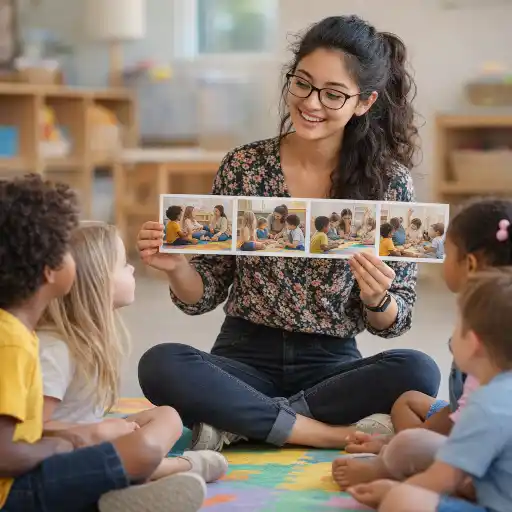
Place the two photographs where a small group can see them clearly. Give children time to look before asking questions. Start with what can be observed, then invite ideas about the unseen events between the pictures:
- “What do you notice in the first picture?”
- “What looks different in the second one?”
- “What might have happened in between?”
- “What clues make you think that?”
Keep the goal open-ended. Children might propose several plausible explanations, and comparing these ideas can be as valuable as settling on a shared version. When using Between the Pictures Story Cards, treat the images as invitations to communicate—not a test of whether children can guess an intended answer.
Which prompts help children build a coherent story?
Effective prompts help children move from noticing details to connecting events. Begin with concrete questions such as “Who is here?” and “What is happening?” Then scaffold toward time, cause, and intention: “What happened first?” “Why might that have happened?” or “What could the person do next?” This gradual progression supports children without taking over their story.
Model a few useful linking words in context: first, then, after, because, and finally. For example, if a child says, “The tower fell,” respond, “The tower fell after the blocks got too tall. What do you think happened next?” Expanding a child’s idea models richer language while honoring their contribution.
Allow enough wait time for children to think. Some may answer with a phrase, gesture, drawing, or home-language words; each can be a meaningful first step in constructing a narrative. If a child seems unsure, offer a choice or point to a visual clue rather than supplying the whole story.
- Invite children to describe visible details before asking them to infer.
- Ask open questions that encourage explanations, not just yes-or-no answers.
- Echo and expand children’s words without demanding repetition.
- Welcome different interpretations and ask children to explain their clues.
- ✨ Give each child a turn as storyteller, detail detective, or question asker.
How can you adapt the activity for different learners?
Children vary in how they communicate, attend, and make sense of images. Keep the learning goal—connecting and recounting events—while adjusting the support. Offer only two or three visual options at first, use clear photographs, and pair spoken prompts with pointing, gestures, or objects from the scene. Some children may prefer to dictate a story to an adult, arrange picture cards, act out a possible event, or respond through an augmentative communication system.
For multilingual children, invite responses in any language the child uses. A familiar home-language word or phrase can carry a complex idea, even when a child is still learning English. Families can also share photographs or familiar experiences that give classroom stories a meaningful cultural connection. The goal is communication and narrative thinking—not a performance in English.
Adjust the level of challenge thoughtfully. Children who are just beginning can choose which of two simple events came first. Children ready for more can add a character’s feelings, explain cause and effect, or invent two possible middle scenes. Storytelling research and classroom guidance emphasize the value of respecting children’s histories and multiple ways of expressing ideas; see Appreciating Diversity through Children’s Stories and Language Development.
- For extra support: provide a “first, then, last” visual strip or model one sentence.
- For added challenge: ask children to compare two explanations or create an alternate ending.
- For group participation: let children contribute a word, gesture, sound, or scene in turn.
How can teachers extend the stories and notice learning?
Let children carry their invented stories beyond the initial conversation. They can arrange the Between the Pictures Story Cards, draw an imagined middle scene, dictate a caption, or act out the events with blocks, puppets, and dramatic-play materials. A child may also take a turn choosing two classroom photographs for classmates to connect. These follow-ups make storytelling active and give children different ways to revisit an idea.
Use brief, informal observation to guide your next teaching move. Notice whether children identify details, connect events, use time-order words, explain a reason, or respond to a peer’s interpretation. Record what the child actually says or does rather than labeling an answer as simply “good” or “wrong.” An observation such as “pointed to the spilled paint and said, ‘Then they cleaned it’” is more useful for planning than a general judgment.
Children’s stories are imaginative explanations, not evidence that an event really occurred. Make that distinction clear, especially when images involve conflict, injury, or distress. If a child independently makes a concerning disclosure, respond calmly, listen without leading questions, and follow your program’s safeguarding and reporting procedures. Do not use picture prompts to investigate or verify a disclosure.
What common pitfalls should providers avoid?
A common pitfall is treating the photographs like a quiz with one hidden answer. That can narrow children’s thinking and discourage less-confident speakers. Instead, ask for clues and reasoning, acknowledge plausible alternatives, and model language that helps children connect their ideas. Another pitfall is asking a rapid series of questions; too many prompts can make the exchange feel like an interview. Ask one question, listen carefully, and build on what the child offers.
It is also easy to over-focus on complete sentences or precise sequence words. Children’s gestures, short phrases, home-language contributions, and invented interpretations all offer useful insight into their thinking. Adults can gently model expanded language without implying that a child’s current communication is inadequate.
- Avoid correcting an imaginative story simply because it differs from your own interpretation.
- Avoid interpreting a photograph for children before they have time to observe it.
- Avoid using identifiable child images without appropriate permission and secure handling.
- Avoid confusing an invented sequence with a factual account of an event.
State requirements vary - check your state licensing agency, and follow your program’s policies for photography, consent, and record handling.
Conclusion: What can you try with two pictures this week?
To help children tell what happened between two classroom photographs, start with a pair of clear images that show a change. Invite children to notice details, ask what might have happened in between, and encourage them to explain their ideas using words, gestures, drawing, or play. Provide time to think, welcome different interpretations, and use observations to decide what support or challenge to offer next.
The central takeaway is simple: two photographs can open the door to rich conversations about sequence, cause, feelings, and possibility. With a few thoughtful prompts and an inclusive approach, Between the Pictures Story Cards can become a flexible storytelling experience that honors children’s voices and strengthens early #literacy. For a deeper exploration of interactive storytelling and read-aloud strategies, consider the linked ChildCareEd course and check whether it aligns with your professional learning needs.
- CDA Home Visitor Subject Area 3 Part 3 Birth to 5
- Many Colors, One Canvas: MD ECE Conference
- Bienvenido! Welcoming All Families
- From Play to Planning: Building Culturally Competent, Child-Centered Curriculum
- Art from the Heart for Preschoolers: Open Ended Art Projects that Build Self-Esteem
- Creating Engaging and Meaningful Learning Experiences
- Creating Environments that Nurture Growth and Community
- Building Bridges for Dual Language Learners
- Healthy Habits from the Start
- Resources: Building Blocks to Excellence
- Learn to Use Open Ended Questions to Find Out About Your Child's Day
- CDA Certification en Español: Recursos y Consejos para Educadores Bilingües
- 💛🧩 ¿Cómo puedo hacer que mi enseñanza sea inclusiva para los niños con autismo?
- Recursos en Español sobre el Sueño Seguro del Bebé
- 10 Ejemplos de Cómo la Cultura Influye en el Desarrollo Infantil
- Proporciones de Cuidado Infantil y Tamaños de Grupo por Edad en Maryland (Guía Rápida para Centros y Hogares)
- Proporciones de Cuidado Infantil y Tamaños de Grupo por Edad en Nueva Jersey (Guía Rápida para Centros y Hogares)
- Proporciones de Cuidado Infantil y Tamaños de Grupo por Edad en Virginia (Guía Rápida para Centros y Hogares)
- Cómo Trabajar en el Cuidado Infantil en Carolina del Norte: Requisitos y Pasos
- Celebrando la amistad en el cuidado infantil durante el Día de los Mejores Amigos
- Canciones, juegos y preguntas de círculo para niños
- How Can Preschool Teachers Make a Simple Classroom Movie to Boost Early Storytelling?
- How can we teach preschoolers to ask better questions and make predictions?
- How Can I Use Everyday Materials for Meaningful STEM Exploration in My Preschool Classroom?
- How Can Child Care Providers Encourage Children to Ask Questions and Investigate?
- How Can Developmental Observation Strengthen Early Childhood Practice?
- How Can You Help a Child Who Won’t Listen in the Classroom?
- How Can Photos Help Children Remember Classroom Routines?
- How Can Classroom Photo Sequences Help Children Tell What Happened?
- What Are Simple Ways to Support Memory and Recall in Young Children?
