Those few steps from the play area to the sink or from the classroom to the playground can build language, curiosity, movement, and connection. During arrival, use the Morning Arrival Routine Cards Buy Now $1.99 to help children identify their next destination and talk about what comes next as you move together. For more practical ideas, explore Moving About the Classroom: Effective Transitions for Everyday  Buy Now $24.00, a focused training that helps providers turn everyday transitions into purposeful teaching moments. Read on for ways to make the route itself part of the learning while keeping the group moving and supervision consistent.
Why is the walk between activities worth planning?
Children experience many transitions each day, and they are not simply gaps between “real” learning. Moving together gives children repeated chances to practice listening, following a sequence, managing their bodies, and anticipating what happens next. When adults plan these moments, children spend less time waiting and more time engaged. Consistent, supportive transitions can also reduce uncertainty and help the classroom feel more settled.
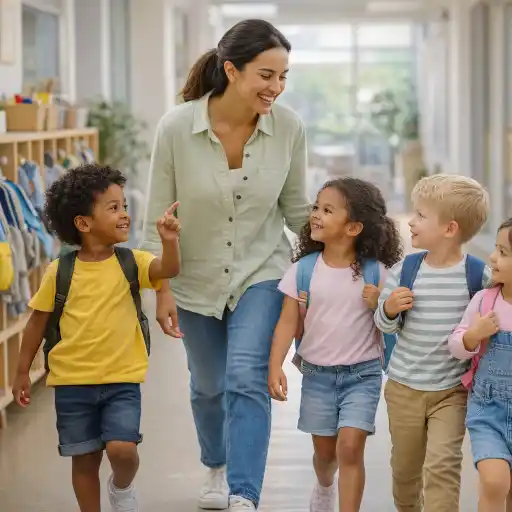
A walk can invite purposeful attention. On the way to lunch, children might notice a patch of sunlight, count steps, or describe the sound of shoes on the floor. The goal is not to deliver a formal lesson while everyone is in motion; it is to notice, name, and extend something children are already experiencing. Responsive, back-and-forth conversation during everyday routines creates natural opportunities for communication and connection.
These brief experiences support more than vocabulary. Children practice #language, observation, self-regulation, and group awareness. A well-designed transition also respects the pace of young children: some can move independently, while others may need an adult nearby, a clearer cue, or additional time. The CSEFEL guidance on helping children make transitions emphasizes planning for these moments and adapting support to individual needs.
For providers and directors, intentional walks are a practical way to weave learning into the existing schedule. A few thoughtful prompts can make an ordinary hallway or familiar route feel newly interesting.
How can educators turn an everyday route into a mini-lesson?
Start with children’s attention, not a script. If a child points toward a window, pauses at a doorway, or comments on a sound, respond to that interest. Name what you notice and invite a thought: “I hear a truck outside. Is it getting louder or softer?” Follow the child’s answer with another comment, then allow a pause. Genuine interaction is more valuable than asking a string of quiz-like questions.
Choose one simple learning focus for each walk so children can attend without being overloaded. For example:
- Language: describe a texture, sound, color, or action using specific words.
- Math: count steps, compare near and far, or notice shapes along the route.
- Science: observe light, weather, plants, or how a puddle changes.
- Social learning: practice taking turns, walking with a partner, or noticing how the group stays together.
- Movement: try deliberate steps, a gentle march, or a brief balance challenge where the route is safe.
On a planned outdoor walk, invite children to look closely at plants, birds, clouds, or neighborhood features. The NAEYC suggestions for turning a walk into a nature walk encourage adults to model careful noticing and explore what children find interesting. Let the walk remain open to discovery; an unexpected observation can be the most meaningful part.
Keep prompts short and matched to the group’s age and energy. A quiet walk to rest time may call for noticing colors rather than jumping games. The purpose is to connect movement with a small, accessible idea—not to turn every trip into a performance.
Which prompts and activities work well while children are walking?
Effective walk activities are brief, repeatable, and safe for the setting. They help children stay engaged without diverting the educator’s attention from supervision. Use familiar games and songs so children can participate without needing lengthy explanations. A consistent activity can also become a predictable signal that the group is moving to a new part of the day.
- “I spy”: Invite children to find an object by color, shape, or location.
- Sound detectives: Pause briefly to identify what the group can hear, such as footsteps, birds, or a door closing.
- Step counting: Count a manageable set of steps, then stop and reset rather than turning it into a race.
- Movement words: Walk slowly, take tiny steps, or march gently when the space and supervision plan allow.
- Call-and-response: Use a familiar phrase and response to reinforce the transition cue.
- 🌱 Nature noticing: Look for one outdoor detail—such as a leaf, cloud, or bird—without picking plants or disturbing wildlife.
Keep the activity secondary to safe movement. Children should not be encouraged to run, compete, close their eyes, or handle objects while walking. On outings, set clear boundaries, maintain required ratios and active supervision, and follow program procedures for routes, attendance checks, and hazards. A sidewalk or hallway is a pathway first; learning prompts should never interfere with safe travel.
When the route is crowded or children need a quieter transition, simply narrate what is happening: “We are walking to the sink. The door is ahead; then we will wash hands.” The Hanen Centre’s guidance on language in early childhood settings highlights how everyday moments can support conversation by following a child’s lead and allowing time to respond.
How can walks support different ages, abilities, and languages?
A learning walk should be accessible and responsive rather than identical for every child. Toddlers may benefit from a very short route, familiar words, and opportunities to pause. Preschoolers may enjoy comparing, predicting, or remembering what they saw yesterday. Children who use gestures, communication devices, home languages, or other communication supports should be included through those familiar ways of communicating.
Adjust the pace and the task to the individual child. Some children may need a visual card showing the destination, a brief advance warning, a hand to hold, or an adult close by. A child with limited mobility can participate from a stroller or wheelchair, with the group adapting its route and pace. For outdoor exploration, children can observe from an accessible path or window if a particular surface or distance is not suitable.
Useful inclusive practices include:
- Pair spoken words with gestures, photos, objects, or signs.
- Use children’s home languages where possible and invite families to share familiar words for places, plants, or animals.
- Offer more processing time; a point, facial expression, or pause can be a meaningful response.
- Plan routes that account for mobility, sensory needs, weather, and the group’s stamina.
- Offer a choice within the routine, such as carrying a picture card or walking beside a trusted adult.
Notice whether the walk itself is calming or overwhelming for a child. Noise, crowding, bright light, or an abrupt change of direction may make the transition harder. Observing what helps allows staff to adapt support without labeling a child as difficult. Predictability and flexibility can work together: keep the destination clear, while making room for individual needs.
How do educators keep the walk safe and meaningful?
Safety and learning are partners, not competing priorities. Before moving, make sure the destination and route are ready, give children a clear cue, and assign staff positions according to program procedures. Continue active supervision throughout the walk: scan, count, listen, and remain positioned to respond. Indoors, check for clutter, wet floors, doorways, and other obstacles. Outdoors, assess weather, traffic, boundaries, surfaces, and any site-specific hazards before leaving.
Keep the group together in a way that fits children’s ages, abilities, and your supervision plan. Avoid activities that require educators to look away from the group or children to focus on handheld materials while moving. If a child stops to observe something, pause the group only when it is safe to do so, or acknowledge the observation briefly and plan to revisit it later. Follow your program’s policies for outdoor routes and outings; state requirements vary - check your state licensing agency.
Common pitfalls are easy to prevent:
- Too many questions: use one open invitation, then listen and respond.
- Rushing: allow realistic transition time and prepare the next space in advance.
- Turning movement into a race: emphasize safe, steady travel rather than speed.
- Collecting unsafe items: observe and discuss; only gather materials when permitted and safe for the children’s ages.
- Inconsistent adult cues: agree on shared language, signals, and staff roles.
After arriving, reconnect the walk to the next activity. Invite children to draw a detail they noticed, compare what they saw with a book, or tell a peer about a discovery. This short follow-up helps children revisit an observation and gives educators a chance to see what captured their interest.
How can teams make learning walks part of the daily routine?
Teams can begin with one predictable route and one simple invitation, such as noticing a sound on the way to lunch. Discuss the routine in a brief staff huddle: What is the cue? Where will adults stand? What learning invitation fits the route? What accommodations might individual children need? Shared planning makes the experience more consistent without requiring every adult to use identical words.
Observe children’s responses and adjust. Are they engaged, calm, and able to move safely? Are some children waiting too long or missing the chance to participate? A quick reflection after the transition can reveal whether the route needs more time, fewer prompts, or a different grouping. Families can contribute too: a child’s questions about a neighborhood feature, seasonal change, or familiar animal may become a thoughtful topic for the next walk.
Directors can support staff by modeling a brief learning walk, ensuring that schedules include realistic movement time, and discussing supervision expectations. Keep the aim manageable: the walk is an opportunity for connection and noticing, not another task educators must perfect. Consistency, responsiveness, and safety matter more than elaborate materials.
For educators who want a deeper foundation in planning routines and transitions, Every Moment Matters: Schedules and Transitions Buy Now $55.00 explores ways to organize daily flow and respond to children’s individual temperaments. Teams interested in extending outdoor discovery can also explore Creating the Natural Outdoor Classroom Buy Now $16.00 and Language Development in Early Childhood Buy Now $16.00. These English-language courses offer additional professional learning to complement the practical routines described here.
Conclusion: What makes the walk between activities a learning moment?
The walk between activities becomes a learning moment when educators combine safe, predictable movement with attentive conversation and child-led observation. A route can support vocabulary, early math and science thinking, movement, cooperation, and growing independence—all through brief, purposeful interactions woven into the day.
Start small: give a clear transition cue, choose one observation prompt, follow children’s interests, and adapt the route or support to each child. Keep supervision central, avoid rushing or turning the walk into a contest, and revisit interesting discoveries after arrival. Every walk need not be a formal lesson. With warmth and intention, the ordinary in-between moments can help children feel connected, capable, and curious.
- From Play to Planning: Building Culturally Competent, Child-Centered Curriculum
- Bienvenido! Welcoming All Families
- Birth to Five CDA Credential with Portfolio Review
- Art from the Heart for Preschoolers: Open Ended Art Projects that Build Self-Esteem
- Montessori Cultural Activities: Exploring the World Through Play and Learning
- Enriching Education: Field Trips
- Every Moment Matters: Schedules and Transitions
- CDA Certification en Español: Recursos y Consejos para Educadores Bilingües
- Cómo Abrir Una Quardería En Casa Sin Dinero?
- Cómo usar tu certificación de 90 horas en Maryland para completar tu CDA
- 10 Ejemplos de Cómo la Cultura Influye en el Desarrollo Infantil
- Proporciones de Cuidado Infantil y Tamaños de Grupo por Edad en Nueva Jersey (Guía Rápida para Centros y Hogares)
- Proporciones de Cuidado Infantil y Tamaños de Grupo por Edad en Virginia (Guía Rápida para Centros y Hogares)
- Cómo Ser Maestra de Preescolar en Illinois
- Cómo Ser Maestra de Preescolar en California
- Calabazas, hojas y manzanas: actividades de otoño para preescolares
- Celebrando la amistad en el cuidado infantil durante el Día de los Mejores Amigos
- Canciones, juegos y preguntas de círculo para niños
- 1 2 3 Eyes on Me: What to Do When This Attention Getter Stops Working
- Too Wiggly to Sit? Fall Movement Activities Toddlers Will Love
- Sensory Break: How Do You Know When a Child Needs One Before a Meltdown Starts?
- How Can a Five-Minute Classroom Reset Help Children Regroup Between Activities?
- How Can Providers Build Strong Routines That Reduce Challenging Behavior?
- Teacher-Led vs. Child-Led Activities: What Is the Difference?
- Teacher-Led vs. Child-Led Activities: What Is the Difference?
- What Are the Best Transition Activities for Preschool Classrooms?
- How Can the Walk Between Activities Become a Learning Moment?
