When children explain what happened first, next, and last, they are doing far more than completing a cooking activity—they are organizing ideas, practicing vocabulary, and making meaning aloud. The printable How to Make S'mores: A Sequencing Activity Buy Now $1.49 offers a simple, hands-on way to extend these skills, while Language and Literacy Foundations in Pre-K  Buy Now $16.00 can help providers strengthen language-rich classroom practices and support professional learning goals; state requirements vary, so check your state licensing agency.
For a complementary focus on interactive stories and retelling, explore Reading Aloud and Storytelling Buy Now $16.00. Together, these resources connect practical classroom experiences with deeper professional knowledge.
Why do recipe sequences matter for young children?
A recipe is a naturally meaningful text structure. It presents a beginning, a series of connected actions, and an outcome children can see, taste, describe, and remember. This concrete structure supports comprehension because children are not merely hearing isolated words; they are linking language to actions, objects, time, and cause-and-effect relationships.
Recipe work also strengthens #oral language. Children hear and use verbs such as spread, place, combine, and assemble; temporal words such as first, next, then, and finally; and descriptive vocabulary related to texture, temperature, size, and taste. Massachusetts guidance describes oral language as a foundation for reading and writing, with vocabulary and syntax developing through high-quality interactions throughout the day.
Most importantly, sequencing gives children a reason to communicate. They must listen to directions, remember steps, negotiate turns, explain decisions, and retell an experience. Carnegie Mellon’s discussion of cooking in early childhood similarly connects recipes with vocabulary, following directions, conversation, print awareness, and retelling procedures in order.
- Children practice listening for important details.
- They connect spoken language with pictures, symbols, and print.
- They use language to plan, predict, describe, and reflect.
- They experience comprehension as something useful and enjoyable.
How can providers introduce a recipe sequence before the activity?
Begin with a brief preview rather than immediately handing children the materials. Show the ingredients or picture cards and invite children to name what they recognize. Ask, “What do you think we will do with these?” Accept predictions even when they are incomplete; the goal is to activate background knowledge and create a communicative purpose.
Next, introduce only a few target words. For a s’mores sequence, words might include graham cracker, chocolate, marshmallow, layer, and assemble. Pair each word with an object, gesture, photograph, or demonstration. Children are more likely to understand and remember vocabulary when they hear it in context and use it repeatedly.
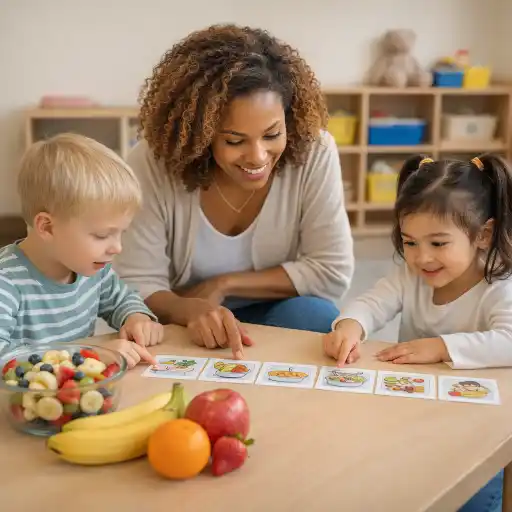
Place the picture steps in a mixed-up arrangement. Invite children to study the images and explain their reasoning. Avoid treating this as a test with one correct speaker. A child may point, gesture, use a home language, name one object, or offer a complete explanation. Each response provides an entry point for conversation.
- “What do you notice in this picture?”
- “Which step might come before this one?”
- “What would happen if we skipped this step?”
- “How are these two pictures alike or different?”
For children who need additional support, offer two choices, model the first step, or use a visual schedule. For children ready for greater challenge, ask them to justify the order using because, after, before, and finally.
How should teachers model sequencing language during the recipe?
Children benefit when adults make the structure of the activity audible. Narrate actions naturally: “First, we place the cracker on the plate. Next, we add the chocolate. Then we put the marshmallow on top. Finally, we add the second cracker.” This language model gives children a framework for both comprehension and later storytelling.
Use repetition without making the exchange mechanical. After modeling, pause and invite children to complete a phrase: “First we…” or “After we add the chocolate, we…” Wait long enough for children to think. If a child responds with a short phrase, expand it without requiring imitation: “Chocolate” can become “Yes, next we place the soft chocolate on the cracker.”
Recipe language is especially useful for teaching complex sentences. Model relationships such as:
- “Before we assemble the s’more, we wash our hands.”
- “We add the chocolate because it goes between the crackers.”
- “After the marshmallow is placed, we carefully add the top cracker.”
- “Although the steps are simple, we still need to follow them in order.”
Cooking-related speech activities also support following directions, temporal concepts, executive functioning, and narrative sequencing. Keep the experience collaborative: invite children to hold a card, point to the current step, or remind the group what comes next. Participation can involve speaking, pointing, signing, drawing, or demonstrating.
How can the s’mores activity extend comprehension and storytelling?
The How to Make S'mores activity Buy Now $1.49 asks children to color, cut, and glue picture steps in order. Those actions create a useful bridge between visual comprehension, fine-motor work, and symbolic representation. Before children glue, encourage them to explain the sequence aloud and compare their arrangement with a partner.
After the activity, move beyond recall questions. Ask children to reconstruct the process without looking at the cards, then invite them to use the cards as prompts if needed. Encourage a beginning-middle-end retelling:
- Beginning: What materials did we need, and what did we do first?
- Middle: What did we add or change next?
- End: How did the finished s’more look, feel, or taste?
Children can dictate a class recipe, draw the steps, create a pretend restaurant menu, or act out the procedure with dramatic-play materials. A child who says, “Put cracker, chocolate, marshmallow,” can be supported with an expanded model: “First we put the cracker down, then we add the chocolate and marshmallow.”
Offer sensory alternatives when food preparation is not appropriate. Use felt pieces, laminated cards, play food, or classroom objects. The literacy purpose remains the same: children organize events, connect language to representations, and communicate meaningfully.
How can providers include multilingual learners and diverse communicators?
Recipe sequences are highly accessible because they combine visual information, predictable routines, gestures, and real objects. These supports benefit children learning English, children who communicate through sign or augmentative systems, and children who need additional processing time.
Invite families to share a simple recipe, food word, or cooking tradition in the home language. Children may sequence and discuss the experience in their strongest language before connecting selected words to English. Supporting the home language strengthens identity, family relationships, conceptual understanding, and participation; it does not interfere with English development.
- Use bilingual labels for ingredients when families can provide accurate translations.
- Pair spoken directions with pictures, gestures, and demonstrations.
- Accept pointing, signing, drawing, home-language responses, and speech as communication.
- Invite children to compare how a familiar food is prepared at home and at school.
- Never require a child to translate publicly or perform a home language.
Be attentive to cultural and dietary considerations. S’mores may not fit every family’s food practices, allergy plan, or religious preferences. A pretend version or alternative recipe can preserve the sequencing objective while respecting children’s needs. State requirements vary - check your state licensing agency, and follow program policies for food handling, allergies, supervision, and sanitation.
For deeper support, Building Bridges for Dual Language Learners Buy Now $25.00 offers strategies for culturally responsive environments and family communication.
How can directors and teachers assess learning without turning play into a test?
Observation is the most appropriate assessment approach for a playful recipe sequence. Notice what children understand and communicate in context rather than judging only whether they can recite all steps independently. Record exact words, gestures, use of sequencing terms, ability to follow directions, and the amount of support needed.
Useful documentation might include a brief anecdotal note, a photograph of the completed sequence with the child’s explanation, or a dictated retelling. Consider documenting:
- Whether the child identifies the first, middle, and final steps.
- Which vocabulary words the child understands or uses.
- Whether the child explains cause and effect.
- How the child participates with peers and takes conversational turns.
- Whether performance changes when pictures, gestures, or home-language support are provided.
Use observations to plan a next step. A child who identifies pictures but does not yet explain order may need repeated modeling and sentence frames. A child who retells accurately may be ready to add descriptive details, reasons, or an alternative ending. The course Assessment of Language and Literacy Skills Buy Now $24.00 can help providers strengthen objective observation and individualized planning.
Common mistakes include introducing too many vocabulary words, asking questions without allowing wait time, correcting children harshly, or focusing on worksheet completion instead of meaning. Keep the activity brief, joyful, and responsive. The strongest evidence of comprehension may be a child explaining the procedure during later pretend play.
Conclusion: How do recipe sequences build comprehension and oral language?
Recipe sequences build comprehension and oral language because they unite meaningful action with predictable structure. Children listen, remember, order events, use precise vocabulary, and retell experiences with a clear purpose. A simple picture-based activity such as How to Make S'mores: A Sequencing Activity Buy Now $1.49 can become a rich language experience when adults model temporal words, invite explanations, honor multiple communication modes, and extend the learning into storytelling and play.
To apply the approach tomorrow:
- Choose a familiar recipe or classroom procedure with three to five steps.
- Represent each step with a picture, object, or child-created drawing.
- Model first, next, then, after, because, and finally.
- Invite children to sequence, explain, act out, and retell.
- Document one strength and one possible next step for each child.
For broader professional learning, consider Science of Reading Foundations in the Pre-K Classroom Buy Now $16.00. It connects comprehension, vocabulary, storytelling, emergent writing, and other early literacy foundations to intentional classroom practice.
References: ChildCareEd s’mores sequencing activity Buy Now $1.49; Language and Literacy Foundations in Pre-K Buy Now $16.00; Massachusetts Department of Elementary and Secondary Education: Oral Language; Carnegie Mellon University: A Closer Look at Cooking; Speech Therapy Talk: Cooking Activities; NurtureStore: Recipe Sequencing; ChildCareEd: Boosting Language Through Play; ChildCareEd: Strengthening Language and Literacy.
- CDA Certification en Español: Recursos y Consejos para Educadores Bilingües
- 😤💬 ¿Qué Le Digo a un Niño que Acaba de Morder a Otro?
- 👶 ¿Cuáles son las proporciones y grupos requeridos en Dakota del Norte? 🏫
- Recursos en Español sobre el Sueño Seguro del Bebé
- Curso de Comunicación de 9 Horas de Maryland
- Apoyo en Español para Capacitaciones Grupales Presenciales y por Zoom en Cursos Selectos
- 10 Ejemplos de Cómo la Cultura Influye en el Desarrollo Infantil
- Proporciones de Cuidado Infantil y Tamaños de Grupo por Edad en Maryland (Guía Rápida para Centros y Hogares)
- Proporciones de Cuidado Infantil y Tamaños de Grupo por Edad en Virginia (Guía Rápida para Centros y Hogares)
- Apoyo en Preescolar para Retrasos del Habla: Estrategias Simples que Ayudan
- Retraso del Habla en la Guardería: Cómo Pueden Ayudar los Proveedores
- Cómo Ser Maestra de Preescolar en Illinois
- Cómo Ser Maestra de Preescolar en Maryland
- Celebrando la amistad en el cuidado infantil durante el Día de los Mejores Amigos
- Canciones, juegos y preguntas de círculo para niños
- Cómo simplificar la capacitación para sus empleados de daycare
- Why Do Predictable Books Help Preschoolers Feel Like Readers?
- How Can Recipe Sequences Build Comprehension and Oral Language in Preschool?
- How Can Familiar Real-Life Processes Help Preschoolers Learn Sequence Words?
- How Can You Make a Classroom Cooking Activity Accessible to Children with Different Abilities?
