When children trace a line and then paint it, they are doing more than making art: they are exploring movement, shape, and control through hands-on practice. Pairing these experiences can make prewriting inviting and meaningful; explore ChildCareEd’s Science of Reading Foundations in the Pre-K Classroom Buy Now $16.00 to deepen your understanding of emergent writing and other early literacy foundations, and help translate playful activities into intentional classroom practice.
Why combine tracing and painting for prewriting practice?
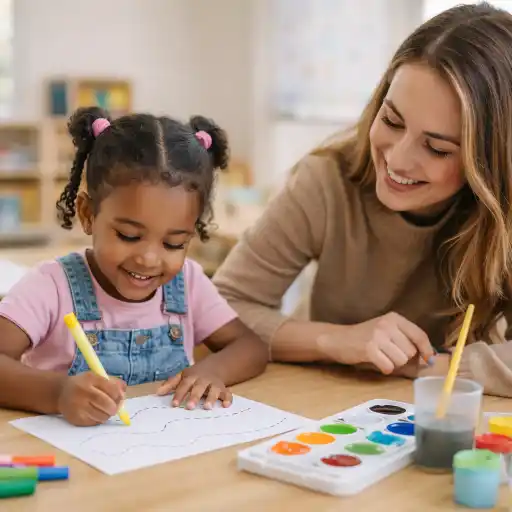
Before children are ready for sustained pencil-and-paper tasks, they benefit from exploring the movements that later support drawing and writing. Tracing invites them to follow a visible path, while painting gives them room to make that path with a brush, sponge, finger, or other child-safe tool. Together, these actions engage visual attention, movement planning, hand-eye coordination, and control of pressure.
Multisensory practice also makes early mark-making feel like discovery rather than a test. A child can see a stroke, feel the tool move, and watch color appear. If the result does not match the model, the child can try again without treating the first attempt as failure. That low-pressure repetition matters: confidence and willingness to persist are part of learning, not extras.
Prewriting is broader than copying letters. Young children benefit from lines, curves, circles, zigzags, and free drawing before adults expect accurate letter forms. As the ChildCareEd guide to prewriting without worksheets emphasizes, movement, sensory exploration, purposeful play, and everyday classroom routines can help build the foundations for later writing.
For providers, combining tracing and painting is a flexible way to support #prewriting, creativity, and fine-motor exploration in one activity. The goal is not a perfect page; it is a child who is curious enough to make another mark.
What skills can children practice through this activity?
Tracing and painting can invite several developmental skills at once, though children will not show them all in the same way or at the same pace. Following a broad path supports visual-motor coordination: children look at a line and guide a hand or tool along it. Holding a brush, dipping it, and moving it with purpose gives practice with grasp, wrist movement, and pressure control. Painting also encourages children to notice how a small change in movement affects the mark on the page.
Start with prewriting strokes rather than expecting children to reproduce letters. You might offer straight paths, broad curves, circles, and simple waves. An adult can trace a path first, then invite the child to paint over it, beside it, or in a different color. A raised or tactile line may offer another way to explore the route before painting.
- Use large paper and thick, washable paint tools so children can make broad movements comfortably.
- Offer short, easy-to-grasp brushes, cotton swabs, chunky crayons, or sponges as alternatives.
- Let children choose colors and decide whether to follow a path, change it, or create their own.
- Describe the action: “You followed the curve,” or “Your brush made a long line.”
Multisensory experiences such as tactile tracing can make shape and stroke exploration more accessible for some learners. PreKinders describes sensory trays and tactile letters as ways to practice letter formation, shapes, and prewriting lines; consider these as optional extensions rather than a single required method. Keep the focus on exploration, not on whether every child uses the same grip or produces the same outcome.
How can educators set up a useful tracing-and-painting invitation?
A strong activity begins with a clear, manageable invitation and materials children can use with as much independence as possible. Choose a stable table or easel, protect the work area, and prepare washable paint, appropriate brushes, large paper, and a few simple paths. Thick lines are easier to see and follow than fine, crowded patterns. For a reusable option, place a printed or drawn path inside a clear protective sleeve and have children trace with a washable tool before moving to paint on paper.
Introduce one movement at a time. Model slowly, naming where you begin and how the line travels, then invite children to try. Instead of moving a child’s hand through the task, offer a visual cue, demonstrate again, or simplify the path. Children can first trace with a finger, then with a dry brush, and finally with paint if they are interested. Some may prefer to paint freely without a template; that choice still builds mark-making experience.
- 🖌️ Offer two or three tools and let each child choose the one that feels comfortable.
- Use a small amount of paint and refill as needed to limit spills and keep the activity manageable.
- Place paper at a comfortable height; an easel or other vertical surface can provide a different body position and larger arm movements.
- Allow time for children to observe, experiment, and talk about their work.
Make participation flexible. A child who dislikes wet or sticky sensations can use a brush, a sponge, or a dry tracing tool; another child may welcome finger painting. For further ideas that strengthen emergent writing through everyday materials, see ChildCareEd’s guidance on supporting early writing without pressure. Adapt the setup to children’s interests, access needs, and classroom routines.
How can you scaffold the activity for different learners?
Scaffolding means adjusting the activity so children can participate meaningfully while still having room to grow. One child may be ready to follow a curved path with a small brush; another may benefit from a broad, straight route and a larger tool. Neither response is a problem to correct. Observe what the child can do comfortably, then make one small adjustment to the materials, path, or level of adult support.
Offer alternatives for children who experience sensory discomfort, fatigue, mobility differences, or difficulty coordinating both hands. Try dry-erase tracing, water painting outdoors, a sponge dabber, a wider brush, or a paper secured to the table. A child can also point to a path while an adult names its direction, or dictate what they want the adult to draw. Avoid insisting on finger paint, a particular hand, a specific grasp, or a finished product.
Use encouraging, descriptive feedback that notices effort and decisions: “You slowed down at the turn,” or “You chose a wider brush.” If a child becomes frustrated, reduce the challenge, pause, or shift to free painting. Consistent invitations over time are more useful than one long session.
Document learning lightly and respectfully. A brief note or photo can capture which tools a child chose, how they approached the path, and what they said about the marks. Look for changes across experiences rather than treating one sample as a test. If persistent concerns about motor participation arise, share objective observations with the family and follow your program’s procedures for consultation or referral. Keep the activity strengths-based: the child’s interest, communication, and experimentation all count as learning.
What common pitfalls should providers avoid?
Tracing and painting are most helpful when they remain playful and responsive. A common pitfall is turning the activity into a demand for neatness: repeated correction can make children cautious about trying. Instead, demonstrate a movement, offer a cue when useful, and accept a range of marks. For preschoolers, a broad curve or a child-invented path may be more developmentally appropriate than a worksheet of small letters.
Another pitfall is confusing practice with performance. Children do not need to complete a page or produce a recognizable letter for the experience to matter. Give them time to test tools, notice cause and effect, and make choices. If a template creates frustration, simplify it or remove it. A free-painting invitation can still support control, creativity, and confidence.
- Avoid: requiring every child to use the same tool, hand, grip, or tracing pattern.
- Try instead: offering accessible choices and modeling a simple starting movement.
- Avoid: using too many paths, colors, or directions at once.
- Try instead: presenting one clear route and extending the challenge only when a child is ready.
- Avoid: overlooking supervision, paint safety, or cleanup needs.
- Try instead: selecting age-appropriate materials, supervising closely, and following product instructions and program policies.
Remember that interest and development vary. A child may be eager to paint but not yet interested in following a model; another may trace carefully before wanting to paint. Both are valid entry points. State requirements vary - check your state licensing agency for relevant rules about materials, supervision, and classroom practice.
How can teams connect the activity to literacy and observe progress?
Early writing connects movement with communication. As children trace and paint, educators can link marks to language without turning the activity into a formal reading lesson. Invite children to name their shapes, describe what a line could represent, or tell a story about the finished picture. Add their words as a dictated caption. If a child is curious about letters, offer a familiar letter—such as one from their name—alongside lines and shapes, while keeping the invitation optional.
To make the learning more intentional, plan a simple sequence: explore a path with a finger, trace it with a dry tool, paint it, and then talk about the result. This sequence is not a rigid requirement; it is a framework staff can adjust in response to children. The Science of Reading Foundations in the Pre-K Classroom course Buy Now $16.00 covers emergent writing alongside print knowledge, alphabet knowledge, vocabulary, comprehension, and storytelling. It can help providers connect a hands-on art invitation with broader early literacy practices.
Observe rather than score. Notice whether a child attends to the path, experiments with direction or pressure, uses tools with increasing control, communicates an idea, or returns to the activity. Record one strength and one possible next step. Across time, these observations can help staff decide whether to make the path larger, introduce another kind of stroke, add a storytelling prompt, or simply continue offering child-led painting.
Conclusion: What should providers remember about combining tracing and painting?
Combining tracing and painting gives young children a playful way to explore lines, curves, movement, and mark-making before formal handwriting expectations take center stage. Tracing provides a visible route to follow; painting adds choice, color, tactile experience, and opportunities to experiment. Together, these experiences can support visual-motor coordination, tool control, language, and confidence—while respecting the fact that children develop at different rates.
Keep the setup simple, provide adaptable tools, model without taking over, and respond to each child’s comfort and interests. Focus on participation and discovery rather than a perfect product. Invite children to describe their marks, tell a story, or connect a shape to a familiar letter when they are ready. For a fuller professional-learning experience on literacy foundations and emergent writing, explore ChildCareEd’s Science of Reading Foundations in the Pre-K Classroom Buy Now $16.00. Small, joyful invitations can help make prewriting a meaningful part of the classroom day.
Latest Jobs
- Many Colors, One Canvas: MD ECE Conference
- CDA Home Visitor Subject Area 2 Part 3 Birth to 5
- The Best Promotion is Play
- Sensitive Periods in Montessori: Guiding Natural Learning
- Texas Director Credential
- Montessori Cultural Activities: Exploring the World Through Play and Learning
- Families, Communities, and Classrooms: Working Together for Children
- Professional Integrity in Child Care
- Free Childcare Training
- CDA Certification en Español: Recursos y Consejos para Educadores Bilingües
- 🔍 ¿Qué ves cuando observas a un niño aprender?
- 👶 ¿Cuáles son las proporciones y grupos requeridos en Dakota del Norte? 🏫
- Recursos en Español sobre el Sueño Seguro del Bebé
- Curso de Comunicación de 9 Horas de Maryland
- Apoyo en Español para Capacitaciones Grupales Presenciales y por Zoom en Cursos Selectos
- 10 Ejemplos de Cómo la Cultura Influye en el Desarrollo Infantil
- Proporciones de Cuidado Infantil y Tamaños de Grupo por Edad en Maryland (Guía Rápida para Centros y Hogares)
- Proporciones de Cuidado Infantil y Tamaños de Grupo por Edad en Nueva Jersey (Guía Rápida para Centros y Hogares)
- Proporciones de Cuidado Infantil y Tamaños de Grupo por Edad en Virginia (Guía Rápida para Centros y Hogares)
- Actividades de Otoño Fáciles para Preescolares esta Temporada
- Cómo Trabajar en el Cuidado Infantil en Carolina del Norte: Requisitos y Pasos
- Celebrando la amistad en el cuidado infantil durante el Día de los Mejores Amigos
- Canciones, juegos y preguntas de círculo para niños
- Cómo simplificar la capacitación para sus empleados de daycare
- How can child care programs build prewriting skills without worksheets?
- Why Do Pre-Writing Skills Still Matter in Early Childhood?
- How Can Child Care Providers Teach Beginning Sounds with Tracing, Pictures, and Repetition?
- How Can Tracing and Painting Build Multisensory Prewriting Skills?
