Can a simple clothespin and picture card turn practice time into purposeful learning? Clip cards strengthen finger muscles while inviting children to look closely, make decisions, and persist; providers who want a deeper foundation can explore How Preschoolers Develop  Buy Now $32.00 to connect fine-motor activities with developmental expectations and age-appropriate planning.
Why do clip cards matter in early childhood classrooms?
Clip cards are small task cards that ask children to place a clothespin beside a correct answer, matching image, number, letter, shape, or category. Their appeal is practical: the materials are inexpensive, portable, reusable, and easy to place in a learning center. More importantly, the activity combines physical action with visual discrimination and decision-making.
For a child, the task may feel like a game. For the educator, it offers an observable opportunity to notice how a child grasps, aims, compares, and responds to feedback.
This matters because # finemotor development supports much more than writing. Children use coordinated hands and fingers to manage utensils, fasteners, art tools, construction materials, and classroom routines. A playful clip card can therefore connect physical development, early academics, and #independence without requiring a lengthy worksheet.
How does clipping strengthen children’s hands?
Opening a clothespin requires resistance from the thumb and fingers. Repeated squeezing and releasing gives children practice with the strength, control, and endurance needed for tool use. Depending on how the pin is held, children may use a tip-to-tip pinch, a three-jaw chuck pattern, or a lateral pinch. These patterns are related to everyday actions such as holding a pencil, picking up a small object, or securing paper.
Occupational therapy resources explain that clothespin activities can address bilateral coordination, hand strength, eye-hand coordination, motor planning, and proprioceptive input. Tools to Grow also notes that clothespins encourage resistance, development of the hand arches, skilled control of the thumb and radial fingers, and stabilization of the ring and little fingers.
- Begin with larger, easier-to-squeeze plastic pins.
- Offer sturdy cardstock so the card does not bend.
- Invite children to clip around a rim, line, or marked circle.
- Increase repetitions gradually rather than demanding speed.
- Watch for fatigue, discomfort, or compensatory movements.
Strength develops through meaningful repetition. A child might clip three answers today, six next week, and eventually complete a full card while maintaining accuracy. The goal is not athletic performance; it is confident participation in developmentally appropriate #play.
How do clip cards develop focus and visual thinking?
Clip cards require children to coordinate attention across several steps: inspect the card, understand the question, compare choices, select an answer, and position the clothespin accurately. This sequence exercises sustained attention and working memory in a concrete, manageable format. Because the hands are actively involved, children often remain engaged longer than they might with a passive verbal question.
Physical manipulatives can attract attention and promote active participation, but they do not guarantee learning by themselves. The PEDAL evidence review emphasizes that adult guidance matters: materials should be monitored and gently connected to the intended learning goal. With clip cards, an educator might ask, “What did you notice?” or “How did you decide?” rather than immediately confirming the answer.
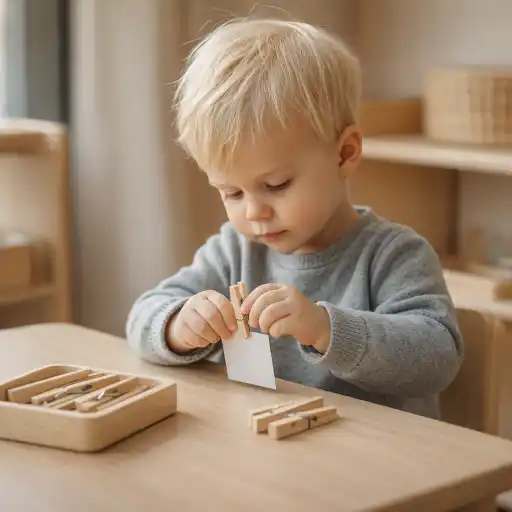
Use short sessions and realistic expectations. Five to ten minutes may be enough for a young child, while a small group can rotate through cards for approximately 8–15 minutes. Reduce visual clutter, present only a few cards, and provide a clear beginning and ending routine. A calm invitation, such as “Find the picture that matches and clip it,” supports attention more effectively than repeated correction.
How can providers connect clip cards to curriculum goals?
Clip cards become more valuable when the content reflects children’s current interests and instructional goals. The fine-motor action remains consistent, while the thinking demand changes. This makes the activity easy to differentiate and revisit across the year.
- 🔢 Mathematics: match quantities to numerals, compare more and fewer, identify shapes, or continue patterns.
- Literacy: match uppercase and lowercase letters, identify beginning sounds, rhyme pictures, or connect names with photographs.
- Science: classify animals, identify seasons, compare textures, or select items that sink or float.
- Language: choose an emotion, describe an object, or match a word to a familiar image.
- Social-emotional learning: identify calming strategies, helpful actions, or facial expressions.
Use actual classroom interests whenever possible. If children are studying insects, create cards with insect features. If the group is learning names, place children’s names or photographs on cards. Meaningful content supports conversation and makes the #focus demand feel worthwhile.
Clip cards can also be paired with extensions. After clipping an answer, invite a child to explain the choice, count the items again, draw a related picture, or find a classroom object that matches. The card is the entry point—not the entire lesson.
How can clip cards be adapted for diverse learners?
Children vary in hand strength, visual processing, attention, language, and prior experience. Adaptation is not lowering expectations; it is changing access so each child can participate meaningfully. Start by identifying the essential goal. If the goal is quantity recognition, the clothespin may be replaced temporarily with a larger clip, a sticker, or a pointing response.
- Use large-print images, high contrast, and uncluttered backgrounds.
- Provide fewer choices for children who become overwhelmed.
- Offer large clothespins, spring-assisted scissors, or easy-grip clips.
- Stabilize the card with a tray, nonslip mat, or binder clip.
- Pair spoken directions with photographs, gestures, or modeled steps.
- Allow a partner to hold the card while the child clips.
For children developing dual-language skills, use familiar pictures, gestures, and home-language labels when available. For children with motor differences, consult families and relevant specialists about helpful adaptations. Do not interpret slower performance as lack of understanding; observe the difference between a cognitive error and a physical access barrier.
Safety remains essential. Clothespins and card pieces may pose risks for children who mouth objects, and damaged pins can pinch skin or splinter. Inspect materials, supervise use, and separate small-piece activities from younger children as needed. State requirements vary - check your state licensing agency.
How can teachers avoid common clip-card mistakes?
A well-intended activity can become frustrating when the challenge, materials, or adult support are mismatched. The first common mistake is treating every card as an assessment. Clip cards should invite exploration and practice, not create pressure to perform quickly or correctly in front of peers.
- Too difficult: reduce choices, enlarge pictures, or use easier clips.
- Too repetitive: change themes, add movement, or invite children to design cards.
- Too much correction: model once, offer a brief prompt, then observe.
- Speed over accuracy: value careful looking and controlled movement.
- Unclear purpose: write one adult-facing learning objective for each set.
- Overcrowded center: provide two or three cards and limited materials at a time.
Use observation notes to guide next steps. Record whether the child uses one or both hands, maintains a functional grasp, scans all choices, persists after an error, and explains a decision. These notes are more informative than simply marking a card “finished.” If concerns about strength, coordination, asymmetry, or fatigue persist, share objective observations with the family and follow the program’s referral procedures.
Directors can support consistency by preparing a shared progression: large clips before smaller clips, matching before classification, and single-step prompts before multistep challenges. Training such as Spicing Up the Classroom: Learning Centers Buy Now $16.00 can help teams organize purposeful centers and connect hands-on materials with intentional instruction.
What is a practical clip-card routine for this week?
Begin with one goal, one small group, and a short routine. For example, prepare six picture cards showing different quantities and provide one clothespin per child. Model how to look, choose, clip, and return the card. Then let children work while you observe and ask occasional open-ended questions.
- Choose a developmental goal, such as counting sets to five.
- Prepare clear, durable cards with two or three choices.
- Select clips that match children’s current hand strength.
- Model the process without requiring a particular speed.
- Observe one motor behavior and one thinking behavior.
- Adjust the next session based on children’s responses.
Keep the experience social when children are ready. Partners can take turns choosing a card, checking an answer, or describing a strategy. Children can also create their own cards with drawings and dictate the question to an adult. This shifts the activity from answering teacher-made prompts to communicating ideas.
For additional professional learning, providers may consider 45 hour Growth and Development Birth-age 12 ONLINE Buy Now $399.00$275.00, DAP for Preschool Buy Now $24.00, Supporting Children’s Independence Buy Now $24.00, and Building Equity: Inclusionary Practices in Preschool Buy Now $10.00. These courses can deepen knowledge of development, intentional planning, independence, and inclusive participation; review course details and state requirements before enrolling.
Conclusion: How do clip cards build fine motor strength and focus?
Clip cards build fine motor strength through repeated squeezing, controlled release, and purposeful positioning. They build focus by asking children to attend, compare, decide, act, and check their work. Their greatest value emerges when educators keep the challenge brief, connect cards to meaningful curriculum, adapt materials thoughtfully, and observe the whole child.
Used this way, a clothespin is more than a classroom supply. It becomes a flexible tool for strengthening hands, supporting visual thinking, encouraging persistence, and making learning accessible. Start with one simple set this week, notice what children can do, and let their responses guide the next challenge.
- CDA Home Visitor Subject Area 3 Part 3 Birth to 5
- CDA Home Visitor Subject Area 2 Part 3 Birth to 5
- The ABCs of Behavior: Turning Challenges into Learning Opportunities
- CDA Infants/Toddlers: Health and Safety
- CDA Infants/Toddlers: Abuse and Neglect Reporting Requisites
- Setting the Stage: Story Time
- CDA: Special Needs: Understanding the Whole Child
- Texas Director Credential
- CDA Infants/Toddlers: Brain Development and Gene Expression
- How to boost fine motor skills: Holiday Edition
- Cuáles Son las Señales de Alerta en el Desarrollo Infantil que Todo Educador Debe Conocer?
- Pascua En El Aula: Actividades Sencillas Para Aprender y Celebrar Con Seguridad
- Celebra El Cumpleaños de Dr. Seuss En Tu Guardería Con Actividades Fáciles y Divertidas!
- Recursos en Español sobre el Sueño Seguro del Bebé
- What are 25 easy fine motor activities I can use in my preschool?
- ¿Cuáles son las mejores actividades de primeros auxilios para adultos?
- Actividades de Motricidad Gruesa que Desarrollan el Equilibrio, la Coordinación y la Fuerza
- 10 Ejemplos de Cómo la Cultura Influye en el Desarrollo Infantil
- Capacitación en Salud y Seguridad Preventiva en Línea para Proveedores de Cuidado Infantil
- Lista para Guardería en Casa en Illinois: Cómo Iniciar una Guardería en el Hogar
- Lista para Guardería en Casa en Texas: Cómo Iniciar una Guardería en el Hogar
- Cómo Ser Maestra de Preescolar en Dakota del Norte
- Capacitación Previa al Servicio para Proveedores de Cuidado Infantil en Dakota del Norte
- Cómo simplificar la capacitación para sus empleados de daycare
- How Do Clip Cards Build Fine Motor Strength and Focus?
- Why Are Self-Checking Clip Cards Great for Independent Practice?
- How Do Clip Cards Build Fine Motor Strength and Focus?
- How Can Clip Cards Prepare Little Hands for Writing?
- How Can Clip Cards Build Focus and Fine Motor Skills?
