Cleanup can feel like the most rushed part of the day, yet it may be one of the richest opportunities for children to practice thinking, language, cooperation, and independence. With intentional labels, songs, sorting cards, and clear expectations, providers can transform a daily chore into meaningful learning; Creating Engaging and Meaningful Learning Experiences  Buy Now $55.00 offers deeper strategies for planning developmentally appropriate experiences and earning focused professional learning. Directors may also explore Every Moment Matters: Schedules and Transitions Buy Now $55.00 to strengthen classroom flow and make transitions more purposeful.
Why does cleanup time matter beyond a tidy room?
Cleanup is not merely the final step after play. It is a recurring context in which children practice executive function, social participation, motor planning, language, and responsibility. A child who remembers that cars belong in the blue basket is using working memory and classification. A child who stops building when the song begins is practicing inhibitory control and flexible attention. Two children carrying a tray together are negotiating, coordinating movement, and contributing to their community.
These skills are easy to overlook because the visible outcome is simply an organized room. However, the process matters more than perfection. NAEYC describes developmentally appropriate practice as strengths-based, play-based, and responsive to each child’s individuality and context. Cleanup fits that framework when adults treat it as a skill to teach rather than a behavior to demand.
The invisible skills of cleanup include sequencing, self-regulation, cooperation, and care for the environment. When educators slow down enough to notice these behaviors, they can document meaningful growth and plan appropriate next steps.
How can labels make the classroom teach children where materials belong?
Labels turn storage into an environmental teaching tool. Children do not need to depend on an adult’s repeated directions when shelves and containers clearly communicate each material’s “home.” Picture-and-word labels are especially useful for emerging readers, multilingual learners, and children who benefit from visual information.
Begin with the materials children use most often. Photograph the actual contents of a bin, print the image clearly, and place it at children’s eye level. Pair the photograph with a simple word such as “blocks,” “books,” or “animals.” Keep one activity or category in each container whenever possible. A label that represents a mixed, overflowing basket may confuse rather than support classification.
- Use durable, high-contrast labels.
- Place labels on the shelf and the container when appropriate.
- Keep frequently used materials within safe reach.
- Teach children how to match an item to its picture.
- Review labels when materials or classroom interests change.
Labels should reflect children’s identities and languages. Invite families to share home-language words for familiar materials, and include authentic photographs when they are more meaningful than generic illustrations. Visual supports should complement gestures, spoken directions, objects, and modeling—not replace responsive interaction.
How do songs and signals support smoother cleanup transitions?
A predictable song or rhythm gives children an auditory cue that play is changing. This is particularly helpful because stopping an absorbing activity requires emotional and cognitive flexibility. The signal should be consistent, brief, and welcoming rather than threatening. A familiar tune can help children anticipate what comes next and reduce the number of verbal reminders adults must repeat.
Use a two-minute warning before the song begins. Then state one concrete expectation: “When the song starts, return the animals to the labeled basket.” Avoid turning the song into a race. Speed can encourage unsafe carrying, bumping, or careless placement. The purpose is participation and learning, not finishing before the final note.
- 🎵 Sing the same short cleanup song for several days before changing it.
- Use a visual card showing the cleanup steps.
- Invite children to add motions, claps, or words.
- Offer a quieter signal for children sensitive to sound.
- End with a brief acknowledgment of specific effort.
NAEYC and Head Start resources emphasize that routines and transitions should create supportive, predictable environments. When children know the sequence—warning, signal, task, check, next activity—they can gradually assume more responsibility.
How can sorting cards turn tidying into mathematics and language learning?
Sorting cards add a clear cognitive purpose to cleanup. Children can classify objects by color, shape, size, function, or location while returning them to storage. The Illinois Early Learning Project identifies sorting and organizing as important early mathematics experiences and specifically notes that cleanup can provide a natural context for grouping objects.
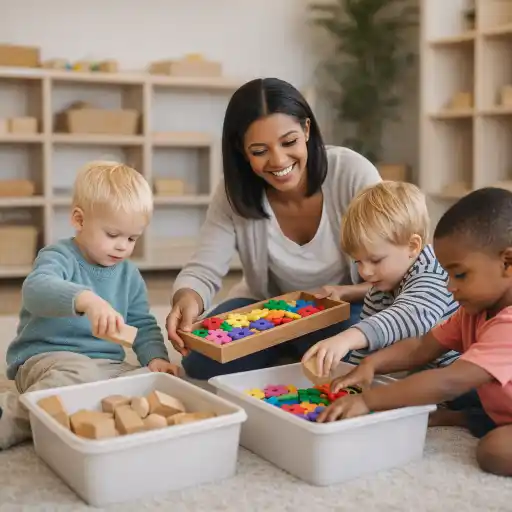
Start with one attribute. “Find the red materials” is accessible for younger children, while “Which items belong together and why?” invites more advanced reasoning. Use sorting cards showing the target category, such as a red block, a puzzle, or a book. Children can match objects to the card, place them in a basket, and explain their decisions.
- Count how many objects each group contains.
- Compare which basket has more or fewer.
- Sort the same materials a second way.
- Use positional words such as inside, beside, under, and above.
- Invite children to create a new category.
Language grows through the conversation around the task. Model words such as “same,” “different,” “belongs,” “category,” and “because.” For multilingual learners, pair speech with gestures, pictures, and home-language support. The goal is not to produce one “correct” answer quickly; it is to make children’s reasoning visible.
How can providers keep cleanup developmentally appropriate, inclusive, and safe?
Expectations should match children’s ages, abilities, sensory needs, communication styles, and prior experiences. Toddlers may place large objects in an open bin or wipe a low surface with a dry cloth. Preschoolers may sort materials, straighten books, carry a lightweight tray, or follow a two-step picture sequence. Children who need additional support may use adapted containers, larger labels, fewer choices, or a peer partner.
Separate child participation from adult sanitation. Children should not handle bleach, disinfectants, bodily fluids, broken glass, or hazardous waste. Adults remain responsible for chemical use, required contact times, ventilation, and regulated cleaning procedures. Children can participate with safe tools and materials approved by the program, followed by appropriate hand hygiene.
State requirements vary - check your state licensing agency before changing sanitation practices, products, supervision procedures, or documentation. Directors can support consistency through written schedules that distinguish child-friendly tidying from adult-only cleaning.
Common mistakes include giving vague directions, offering too many materials, expecting every child to clean in the same way, or redoing children’s work without explanation. Prevent these pitfalls by breaking tasks into one or two steps, reducing clutter, modeling the process, allowing processing time, and recognizing effort. A child who points, gestures, uses AAC, or speaks a home language is participating meaningfully.
How can directors use cleanup to strengthen curriculum and staff practice?
Directors can make cleanup learning visible by including it in curriculum planning, staff coaching, and observation systems. Ask educators to identify one learning goal for the routine, such as classification, self-regulation, vocabulary, or cooperation. Then select a small support—a label, card, song, or helper role—and observe what changes.
Brief documentation can capture the process:
- “Maya sorted eight animals by classroom location without prompting.”
- “Jordan waited for a peer before carrying the tray.”
- “Ari used ‘same’ and ‘different’ while matching puzzle pieces.”
- “Sam followed the picture sequence but needed support with the final check.”
Use these observations to adjust the environment and plan future experiences. If children repeatedly misplace materials, the issue may be unclear storage rather than noncompliance. If cleanup takes too long, reduce the number of available materials or assign smaller tasks. If some children disengage, offer a meaningful role, visual support, movement break, or quieter responsibility.
For ready-to-use support, the Cleanup Learning Labels, Songs, and Sorting Cards resource can help staff introduce consistent visual cues and playful classification. Pairing a practical resource with professional learning such as Spicing Up the Classroom: Learning Centers Buy Now $16.00, Classroom Tools for Emergent Literacy Buy Now $25.00, and Early Mathematics Through Play Buy Now $24.00 can deepen the connection between routines, curriculum, and assessment.
Summary: What hidden learning can cleanup time reveal?
Cleanup time reveals far more than children’s ability to put materials away. It provides repeated practice with executive function, #independence, classification, vocabulary, motor coordination, cooperation, and care for a shared environment. The strongest routines are predictable, explicitly taught, visually supported, inclusive, and safe.
Start with one classroom area. Add a photograph-and-word label, teach a short three-step routine, introduce a consistent song, and offer one sorting challenge. Observe children’s strategies rather than judging the finished room. Adjust the environment when expectations are unclear, and protect adult responsibilities for sanitation and hazardous tasks.
When providers recognize the hidden curriculum within cleanup, a rushed transition becomes an intentional learning experience. The goal is not a perfectly tidy room at any cost; it is a classroom where children understand how to contribute, solve problems, communicate, and grow. In that sense, cleanup is not time taken away from learning—it is #learning woven into the day.
Additional ChildCareEd courses: Creating Engaging and Meaningful Learning Experiences Buy Now $55.00, Every Moment Matters: Schedules and Transitions Buy Now $55.00, Classroom Tools for Emergent Literacy Buy Now $25.00, Early Mathematics Through Play Buy Now $24.00, and Spicing Up the Classroom: Learning Centers Buy Now $16.00.
- 😤💬 ¿Qué Le Digo a un Niño que Acaba de Morder a Otro?
- Cómo Abrir Una Quardería En Casa Sin Dinero?
- Recursos en Español sobre el Sueño Seguro del Bebé
- 10 Ejemplos de Cómo la Cultura Influye en el Desarrollo Infantil
- Retraso del Habla en la Guardería: Cómo Pueden Ayudar los Proveedores
- Cómo Trabajar en el Cuidado Infantil en Carolina del Norte: Requisitos y Pasos
- Cómo Ser Maestra de Preescolar en Illinois
- Capacitación CDA gratuita en Illinois
- Canciones, juegos y preguntas de círculo para niños
- What Is the Difference Between Early Childhood Education and Child Development?
- How Can Child Care Providers Prevent and Respond to Bullying?
- What Is Classroom Clutter Communicating About Children’s Behavior?
- How Does Cleanup Time Reveal Hidden Learning in Early Childhood Classrooms?
- How Can Sorting Activities Strengthen Early Thinking Skills?
- How Can Child Care Providers Help Families See the Learning Hidden Inside Messy Play?
- How Can Child Care Providers Document Learning During Ordinary Routines?
- How Should Child Care Providers Respond When Preschoolers Lie?
- How Can Providers Notice Developmental Progress Hidden in an Infant’s Daily Routine?
- How Can You Set Up Learning Centers in a Preschool Classroom?
- How Can Child Care Programs Measure the Hidden Setup and Reset Costs of Classroom Activities?
