Do you ever wonder whether your daily work is primarily teaching children or supporting their broader development? Understanding the distinction can sharpen curriculum decisions, family conversations, and professional goals; ChildCareEd’s Early Childhood Education course  Buy Now $99.00 offers 30 hours of practical training in curriculum, observation, guidance, and family partnerships.
Early childhood education and child development are closely connected, but they are not interchangeable terms. One emphasizes intentional learning experiences and educational practice; the other examines how children grow and change across physical, cognitive, language, social, and emotional domains. For child care providers and directors, distinguishing the two is not merely academic. It helps teams interpret children’s behavior more accurately, plan responsive environments, and communicate with families without reducing a complex child to a checklist.
The distinction also matters because quality early learning is shaped by relationships and context. Research summarized by the OECD emphasizes that children’s early skills develop through frequent, warm interactions with caregivers and educators. Similarly, a Canadian literature review reports that the quality of interactions and learning experiences—not simply attendance—has a meaningful relationship with children’s outcomes.
What does early childhood education mean in practice?
Early childhood education, or ECE, refers to formal and informal teaching and learning experiences generally provided from birth through approximately age eight. It includes infant and toddler programs, preschools, kindergarten, early elementary classrooms, family child care, and other settings in which adults intentionally support young children’s learning.
ECE is therefore an applied field. Educators use knowledge of development to design environments, select materials, facilitate play, guide behavior, document learning, and partner with families. The central question is practical: What experiences and interactions will help this child learn and participate meaningfully?
- Planning age- and ability-appropriate experiences
- Supporting early language, literacy, mathematics, science, and the arts
- Building social-emotional competence through relationships and play
- Observing children and adjusting instruction
- Creating safe, inclusive, and culturally responsive environments
ECE is not synonymous with academic acceleration. High-quality practice addresses the whole child and recognizes that care routines, conversations, movement, exploration, and pretend play are educational opportunities. NAEYC-aligned professional standards emphasize development from birth through age eight, individual variation, family and cultural context, observation, assessment, and responsive teaching.
For directors, this means evaluating whether staff can translate developmental knowledge into consistent classroom decisions. A provider may understand that toddlers are developing autonomy, for example, but ECE practice asks how the schedule, materials, transitions, and adult language will support that emerging independence.
What is child development, and what does it study?
Child development is the systematic study of how children grow, learn, behave, and form relationships from infancy through adolescence. It examines developmental processes rather than focusing exclusively on classroom instruction. Professionals consider the interaction of biology, relationships, culture, family systems, health, community, and learning environments.
Development is multidimensional. The CDC describes milestones as skills most children can demonstrate by a particular age in how they play, learn, speak, act, and move. These milestones are useful clues, not rigid predictions. Children develop at different rates, and a single observation should never be used to label a child or diagnose a condition.
- Physical development: growth, coordination, motor skills, and health
- Cognitive development: thinking, memory, problem-solving, and reasoning
- Language development: understanding and expressing communication
- Social-emotional development: relationships, emotional expression, and self-regulation
- Adaptive development: self-help, routines, and growing independence
Child development is informed by theories and research. Maturationist, constructivist, behaviorist, psychoanalytic, and ecological perspectives have all influenced early childhood practice. The ecological perspective, for instance, encourages providers to consider how family, culture, community, and classroom conditions shape a child’s experiences.
In daily child care, development knowledge supports careful observation and referral. When concerns arise, providers should document specific patterns, communicate respectfully with families, and follow local referral procedures. Screening is not the same as diagnosis, and state requirements vary - check your state licensing agency.
How do early childhood education and child development differ?
The clearest distinction is one of emphasis. Early childhood education is primarily concerned with designing and facilitating learning experiences. Child development is primarily concerned with understanding developmental change and the factors that influence it.
The boundary is not absolute. An early childhood educator must understand development to teach responsibly, and a child development specialist must understand educational settings when recommending supports. In fact, effective programs depend on the interaction of both fields. Developmental research informs curriculum, while educators’ observations reveal how theories operate in real environments.
A useful shorthand is this: child development supplies a map of how growth unfolds; early childhood education uses that map to decide what adults do next. Neither field is superior. They answer different questions and become most powerful when used together.
Why does this distinction matter for providers and directors?
Confusing education with development can lead to unrealistic expectations. A teacher may interpret a child’s limited attention during group time as defiance when the behavior may reflect developmental capacity, sensory needs, fatigue, language differences, or an environment that demands too much waiting. Developmental knowledge broadens interpretation; ECE knowledge turns that interpretation into a practical response.
😊 A practical team question is: “What are we noticing, what might explain it, and what can we change in the environment or interaction?” This approach avoids blaming children or families and encourages reflective practice.
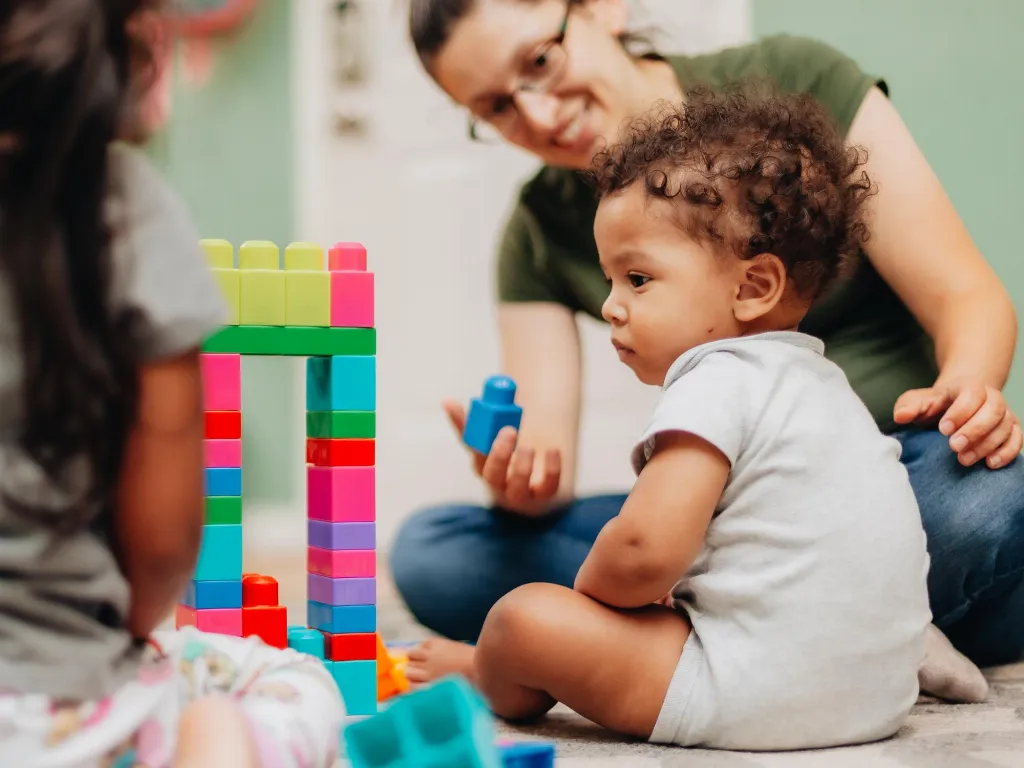
The distinction also strengthens program quality. The Canadian review of early learning and child care identifies warm educator-child relationships, stimulating activities, staff qualifications, physical environments, and group conditions as important dimensions of quality. Directors can use this framework when coaching staff and reviewing classrooms.
- Use developmental knowledge to set realistic goals.
- Use observation to identify strengths, interests, and possible concerns.
- Use ECE strategies to adapt materials, schedules, and interactions.
- Invite families’ knowledge of the child’s culture, language, routines, and abilities.
- Review whether assessments are developmentally, culturally, and linguistically appropriate.
Professional learning can help staff connect theory to action. ChildCareEd’s Theory of Learning Buy Now $24.00 course explores major theorists, play, attachment, and learning approaches, while the Developmental Screening in Early Childhood Buy Now $16.00 course focuses on distinguishing screening from assessment and documenting developmental concerns. Georgia-based providers can also explore Georgia’s early childhood education providers, career pathways, and resources.
How can educators integrate both fields in daily practice?
Integration begins with an observation-to-action cycle. First, observe children in authentic routines and play. Next, interpret what you see through multiple developmental domains and contextual factors. Then plan an intentional response, implement it, and revisit the evidence. This cycle keeps curriculum connected to children rather than to isolated worksheets or predetermined activities.
- Observe: Record what the child says, does, chooses, and attempts without judgment.
- Interpret: Consider physical, cognitive, language, social-emotional, and adaptive development.
- Plan: Select a small goal and offer materials or interactions that provide an appropriate challenge.
- Scaffold: Model, ask open-ended questions, provide visual support, or adjust the task.
- Reflect: Review the child’s response and decide what to maintain, change, or discuss with the family.
For example, if children repeatedly build ramps, a teacher can use the interest to support engineering, vocabulary, measurement, collaboration, and persistence. The activity is educational because the teacher intentionally extends learning; it is developmentally responsive because the design begins with children’s observed interests and abilities.
Directors can support integration by scheduling collaborative planning, using brief observation forms, reviewing documentation during coaching meetings, and protecting time for staff reflection. Avoid treating development as a compliance checklist or education as a collection of disconnected activities. The strongest practice is relational, intentional, playful, and flexible.
Useful professional resources include the ChildCareEd overview of child development theories and its discussion of developmentally appropriate practice. These resources reinforce that age, individual variation, family culture, and observation should guide planning.
What are common mistakes, and how can programs avoid them?
Several recurring mistakes arise when education and development are treated as the same thing or as competing priorities.
- Overreliance on age-based expectations: Age ranges are useful guides, but they do not capture individual development. Pair milestone information with ongoing observation and family input.
- Using milestones as grades: Milestones are indicators for understanding and support, not a ranking system. Avoid public comparisons among children.
- Confusing screening with diagnosis: Screening may identify a need for further evaluation; it does not explain the cause or determine eligibility for services.
- Prioritizing worksheets over relationships and play: Young children learn through active, meaningful experiences. Balance intentional instruction with exploration, movement, conversation, and play.
- Ignoring context: Language, culture, disability, health, trauma, family transitions, and access to resources can influence behavior and learning. Ask questions before drawing conclusions.
- Planning without evidence: Activities should connect to observations, developmental goals, and children’s interests rather than being selected only because they are convenient.
To avoid these pitfalls, teams can use a simple review protocol: identify the observation, name the developmental domain or domains involved, consider contextual explanations, select a responsive teaching strategy, and document the child’s response. Discuss concerns with families using specific, strengths-based language. If referral is appropriate, follow local procedures and maintain confidentiality.
Directors should also verify that staff training aligns with program needs and applicable regulations. State requirements vary - check your state licensing agency before counting a course toward a credential or required training category.
Conclusion: What is the essential difference?
Early childhood education and child development are distinct but interdependent. Child development studies how children grow across domains and contexts; early childhood education applies that knowledge through curriculum, relationships, environments, guidance, and assessment. The essential difference is therefore not “teaching versus caring,” because high-quality ECE includes both. It is the difference between understanding developmental processes and intentionally designing experiences that support them.
For providers and directors, the most useful practice is to connect the two: observe carefully, interpret development broadly, plan responsively, partner with families, and reflect with colleagues. When theory informs action and action remains grounded in each child’s strengths, early learning becomes more equitable, joyful, and effective.
Additional ChildCareEd courses to explore:
- 45 Hour Child Growth and Development
- 45 Hour School Age Methods and Materials
- CDA Bridge Bundle: Family Child Care
- CDA Bridge Bundle: Family Child Care without Portfolio Review
- CDA Bridge Bundle: Infant/Toddler without Portfolio Review
- CDA Bridge Bundle: Preschool without Portfolio Review
- Creating Environments that Nurture Growth and Community
- Texas Director Credential
- Accreditations and Affiliations
- Child Care Professionals
- Keeping Our Youngest Students Safe: The Vital Importance of Pediatric First Aid and CPR Training for Teachers
- CDA Certification en Español: Recursos y Consejos para Educadores Bilingües
- Studying ECD online: Why ChildCareEd Should be Your Top Choice
- Little Learners, Big Beginnings: Start Your ECE Career in Maine
- The Top Rewards of Working in Early Childhood Education
- Daycare Teacher Discounts: Deals and Benefits You May Be Missing
- Do You Need a Bachelor’s Degree to Be a Preschool Teacher—or Can a CDA Be Enough?
- What Is the Difference Between DCDEE WORKS and DCDEE Moodle?
- What Is the Difference Between Early Childhood Education and Child Development?
- What Are ECE Units, CEUs, Clock Hours, and College Credits—and How Do They Differ?
