What changes when children keep counting past 100? Extending number charts to 120 helps them see that familiar patterns continue, strengthening counting, number order, and place-value understanding. In this article, we’ll explore how number charts can help children recognize those patterns with support from Early Mathematics Through Play Buy Now $24.00 and the 120 Chart Fill-In: Missing Numbers Practice (1–120) Buy Now $1.49.
Why does seeing a number pattern matter beyond 100?
A number chart is more than a reference sheet. It is a visual model of the base-ten system that helps children notice how numbers are organized, related, and transformed. When a child sees 98, 99, 100, 101, and 102 together, the transition beyond 100 becomes a continuation of a system rather than a completely new topic.
This matters because children may memorize counting sequences without understanding the structure underneath them. Research on early mathematical development emphasizes the importance of pattern and structure, including the ability to recognize regularities, organize quantities, and generalize relationships. A chart gives those relationships a stable visual location for discussion.
For providers, the goal is not to rush young children into formal computation. It is to help them develop flexible #numberSense through questions such as:
- What changes when we move one space to the right?
- What stays the same when we move down a column?
- What do you notice about the numbers ending in zero?
- How can we predict the next number without counting every number?
The 100 and 120 Number Charts resource Buy Now $0.00 provides filled and blank charts that can support this work. Used intentionally, the chart becomes a tool for reasoning rather than a decoration on the wall.
How does a chart make place value visible?
Place value explains why the digit 1 means different things in 1, 10, 100, and 1,000. Number charts help children see that changing a digit’s position changes its value. In a chart extending from 1 to 120, the numbers 101 through 109 can be examined as one hundred plus additional ones, while 110 demonstrates a new group of ten.
Teachers can connect the chart to concrete materials. Children might build 106 with one hundred flat, one ten, and six ones, then locate 106 on the chart. This movement among objects, spoken language, written notation, and visual position supports conceptual understanding.
Useful prompts include:
- How many hundreds, tens, and ones are in 124?
- What is the same about 114 and 124? What is different?
- What happens to the tens digit when we add ten?
- Can you write 137 in expanded form?
These conversations reinforce the foundational ideas of ordering, position, and amount described by NRICH’s guidance on early number sense and place value. The chart does not replace manipulatives; instead, it helps children connect concrete groupings to symbolic representations.
Keep language precise but accessible. Say, “When we move down one row, the number increases by ten,” and invite children to verify the claim. This encourages mathematical argument and helps children understand that the chart’s layout reflects the base-ten system.
Which patterns can children investigate beyond 100?
Once children are comfortable reading the chart, invite them to investigate patterns rather than simply fill missing numbers. A blank or partially completed chart is especially useful because it creates a genuine problem to solve. Children can use neighboring numbers, row structure, and known counting sequences to justify their predictions.
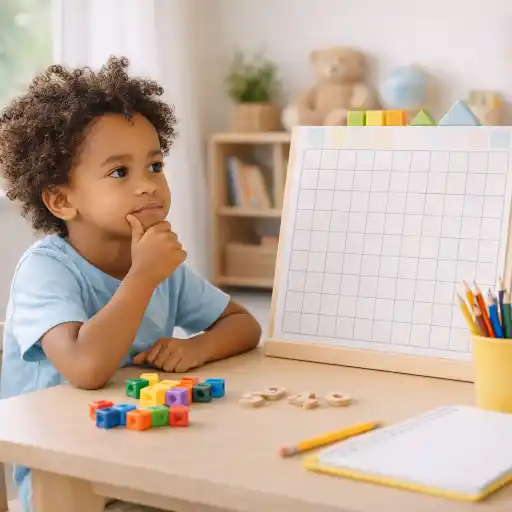
Begin with accessible patterns and gradually increase complexity:
- Counting by ones: Notice that each horizontal step increases the number by one.
- Counting by tens: Compare 104, 114, 124, and 134 to see the ones digit remain constant while the tens digit changes.
- Counting by fives: Highlight numbers ending in 0 or 5 and discuss the alternating pattern.
- Even and odd numbers: Shade alternating numbers and look for repeated visual arrangements.
- Multiples: Mark multiples of 3, 4, or 10 and ask children to describe the resulting structure.
🌟 Invite children to become “pattern detectives.” Give each pair a highlighter and a challenge card such as, “Find all the numbers that are ten more than a number in the top row.” Ask them to explain how they know, not merely point to answers.
These experiences connect to research showing that patterning and spatial organization support early arithmetic development. They also prepare children for multiplication, division, and algebraic reasoning by encouraging them to describe a rule and apply it to unfamiliar numbers.
How can providers turn number-chart work into meaningful play?
Number-chart learning is most effective when children move, talk, manipulate, and solve problems together. A chart can become a floor game, a scavenger hunt, a small-group puzzle, or a collaborative investigation.
- Missing-number mystery: Cover several spaces and ask children to use neighboring numbers as clues.
- Human number line: Give children number cards from 95 to 110 and invite them to arrange themselves in order.
- Ten-more, ten-less: Call out a number and ask children to move to the number ten spaces away.
- Pattern coloring: Color multiples of 2, 5, or 10 and compare the visual designs.
- Number detective: Describe a number using clues such as “I am greater than 100, less than 120, and have six ones.”
Use pairs or small groups so children can explain strategies and hear different approaches. For younger children, begin with charts to 20 or 50 and extend the range only when the structure remains meaningful. For older school-age children, connect the chart to factors, prime numbers, fractions, or coordinate language.
Open-ended questions strengthen reasoning: “Could there be another answer?” “How could you prove it?” and “What would happen if we changed the starting number?” These prompts transform a worksheet task into a shared mathematical inquiry.
Providers can also connect chart work to routines. Count children present, compare attendance across days, or use a chart to determine how many days remain until a classroom event. Authentic purposes help children see mathematics as useful rather than isolated.
How should teachers differentiate and assess number-chart understanding?
Children do not approach numbers beyond 100 with identical experiences or levels of readiness. Some may need concrete groups of ten, while others are ready to generalize patterns across hundreds. Differentiation begins with observation.
- For emerging counters: use smaller ranges, large manipulatives, number cards, and one-to-one counting.
- For children developing place value: pair charts with base-ten blocks, bundles of sticks, and expanded notation.
- For children ready to generalize: investigate rules, missing intervals, multiples, and numbers above 120.
- For multilingual learners: provide visual supports, gestures, home-language vocabulary, and sentence frames such as “I notice ___ because ___.”
- For children with motor or visual needs: enlarge the chart, increase contrast, use tactile markers, or offer digital access.
Assessment can remain brief and play-based. Ask a child to locate 108, find ten more than 108, build 108 with materials, and explain the relationship. Record the strategy rather than only the answer. A note such as “Jordan found 118 by moving down one row but needed blocks to explain the hundreds digit” gives a clear next step.
Common mistakes include treating chart completion as handwriting practice, expecting children to memorize patterns without discussion, and correcting errors before children can explain their thinking. Slow down, ask for evidence, and revisit the idea with a different representation. State requirements vary - check your state licensing agency when determining documentation or professional development expectations.
Summary: How do number charts help children see patterns beyond 100?
Number charts help children see beyond 100 because they make the structure of the number system visible. Rows and columns reveal counting relationships, place value, skip-counting patterns, and predictable changes across hundreds. When children use charts alongside manipulatives, movement, language, and problem-solving, they begin to understand numbers as connected ideas rather than isolated symbols.
- Use filled, blank, and partially completed charts for different purposes.
- Connect chart positions to ones, tens, and hundreds with concrete materials.
- Ask children to describe, predict, justify, and generalize patterns.
- Embed activities in playful routines and collaborative investigations.
- Observe strategies and adjust the range, materials, and prompts for each child.
The central question is not whether children can recite numbers past 100. It is whether they can explain how numbers relate, predict what comes next, and use patterns to reason. With intentional guidance, a simple chart can become a powerful window into the structure of mathematics.
Additional ChildCareEd courses for professional learning
- Math Foundations in Early Childhood
 Buy Now $16.00 — strategies for integrating hands-on math and problem-solving into daily practice.
 - No Such Thing as Boring Math Buy Now $24.00 — play-based approaches for making mathematical exploration engaging.
- Letter & Number Planning in Child Care Buy Now $24.00 — planning developmentally appropriate number and literacy experiences.
- Enhancing STEM Education for Infants and Toddlers Buy Now $16.00 — early mathematics and inquiry strategies for the youngest learners.
References
- ChildCareEd: 100 and 120 Number Charts Buy Now $0.00.
- ChildCareEd: Teaching Place Value.
- NRICH: Early Number Sense and Place Value.
- Common Core State Standards: Counting and Cardinality.
- Supporting Early Mathematical Development Through Pattern and Structure.
- Engaging Young Children with Mathematical Activities Involving Different Representations.
- Moving Past 100: Place Value and Number Sense Activities.
- Free Printable Number Charts and 100-Charts.
- Pattern and Counting Worksheets and Activities.
- Free Printable Number Charts.
- ChildCareEd: What Preschool Math Skills Should I Teach and When?.
- ChildCareEd: Meaningful, Playful Preschool Math.
- ChildCareEd: Supporting Early Math Every Day.
- ChildCareEd: Supporting Early Math Skills.
- Free Hundreds Chart Activity for Number Recognition.
- Activities and Lessons to Teach Numbers to 100.
- Free Counting Worksheets for Grades K–2.
- ChildCareEd: Hundreds Chart Fill-In Buy Now $1.49.
- ChildCareEd: Math and Montessori.
- ChildCareEd: Why Counting to 20 Does Not Mean Understanding 20.
- 45 Hour Child Growth and Development
- Early Mathematics Through Play
- CDA Home Visitor Subject Area 3 Part 3 Birth to 5
- CDA Home Visitor Subject Area 2 Part 3 Birth to 5
- 45 Hour Preschool Methods and Materials
- 45 Hour Infant and Toddler Methods and Materials
- 45 Hour School Age Methods and Materials
- CDA: Special Needs: Understanding the Whole Child
- Creating Environments that Nurture Growth and Community
- CDA Infants/Toddlers: Stages of Development
- Capacitación de Informes Obligatorios
- Estudio de caso de TDAH
- Obtenga el CDA por $99!
- ❤️ ¿Cómo ayudan los educadores a las familias a acceder a los servicios que necesitan?
- 🤯 ¿Por qué este niño está teniendo un comportamiento difícil de repente?
- Curso Gratis De Cuidado Infantil Con Certificado
- ¿Cómo incluir a niños con necesidades especiales en cuidado infantil? Guía práctica y sencilla
- ¿Cómo empiezo mi certificación CDA en Florida en línea?
- La mejor manera de hacer seguimiento a la capacitación de su equipo de daycare How to Organize Staff Training for Your Child Care Center Cómo organizar la capacitación del personal para su centro de cuidado infantil
- Pumpkin Math Without the Worksheets: Hands-On Pre-K Learning
- Teaching Math to Young Children: Why Counting to 20 Doesn’t Mean They Understand 20
- How Can Child Care Providers Introduce Even and Odd Numbers Through Visual Patterns?
- How Can You Use a Hundreds Chart Beyond Rote Counting?
- How Can Child Care Providers Look Beyond Support Needs to See a Child’s Interests and Strengths?
- Head Start Attendance: Looking for Barriers Behind Repeated Absences
- What Are Simple Ways to Build Early Math Skills During Daily Classroom Routines?
- How Can Toddler Classroom Jobs Build Early Math Beyond Counting?
