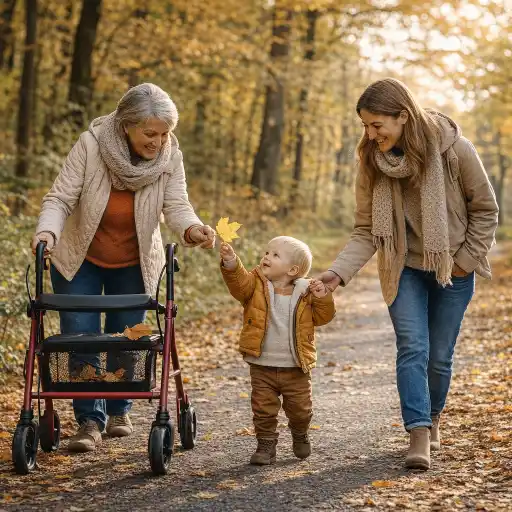
A fall walk can be more than a change of scenery: it can give children a chance to notice colors, sounds, textures, and seasonal change together. With thoughtful route planning, children using wheelchairs, walkers, or other mobility devices can help shape the outing rather than simply accompany it. Explore Planning for Every Child: Responsive Strategies in Action  Buy Now $55.00 to strengthen individualized planning and accessibility practices, and consider Creating the Natural Outdoor Classroom Buy Now $16.00 for practical ways to make nature exploration engaging for your group.
Why does planning a shared route matter?
Outdoor exploration invites children to move, observe, communicate, and wonder. But reaching a trailhead is not the same as having a meaningful experience: a route can be technically open yet include surfaces, slopes, narrow sections, or obstacles that limit a child’s choices. A successful outing supports access and participation, so children can explore at their own pace, contribute ideas, and connect with peers.
Planning also makes the experience more predictable for the team. A route review helps educators anticipate transition points, identify places to pause, and decide how the group will respond if conditions change. It can reduce the pressure to improvise while supervising children outdoors.
Head Start’s Nature Walk and Roll encourages adults to choose a pathway that works for everyone and to follow children’s interests. This approach treats different ways of moving as part of the group’s shared experience—not as a problem to solve separately. Thoughtful #accessibility planning can help every child experience #nature as a place for curiosity, choice, and connection.
How can you review a fall route before the outing?
Whenever possible, preview the route yourself before bringing children. Review the entire journey from the program door to the exploration area and back, including curb cuts, gates, parking or drop-off areas, rest points, and accessible restrooms if relevant. Check current conditions as well as information provided by the park or site; rain, fallen leaves, maintenance, or construction can change a route quickly.
Record details instead of relying on a general label such as “easy” or “accessible.” The Access Recreation guidance on trail design elements recommends describing surface, width, grade, cross slope, distance, and obstacles, along with meaningful features or challenges. Note where a route narrows, where surfaces change, and how far it is between places to stop.
- Surface and traction: Is it firm and stable, or loose, muddy, wet, or covered in slippery leaves?
- Space to maneuver: Are paths and turning areas wide enough for the mobility devices in your group?
- Slopes and transitions: Are there steep sections, cross slopes, abrupt edges, roots, or gaps?
- Rest and shelter: Are there places to sit, pause, warm up, or move out of wind or rain?
- Communication and supervision: Can staff keep the group together and maintain effective sight and sound supervision?
Where possible, ask the child and family what route information or supports are useful. A child’s own experience can reveal details that an adult route check misses.
What makes a route workable for children using mobility devices?
A workable route is not necessarily the longest or most scenic. It is one that allows the child to travel, stop, observe, and participate without avoidable barriers. Consider the child’s mobility device and individual preferences rather than making assumptions based on a diagnosis. The same path may feel different depending on a child’s equipment, strength, comfort, and experience.
Look for a continuous, firm, stable path and manageable transitions between surfaces. Check that branches, bins, signs, and temporary equipment do not block movement. Consider slope and cross slope, distance, turning room, and whether a rest area is available before a child becomes tired. A route review should describe what you observed, not promise that a particular trail will suit every child.
Prepare a flexible plan with a shorter loop or return point. Let the child help decide whether to continue, pause, or turn back. If part of the route proves unsuitable, the group can adapt without treating the change as a failure. The review of inclusive outdoor environments in Children with Nature: Inclusion and Accessibility emphasizes attention to both physical and social barriers. A clear #route is a starting point; participation also depends on whether children can make choices and share the experience.
How can the group explore fall together?
Build the walk around a shared invitation rather than a single required way of participating. Children might look for colors, listen for birds or wind, notice the feel of cool air, or compare how leaves move across different surfaces. Some children may travel through the route; others may observe, point, use a communication device, take photographs, or direct a partner toward something interesting.
Use descriptive language and leave room for responses in different forms. “I hear leaves rustling near us” can invite a child to look, gesture, vocalize, or share a thought. Open-ended prompts such as “What do you notice?” and “Where should we pause?” give children influence over the group’s exploration. Head Start suggests using communication cards, devices, and sign language as needed, and including home or Tribal languages where possible.
- Offer a choice of what to observe: color, sound, shape, or movement.
- Bring accessible materials such as picture cards, a camera, or a clipboard if they help children document discoveries.
- Pause at a place where the group can gather without blocking the path.
- Invite peers to ask before helping and to follow the child’s lead about what to explore.
- 🍂 Let children decide whether to look closely, listen quietly, photograph, draw, or describe what they find.
Shared discovery does not require every child to touch or collect natural objects. Observation can be active and meaningful, and children’s preferences should guide how they engage.
How should staff plan for safety and changing conditions?
Before departure, review the route, weather, clothing, supervision roles, group boundaries, and any child-specific support plan. Assign staff positions so adults can monitor the whole group during movement and at pauses. Count children at transitions and keep communication clear about where to stop, turn around, or seek assistance.
Fall conditions can alter traction and visibility. Wet leaves, mud, early darkness, cold rain, wind, or ice may make a planned section unsuitable. Check the route again on the day of the outing, and be ready to shorten it, choose another path, or move the activity indoors. The CDC’s guidance on outdoor play and safety for children in ECE highlights the value of outdoor play alongside the need to address hazards and supervise actively.
- Check the route for hazards, surface changes, and temporary obstructions before children set out.
- Bring the supplies required by program policy, such as first aid, contact information, water, and weather-appropriate extras.
- Keep the route description and return plan available to staff, and follow procedures for outings and attendance checks.
- State requirements vary - check your state licensing agency for applicable outing, supervision, and accessibility requirements.
Risk management should support participation, not default to exclusion. If a specific section is unsuitable, identify a reasonable alternative that preserves the group’s opportunity to explore together.
How can you use the route review to improve future walks?
After the walk, briefly reflect with staff and, when appropriate, children and families. What parts of the route worked well? Where did the group need more time, a different stopping point, or another way to participate? Record observations while they are fresh, including changes in weather or surface conditions. A note such as “the leaf-covered slope felt slippery; the paved loop offered a comfortable alternative” is more useful than simply marking a trail “good” or “bad.”
Use the ChildCareEd guidance on participation in outdoor play as a reminder to look beyond presence: consider whether children had choices, could access the activity, and had opportunities to connect with peers. Update the route planner when new information emerges, and review the plan again as children’s needs, equipment, and seasonal conditions change.
Common pitfalls are avoidable:
- Assuming a trail is suitable because it is labeled accessible; verify current surfaces, slopes, and obstacles.
- Planning only for travel distance; include resting places, turning space, and opportunities to explore.
- Making decisions without the child or family; invite their insight and respect the child’s cues.
- Treating one adaptation as a permanent solution; revisit the plan as conditions and preferences change.
Use the Accessible Nature Walk Route Review and Activity Planner to organize route details, activity options, and post-walk reflections in one practical planning process.
Conclusion: How can a fall walk support shared discovery?
A fall walk with a mobility device can be a rich, shared experience when educators plan for the full route, not just the destination. Review surfaces, slopes, widths, distances, obstacles, rest points, and weather; collaborate with children and families; and offer varied ways to observe, communicate, and contribute. Keep supervision and safety procedures in view, while remaining flexible enough to change course when conditions or children’s needs call for it.
The central question is not simply whether a child can get outdoors, but whether the outing offers genuine choices and connection. With thoughtful preparation, every child can help decide what the group notices next—and take part in the wonder of the season.
Five useful ChildCareEd courses
- CDA Certification en Español: Recursos y Consejos para Educadores Bilingües
- 💛🧩 ¿Cómo puedo hacer que mi enseñanza sea inclusiva para los niños con autismo?
- Proporciones de Cuidado Infantil y Tamaños de Grupo por Edad en Virginia (Guía Rápida para Centros y Hogares)
- Celebrando la amistad en el cuidado infantil durante el Día de los Mejores Amigos
- Canciones, juegos y preguntas de círculo para niños
- How Can Preschool Teachers Use Fall Activities to Strengthen Family Engagement?
- How Can Outdoor Fall Activities Support Children’s Development?
- How Can Fall Activities Build Kindergarten Readiness Skills?
- How Can You Adapt Fall Learning Activities for Children of Different Ages?
- How Can Child Care Providers Involve Families in Observing Children’s Growth During Fall?
- Juego Compartido y Autismo: Cómo Fomentar la Participación sin Exigir Contacto Visual
- How Can You Plan Fall Activities for a Mixed-Age Family Child Care Group?
- How Can You Plan a Safe Fall Texture Walk for Infants Who Aren’t Yet Walking?
- How Can You Create a Fall Listening Walk for Toddlers?
- How Can Fall Nature Frames Help Preschoolers Discover More Than Leaf Shapes?
- How Can One Fall Activity Work for Three Age Groups in Family Child Care?
- Who Gets to Design the Scarecrow? How Can After-School Groups Make Fair Decisions?
- How Can Preschool Classrooms Simplify Fall Learning Centers Without Losing the Joy of Play?
- Who Lives Under That Log? How Can Preschoolers Observe Fall Insects Without Disturbing Them?
- How Can You Plan a Fall Walk With a Mobility Device That Invites Shared Discovery?
