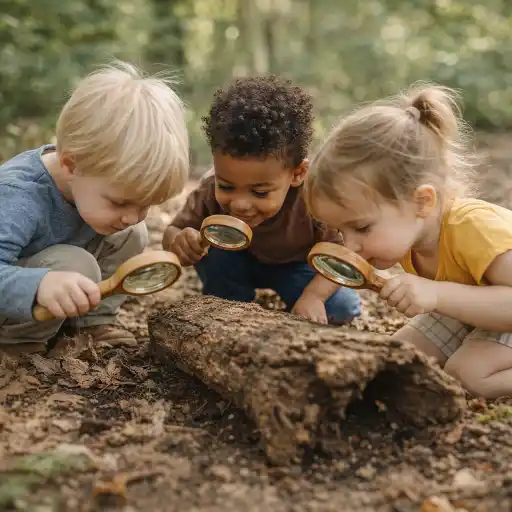
A fallen log can become a small world of discovery—if children learn to look with care rather than lift, grab, or collect. Explore Creating the Natural Outdoor Classroom  Buy Now $16.00 to strengthen your outdoor teaching practice, and consider Basic Science in Early Childhood Buy Now $25.00 for practical support in turning children’s questions into meaningful investigations. Together, thoughtful preparation and focused observation help preschoolers build scientific habits while protecting the creatures and habitats they are curious about.
Why is observing fall insects without disturbing them worthwhile?
Fall invites children to notice changes: leaves gather, temperatures shift, and small animals seek shelter. A log, a patch of leaf litter, or the edge of a garden may prompt the question, “Who lives under there?” The learning opportunity is not simply finding an insect. It is practicing patience, noticing details, asking questions, and recognizing that living things depend on places that people should treat with care.
When educators model respect, children can explore without learning that nature is something to collect or rearrange. Head Start’s bug-hunt guidance encourages observation in natural habitats, child-led exploration, and documentation through drawings or notes. These practices also support language, early science, cooperation, and attention.
Fall insect observations can be brief and flexible. If no insects are visible, children can still study the log’s texture, leaf patterns, tiny holes, or signs of animal activity. The goal is to cultivate #curiosity and care—not to guarantee a particular discovery. A calm, respectful search makes the outdoor classroom a place where children and wildlife can both belong.
How can providers prepare a safe, respectful log investigation?
Start with an adult site check. Choose a familiar outdoor area with clear boundaries and good visibility. Look for traffic, sharp debris, unstable ground, animal waste, irritating plants, and other hazards. Consider the weather, clothing, children’s health plans, and whether the route is accessible to the group. State requirements vary - check your state licensing agency.
Most importantly, do not have children lift or roll a log to reveal what is underneath. A log can be habitat and shelter; moving it may expose or harm organisms. Instead, invite children to observe its surface, ends, nearby leaf litter, or visible openings from a safe distance. If the program’s safety procedures and the site allow an adult to reposition an object, the adult—not children—should assess the risks and return it carefully to its original position. Often, there is no need to move it at all.
- Set a clear boundary and position adults for active supervision.
- Bring simple tools: large-handled magnifiers, clipboards, picture cards, or a camera operated by an adult.
- Teach a short expectation: “Look closely, keep hands to yourself, and leave homes as we found them.”
- Offer ways to participate from different distances and positions.
The CDC’s outdoor play and safety guidance addresses considerations such as insects, outdoor hazards, and active supervision. Use your program’s policies and local guidance to shape the activity.
What questions help children observe instead of handle?
Good prompts focus attention without turning the walk into a quiz. Give children time to look before offering information. You might ask, “What do you notice on the log?” “Where do you see movement?” or “What might this place provide for a small animal?” If children spot an insect, invite them to describe what it is doing, how it moves, and where it is located.
Model scientific language with phrases such as “I notice…,” “I wonder…,” and “What could we find out?” Separate what children see from what they guess. For example, “I see a tiny animal near the bark” is an observation; “It is hiding because it is cold” is a possible explanation to explore. You do not need to know every species name. Wondering together and returning to a question later are valuable parts of inquiry.
- “What colors, shapes, or patterns can you see?”
- “Is it still, crawling, or moving in another way?”
- “What is the same or different about this spot and the nearby leaves?”
- “How can we remember what we observed without taking it home?”
For young children, gestures, pointing, a home-language word, or a drawing can communicate an observation just as meaningfully as a spoken description. The California Academy of Sciences’ insect investigation lesson also emphasizes supportive conversation, tool demonstrations, and sharing discoveries through drawings and stories.
How can children record discoveries and extend the inquiry?
Documentation helps children revisit what they saw and gives educators clues about their interests. Keep it lightweight: a quick sketch, an adult-taken photograph of the habitat, a child’s dictated words, or a simple class tally. The record does not need to identify an insect precisely or produce a polished drawing. Its purpose is to preserve a question, detail, or idea for later discussion.
Back indoors, invite children to compare their notes with nonfiction books or photographs. They might sort pictures by visible features, create a class “Who might live here?” map, or dictate a short account of the investigation. A pretend bug hotel using blocks, loose parts, or the ChildCareEd Insect Habitat Investigation: Bug Hotel Activity and Safety Checklist Buy Now $2.00 can extend the topic without removing wildlife from its home. The printable includes creature cards, habitat mats, a design activity, observation checklists, and safety guidance.
Keep children’s theories visible and open to revision. A child may first say the log is “just wood” and later notice holes, damp patches, or small moving creatures. Revisiting evidence helps children see that careful looking can change what we think. It also offers a natural bridge to drawing, vocabulary, classification, and early #science.
How can educators make the experience inclusive and avoid common mistakes?
Children differ in how close they want to get, what sensory experiences they enjoy, and how they communicate. Offer choices: observe from farther away, use a magnifier, point while an adult records, draw a photograph, or listen to peers describe what they see. Choose a route that accommodates mobility devices and provide visual cues or vocabulary in children’s home languages where possible. A child who chooses not to approach the log is still part of the investigation.
Common pitfalls include lifting logs with children, crowding an insect, promising that the group will find a particular creature, or treating a lack of visible insects as a failed activity. Avoid touching unknown organisms and do not encourage children to collect or bring them indoors. Adults should maintain active supervision and follow program procedures for handwashing and outdoor safety.
- 🍂 Let children observe from a comfortable distance; no one needs to touch an insect.
- Do not move logs, disturb nests, or block an animal’s route.
- Keep explanations provisional when the evidence is limited.
- Adapt the activity if weather, hazards, or children’s needs call for a change.
Calm, affirming language matters. If a child feels uneasy, validate the response and offer a safe way to watch. If a child is eager to get closer, acknowledge the excitement while reinforcing the boundary: “We can look carefully without disturbing its home.”
Conclusion: What is the best way to explore who lives under a log?
Help preschoolers explore a fall log by preparing a safe, accessible observation area, keeping the habitat undisturbed, and giving children time to look before explaining. Open-ended questions, simple tools, and brief documentation can turn a spontaneous discovery into meaningful early science, language, and shared problem-solving.
The central lesson is simple: observe without disturbing. Children can notice movement, color, shape, and habitat while learning that small creatures need shelter and space. When educators model patience, include varied ways to participate, and follow children’s questions, even an ordinary log can invite lasting curiosity and respect for nature.
Explore related ChildCareEd training:
- Creating the Natural Outdoor Classroom
- 45 Hour Child Growth and Development
- What Makes Me Special: An Overview of Autism and ADHD
- Spaces that Support Discovery
- Pediatric RSV First Aid & CPR/AED
- CDA Bridge Bundle: Family Child Care without Portfolio Review
- CDA Bridge Bundle: Infant/Toddler without Portfolio Review
- CDA Bridge Bundle: Preschool without Portfolio Review
- 45 hour Growth and Development Birth-age 12 ONLINE
- CDA Certification en Español: Recursos y Consejos para Educadores Bilingües
- Recursos en Español sobre el Sueño Seguro del Bebé
- Actividades de Motricidad Gruesa que Desarrollan el Equilibrio, la Coordinación y la Fuerza
- 10 Ejemplos de Cómo la Cultura Influye en el Desarrollo Infantil
- ¿Cómo solicito la licencia para una guardería en California?
- Proporciones de Cuidado Infantil y Tamaños de Grupo por Edad en Maryland (Guía Rápida para Centros y Hogares)
- ¿Cuál es la Diferencia Entre la Crianza Respetuosa y la Crianza Permisiva?
- Actividades de Otoño Fáciles para Preescolares esta Temporada
- Lista para Guardería en Casa en California: Cómo Iniciar una Guardería en el Hogar
- Cómo Trabajar en el Cuidado Infantil en California: Requisitos y Pasos
- Calabazas, hojas y manzanas: actividades de otoño para preescolares
- Celebrando la amistad en el cuidado infantil durante el Día de los Mejores Amigos
- Canciones, juegos y preguntas de círculo para niños
- What’s Happening Outside? Fall Science Adventures for Preschoolers
- Go on a Fall Hunt! Outdoor Learning Challenges for Preschoolers
- How Can Educators Turn Indoor Insect Interest into Outdoor Investigation?
- How Can Warm-Climate Child Care Programs Make Fall a Season of Discovery?
- How Can Children Connect Spring Pollination to the Fall Apple Harvest?
- Who Eats What in the Fall Forest? How Can After-School Programs Teach Food Chains?
- Who Lives Under That Log? How Can Preschoolers Observe Fall Insects Without Disturbing Them?
