Cooking activities can bring children together—but only when every child has a meaningful way to participate. Learn how to adapt a s’mores sequencing activity with practical supports for communication, movement, sensory needs, and safe participation; for a fuller planning toolkit, explore ChildCareEd’s Chef's in the Classroom  Buy Now $24.00 course, which covers developmentally aligned cooking activities and modifications for children’s individual needs.
Why does accessibility matter in a classroom cooking activity?
A shared cooking project offers more than a finished snack. Children can practice sequencing, language, early math, cooperation, sensory exploration, and fine-motor skills. A child may be learning to name ingredients, communicate a choice, point to a picture, or wait for a turn; each contribution can be a real part of the group’s work.
Accessibility means planning so children can participate in ways that work for them, rather than expecting every child to complete every step in the same way. The goal is not identical performance. It is meaningful involvement, with appropriate support and room for growing independence. When educators offer options, children are more likely to feel capable and included.
The ChildCareEd resource How to Make S'mores: A Sequencing Activity Buy Now $1.49 asks children to color, cut, and glue picture steps in order. That provides a useful visual starting point before or instead of preparing food. Cooking and recipe sequences can also prompt children to explain what happened first, next, and last, connecting hands-on experience with oral language and comprehension.
Thoughtful adaptations support the whole group. Clear visuals can help children who benefit from predictability, while accessible tools and flexible roles can make the activity more manageable for children with motor or communication differences. A well-planned activity can honor children’s strengths while reducing barriers that might otherwise prevent participation.
How can you plan a flexible s’mores sequence?
Start with the learning goal: children will notice and communicate the order of a simple process. The food itself is optional. You can use a real, program-approved recipe, pretend food, felt pieces, or the printed sequencing cards. Keeping the learning goal separate from the specific ingredients makes it easier to adapt for dietary needs, sensory preferences, and safety.
Prepare materials before children arrive. Set up a clear work surface, reduce unnecessary clutter, and arrange materials within each child’s comfortable reach. Use large, sturdy picture cards when possible. If cutting and gluing are part of the planned task, consider pre-cut pieces, glue dots, or larger cards so children can focus on making choices and ordering steps rather than being blocked by fine-motor demands.
Build flexibility into the plan with different ways to take part:
- Invite children to place, point to, name, sign, or eye-gaze toward the next picture.
- Offer a choice between two steps when an open-ended question feels difficult.
- Use a simple visual strip with “first,” “next,” and “last,” adding steps only when useful.
- Provide a seated work position and stable materials; try a non-slip mat or a larger bowl if needed.
- Allow a child to observe first, participate briefly, or take a predictable role such as handing out cards.
Share the plan with the teaching team. Decide who will supervise food handling, who will support children at the work area, and how each child can participate without being hurried. This makes the activity calmer and lets adults respond instead of improvising under pressure.
Which adaptations support different abilities and communication styles?
Adapt the task to the child, not the child to the task. Observe what already works: Does the child follow pictures, imitate a demonstrated action, respond to a spoken prompt, or need additional processing time? Family input and relevant individualized plans can help staff choose useful supports while respecting each child’s preferences and privacy.
For children with motor differences, offer easy-to-grasp cards, a nonslip work surface, lightweight utensils, or larger ingredients and containers. A child can direct a peer or adult to place a card, rather than handling it independently. For children who use communication supports, make sure familiar signs, picture symbols, communication boards, or devices are available and positioned within reach. Accept a gesture, look, vocalization, or communication device response as a valid contribution.
For children who benefit from additional structure, present one step at a time, model the action, and use a visual “finished” cue. Reduce competing sounds or scents if they are distracting or uncomfortable. Sensory participation should be a choice: a child can explore a picture or utensil without touching food, and tasting should never be required.
Some practical adjustments include:
- Use real photographs alongside or instead of drawings, if that improves recognition.
- Offer a quiet observation space or a brief break, with a clear way to rejoin.
- Use short verbal phrases and pause long enough for children to process and respond.
- Pair children thoughtfully so peer support is respectful, not a substitute for adult supervision.
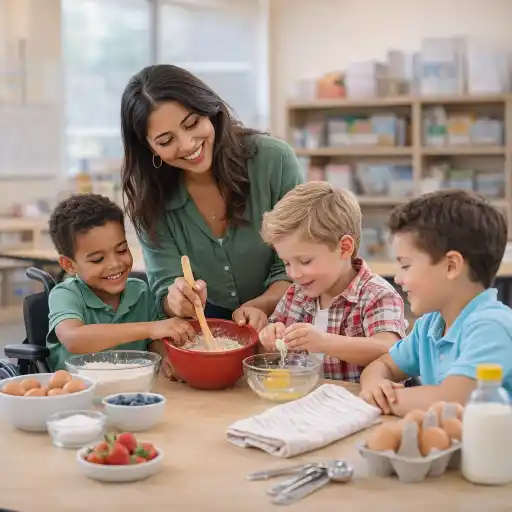
These choices make participation broader while keeping the sequence meaningful for every child.
How can you support language, sensory needs, and choice?
Recipe steps create natural opportunities to model words such as “first,” “next,” “place,” “top,” and “finished.” Narrate what is happening in short, concrete language: “First, we put the cracker on the plate. Next, we add the chocolate.” Then pause. Children can complete a phrase, select a picture, gesture, use a home language, or simply listen and observe.
Connect words to visible actions and objects. Hold up each picture as you describe it, and let children revisit the sequence as needed. If a child communicates a single word or gesture, respond by expanding it without demanding repetition: “Chocolate—yes, you chose the chocolate step.” Recipe sequences can help children organize ideas and practice storytelling, while the ChildCareEd article on recipe sequences and oral language offers related classroom ideas.
Sensory experiences vary from child to child. Some children enjoy touching soft or sticky ingredients; others may prefer to watch, use a utensil, or work with paper pictures. Make each option equally respected. Do not frame tasting as a measure of participation or success.
Choice also helps children feel agency:
- “Would you like to choose the next card or point while I place it?”
- “Would you like the picture or the pretend food?”
- “Do you want to watch this step, or help with it?”
Children may communicate preferences in different ways. Attend to their cues, offer genuine options, and give enough wait time for a response. This supportive approach keeps the activity engaging without placing pressure on children to speak, touch, or taste.
How do you protect safety without excluding children?
Safety planning is part of inclusion: children should have access to the activity, and staff should anticipate risks and put appropriate safeguards in place. Before any food-based activity, review current family information and program procedures for allergies, dietary restrictions, food handling, and choking hazards. Confirm ingredient labels and prevent cross-contact according to your program’s policies.
S’mores can include ingredients that are unsuitable for a particular child or inappropriate for some young children. Marshmallows can pose a choking risk, and any heating step adds another potential hazard. Never assume that an ingredient is safe for every child. Choose an alternative recipe or a pretend version when needed, and follow age-appropriate food guidance, individual care plans, and licensing requirements. State requirements vary - check your state licensing agency.
Use active supervision and make adult responsibilities clear. Children should not use an oven, microwave, hot surface, or sharp tool independently. If food is part of the activity, follow the applicable food-safety guidance for handwashing, clean surfaces, safe storage, and serving. The Institute of Child Nutrition’s Child Care Center Food Safety Guide provides a reference for food preparation practices in child care settings.
Before beginning, check that:
- Each child’s dietary and allergy information has been reviewed by responsible staff.
- Materials and tools are age-appropriate, stable, and within the planned supervision level.
- Children can participate without being required to handle or eat food.
- Staff know who is monitoring the group and who is handling food or equipment.
A paper-based sequencing activity can preserve the learning objective when food preparation is not safe or suitable.
How can you tell whether every child participated meaningfully?
Assess the learning process, not just the finished snack or a child’s ability to recite every step. Observe how each child engages: Do they recognize a picture, indicate what comes next, respond to a prompt, take a role, communicate a preference, or return to the activity after a break? These observations can show what support made participation possible.
Document specific examples rather than broad judgments. For instance: “Maya pointed to the cracker card after the teacher modeled the first step,” or “Jordan used the communication board to choose the next picture.” Note whether the child participated independently, with a visual cue, after modeling, or with physical assistance. Use these notes to plan a suitable next step, not to compare children with one another.
After the activity, offer a low-pressure retelling. Children might arrange cards again, act out the process with pretend ingredients, draw a step, or dictate a class recipe. A child who is ready can explain why a step comes next; another may show understanding by matching a picture to an object. Both can demonstrate learning.
Reflect with colleagues:
- Which materials supported participation, and which created a barrier?
- Did each child have a genuine choice of role or response?
- Were any sensory, communication, movement, or safety needs overlooked?
- What one adjustment would make the next activity more accessible?
For broader professional learning, ChildCareEd’s Tailoring Instruction to Children's Needs Buy Now $24.00 focuses on differentiation and scaffolding, while Food Preparation and Nutrition Buy Now $32.00$26.00 addresses food preparation, storage, and allergy prevention. Review course details and check whether training meets your program’s needs and local requirements.
Conclusion: What makes a cooking activity accessible?
An accessible cooking activity begins with a clear learning goal and a flexible path for children to reach it. In a s’mores sequencing project, children might arrange picture cards, direct an adult, communicate a choice, use pretend ingredients, or participate in a carefully planned food activity. These are all meaningful ways to engage with the sequence.
Plan around children’s strengths and needs: make steps visible, break tasks into manageable parts, offer communication and sensory options, adapt tools and positioning, and avoid making speech, food handling, or tasting a requirement. Pair those supports with careful allergy, choking, hygiene, and supervision practices. Then observe what helps each child participate and use that information to refine the next experience.
The central question is not whether every child completes the task in the same way, but whether every child has a safe, valued opportunity to contribute. Small, thoughtful modifications can turn a familiar classroom recipe into a more welcoming learning experience for the whole group.
If you would like to deepen your planning, explore Chef's in the Classroom Buy Now $24.00 for strategies on designing and adapting cooking activities. State requirements vary - check your state licensing agency.
- Building Equity: Inclusionary Practices in Preschool
- From Play to Planning: Building Culturally Competent, Child-Centered Curriculum
- Birth to Five CDA Credential with Portfolio Review
- Creating Engaging and Meaningful Learning Experiences
- Texas Director Credential
- Wellness in Action: Teaching Healthy Habits to Children
- Preventative Health and Safety
- Families, Communities, and Classrooms: Working Together for Children
- Chef's in the Classroom
- Celebrate the Joy of Reading on National Book Lovers Day
- Eat, Play, Grow: Essential Nutritional Tips for Growing Minds
- DIY Snow Globes: The Fine Motor Craft That’ll Keep Kids (and Adults) Busy for Hours
- How to Include Kids in the Kitchen
- CDA Certification en Español: Recursos y Consejos para Educadores Bilingües
- 💛🧩 ¿Cómo puedo hacer que mi enseñanza sea inclusiva para los niños con autismo?
- Proporciones de Cuidado Infantil y Tamaños de Grupo por Edad en Nueva Jersey (Guía Rápida para Centros y Hogares)
- Proporciones de Cuidado Infantil y Tamaños de Grupo por Edad en Virginia (Guía Rápida para Centros y Hogares)
- Celebrando la amistad en el cuidado infantil durante el Día de los Mejores Amigos
- Canciones, juegos y preguntas de círculo para niños
- How Can Simple Cooking Activities Teach Skills in North Dakota Child Care Programs?
- Made by Me! Labor Day Crafts for Preschoolers That Celebrate Hard Work
- Labor Day Crafts for School-Age Kids That Go Beyond Coloring Pages
- How Do Light vs. Heavy Activities Build Early Measurement Skills?
- What Should a 4-Year-Old Know Before Pre-K?
- How Can You Make a Classroom Cooking Activity Accessible to Children with Different Abilities?
- Beyond Color Matching: Letting Children Choose the Sorting Rule
- How Can You Adapt a Beginning-Sound Activity for Different Learning Needs?
- How Can Thanksgiving Classroom Activities Teach Nutrition and Healthy Eating?
- How Can November Classroom Observations Guide Developmentally Appropriate Activities?
