How to Include Children in the Kitchen: Fun and Educational Activities
Getting kids involved in the kitchen is not only a great way to bond, but it also offers valuable learning experiences. Cooking together can teach children important skills, including following directions, measuring ingredients, and applying early mathematical concepts. Here’s how you can include children in the kitchen in a safe and engaging way. Educators can explore Health and Nutrition  Buy Now $24.00 and Food Preparation and Nutrition Buy Now $32.00 for related professional learning; confirm whether any training applies to your role or program before relying on it for a requirement.
How Can Cooking Become a Hands-On Learning Experience?
Involving kids in cooking Buy Now $24.00 can help them develop essential life skills. Here are a few ways to make it educational:
- Measuring Ingredients: Have children help with measuring flour, sugar, or liquids. This introduces them to basic math concepts like counting and volume.
- Following Recipes: Let them follow a recipe step by step, helping with reading and comprehension.
- Understanding Food Groups: Talk about the nutritional value of different ingredients and why they're important for health.
How Can Educators Keep Kitchen Activities Safe?
Safety is a priority when involving children in the kitchen. To ensure a safe cooking experience:
- Set up before children arrive: Choose a clear work surface, gather stable child-height tools, and keep hot appliances, sharp knives, and cleaning products inaccessible. Explain which areas and tools are off-limits before the activity starts.
- Match tasks to the child: Consider each child’s motor coordination, attention, and experience rather than relying on age alone. Offer washing produce, tearing greens, stirring cool ingredients, or scooping with a spoon; reserve heat and sharp-tool tasks for an adult unless the setting’s policies allow a carefully supervised alternative.
- Manage food hygiene and allergies: Have children wash their hands, clean the work area, and use clean utensils. Check ingredient and family-provided allergy information before serving; prevent cross-contact by keeping ingredients and utensils separate when needed.
- Maintain active supervision: Position yourself to see and reach each child, explain a simple stop-and-wait signal, and handle hot cookware and appliances yourself. Follow your program’s food-safety procedures and applicable licensing requirements.
Before beginning, review the activity for choking and allergy concerns, adapt ingredients and tools to the children participating, and communicate with families about relevant dietary needs. These steps keep the focus on exploration without treating children’s participation as a substitute for adult responsibility.
- Supervision: Always supervise children closely, especially around sharp knives or hot surfaces.
- Age-Appropriate Tasks: Younger children can help with washing vegetables or stirring, while older kids can handle chopping with a safe, child-friendly knife.
- Cleanliness: Teach kids the importance of washing their hands and cleaning up as they go.
How Can Children Explore Creativity in the Kitchen?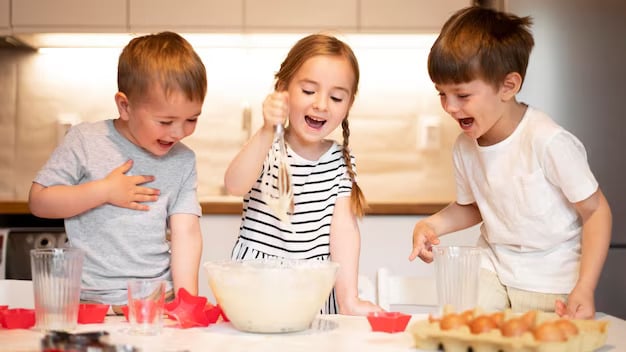
Let children get creative with their cooking. Whether it’s decorating cookies or creating their own sandwich, encouraging kids to be imaginative in the kitchen fosters creativity and independence.
Open-ended choices make this exploration meaningful: invite children to select between two fruits, arrange ingredients into a pattern, or describe how a food smells, feels, or tastes. Respect a child’s decision not to taste something; participation can also mean observing, preparing, or talking about the food. Avoid presenting tasting as a test or requiring children to eat what they make.
How Can Cooking Activities Support Different Areas of Development?
A cooking activity can connect several learning domains at once when educators name the ideas children are exploring and allow time for conversation:
For sensory exploration beyond food preparation, educators can try taste-safe mud play as a hands-on way for children to investigate texture.
- Early math: Count scoops, compare full and empty containers, notice more and less, and describe shapes or sequences. Use measuring as a comparison activity rather than expecting young children to read precise quantities independently.
- Language and literacy: Introduce ingredient names, action words, and descriptive vocabulary. Invite children to predict what comes next, retell the steps, or make a picture-based sequence of the recipe.
- Science and sensory inquiry: Observe changes in color, texture, smell, or form as ingredients are mixed or mashed. Ask open questions such as, “What do you notice?” and “What might happen if we stir?”
- Social-emotional learning: Practice turn-taking, requesting a tool, sharing a task, and responding to a peer’s idea. Offer roles so every child can contribute without competing for a single job.
- Fine-motor development: Use safe, manageable actions such as pinching, pouring, stirring, and spreading with a blunt utensil. Adapt materials and provide assistance to support each child’s access and participation.
For a related look at how everyday kitchen tasks can build learning, see how simple kitchen activities teach valuable skills to young children. Educators can also connect food preparation to early STEM learning through cooking and exploration.
- Decorating Foods: Let kids decorate their plates, cookies, or cupcakes with colorful sprinkles, frosting, or fruit.
- Exploring Flavors: Allow children to try out new ingredients and experiment with flavors, making the cooking process fun and exploratory.
How Can Educators Plan Cooking Activities That Support Learning?
At ChildCareEd, we offer a CDA Training Program that can help early childhood educators incorporate cooking and other hands-on activities into their learning environments. By understanding child development and engagement, educators can better facilitate cooking activities that foster growth and learning.
How Can Educators Adapt Cooking Activities for Different Children?
Plan for participation rather than a single expected result. Offer more than one way to take part: a child may wash produce, point to a picture, choose an ingredient, stir with support, or watch before joining. Use large, stable bowls and utensils that are easy to grip, place materials within reach, and give instructions one step at a time. For children who benefit from visual cues, show the ingredients and a simple sequence of pictures before beginning.
Consider sensory preferences and cultural context when choosing ingredients and describing foods. Let children observe or handle an unfamiliar ingredient without pressure to taste it, and invite families to share food traditions or relevant dietary information. When a child has an allergy, feeding concern, or individualized support plan, coordinate with the family and follow the program’s established procedures before selecting ingredients or assigning tasks.
Keep the activity focused and flexible: a short preparation task may be more appropriate than completing a full recipe. If a child loses interest, offer another role or let them rejoin later. The educational value comes from meaningful participation, conversation, and exploration—not from producing a perfect dish.
How Can Educators Choose a Simple Kitchen Activity?
Start with a no-heat recipe or food-preparation task that fits the children’s abilities, the available space, and the program’s food policies. For example, children can assemble a fruit pattern, layer ingredients in a cup, or mix a simple dip with an adult handling any equipment that presents a hazard. Review the ingredients and steps in advance, check dietary information, and prepare a clean, uncluttered work area.
During the activity, assign clear roles, model one step at a time, and use open-ended prompts such as “What do you notice?” or “How could we arrange these pieces?” Allow time for children to make choices and communicate their observations. Afterwards, invite them to describe what they did, help with age-appropriate cleanup, and revisit the learning through a drawing, story, or conversation.
For ideas related to food acceptance and nutrition, educators may also find healthy cooking strategies for children who are selective eaters and ways to teach nutrition and healthy eating habits useful. For seasonal ideas, educators can also review healthy holiday eating habits for children and families. For further safety context, see guidance on safe food preparation and mealtimes and how food safety training can protect children.
Explore More Resources at ChildCareEd.com
For more ideas on how to engage children in everyday activities, visit our Resource Page for practical tools and tips on enhancing learning through play, cooking, and more.
Read More Articles on Early Childhood Education
Check out our Articles Section for additional insights on fostering creativity and development in children through fun activities, including cooking.
Follow Us for More Fun Ideas
Want more ideas to inspire fun and educational activities with kids? Follow us on our social media platforms:
Call to Action: Follow us for more creative and educational tips to engage children in meaningful learning activities!
How Can Educators Carry These Ideas Into Practice?
Including kids in the kitchen is a wonderful way to teach them valuable skills, from math and science to creativity and teamwork. With the right guidance and safety precautions, children can enjoy cooking and gain a greater appreciation for healthy food. Start exploring these fun activities today with ChildCareEd and discover how to make the most of every learning opportunity.
- CDA Preschool Credential with Portfolio Review
- CDA Infant/Toddler Credential
- Birth to Five CDA Credential with Portfolio Review
- CDA Family Child Care Credential with Portfolio Review
- CDA Infant/Toddler Credential with Portfolio Review
- CDA Bridge Bundle: Family Child Care without Portfolio Review
- CDA Bridge Bundle: Infant/Toddler without Portfolio Review
- CDA Bridge Bundle: Preschool without Portfolio Review
- Creating Environments that Nurture Growth and Community
- DIY Snow Globes: The Fine Motor Craft That’ll Keep Kids (and Adults) Busy for Hours
- How to Include Kids in the Kitchen
- Encouraging better nutrition for growing kids during the colder months
- CDA Certification en Español: Recursos y Consejos para Educadores Bilingües
- 🥦✨ ¿Cómo apoyar a los niños selectivos a probar nuevos alimentos sin presión?
- ¿Cómo afecta la dopamina a los niños: señales, efectos e influencias diarias?
- 10 Ejemplos de Cómo la Cultura Influye en el Desarrollo Infantil
- ¿Cómo solicito la licencia para una guardería en California?
- Regulaciones de Licenciamiento de Cuidado Infantil en California para Centros y Hogares de Cuidado Infantil Familiar
- Lista para Abrir una Guardería en Casa en Dakota del Norte: Cómo Empezar
- Lista para Guardería en Casa en California: Cómo Iniciar una Guardería en el Hogar
- Lista para Guardería en Casa en Texas: Cómo Iniciar una Guardería en el Hogar
- Cómo Ser Maestra de Preescolar en Illinois
- Sweet National Ice Cream Day Activities Kids Will Love
- Pool Noodle Sea Creatures: A Fun Ocean Craft for Preschoolers
- How can Florida child care providers celebrate National Ice Cream Day safely and with learning fun?
- How can Alabama child care providers celebrate National Ice Cream Day safely and with learning?
- How Can Simple Cooking Activities Teach Skills in North Dakota Child Care Programs?
- Can simple kitchen activities teach valuable skills to young children in child care settings?
- How can child care programs handle picky eaters without mealtime battles?
