Fall applesauce-making can be more than a seasonal treat: it can give children meaningful choices, real responsibilities, and rich opportunities to learn. Explore ways to turn each step into hands-on learning, while the Chef's in the Classroom course  Buy Now $24.00 offers providers practical guidance for planning developmentally aligned cooking activities and adapting them to children’s needs. Read on for strategies you can use with an Applesauce Picture Recipe and Cooking Job Board to help every child take part.
Why is child-led cooking worth the planning?
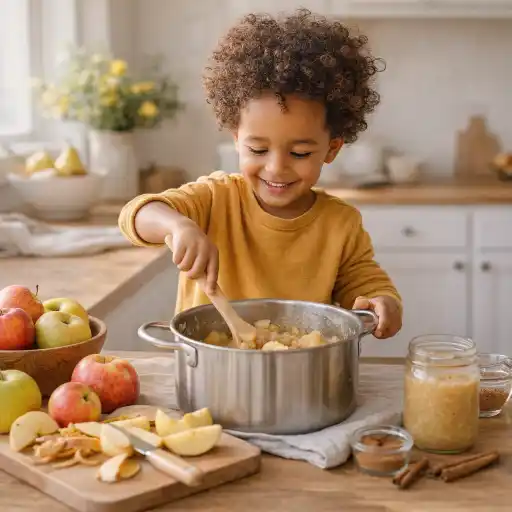
When children help prepare food, they have a purpose beyond watching an adult work. Washing apples, choosing a job, following picture steps, and mashing cooled fruit invite children to make decisions and see how their contributions matter. Cooking also creates natural practice in communication, cooperation, early math, sensory exploration, and small-muscle coordination. These experiences can support confidence and curiosity without requiring a complicated recipe.
Child-led does not mean unsupervised or without structure. The educator sets clear safety boundaries and prepares the environment, then makes room for children to choose among appropriate roles and explore at their own pace. A picture recipe supports predictability and lets children anticipate what comes next. The ChildCareEd guidance on cooking in the classroom likewise describes how cooking can connect counting, sequencing, science, language, and confidence.
Most of all, the focus shifts from producing a perfect batch to supporting children’s process. A little mess, a slower pace, and a lumpy result can all be part of worthwhile learning.
How can you prepare a safe, inviting applesauce activity?
Begin with your program’s food policies and children’s individual needs. Check family-provided allergy and dietary information, review ingredient labels, and plan to prevent cross-contact. Ask families about relevant restrictions or cultural considerations as needed. Choose equipment that is sturdy and appropriate for children’s ages and abilities, and keep hot equipment and sharp tools under adult control.
For a simple classroom version, gather apples, water, a large pot or slow cooker, bowls, and a potato masher or sturdy fork. Optional seasonings such as cinnamon can be offered only when suitable for the group. The Massachusetts Farm to School applesauce guide suggests involving children in washing apples, preparing pieces with appropriate tools and supervision, observing the cooking process from a safe distance, and mashing only after the fruit has cooled sufficiently.
- Set up a clean work area and wash hands before food preparation.
- Prepare picture steps and job choices before children arrive.
- Keep hot appliances, steam, and adult-use cutting tools inaccessible to children.
- Provide an alternative way to participate if tasting or food handling is not appropriate for a child.
State requirements vary - check your state licensing agency. Follow your program’s procedures for supervision, food preparation, serving, and storage.
How do picture recipes and job boards support children’s agency?
A picture recipe turns a multistep process into something children can see, revisit, and help direct. Arrange clear images in sequence—wash, prepare, cook, cool, mash, and serve—and pair them with brief words. Invite children to point to the next picture, describe what they notice, or move a marker after a step is complete. This supports sequencing and early literacy without expecting children to read conventional text.
A cooking job board makes participation visible and fair. Offer a small set of meaningful tasks, rotating roles so children have opportunities to contribute without crowding around one tool or station. Jobs might include apple washer, picture-step helper, ingredient counter, stirrer (before cooking), table setter, or cleanup partner. Children can select a role, choose between two options, or communicate a preference by pointing or using their usual communication supports.
- Keep choices concrete: “Would you like to wash apples or set out bowls?”
- Use photographs or simple illustrations that children can recognize.
- Let children observe first or take a brief turn; participation need not look identical.
- Use the board to show whose turn comes next and what has already been completed.
Use the Applesauce Picture Recipe and Cooking Job Board resource as a planning aid, adapting its visuals and roles to your group and program routines.
What learning can children discover at each step?
Cooking provides authentic reasons to use concepts that may otherwise feel abstract. As children count apples or bowls, they practice one-to-one correspondence. As they compare a large apple with a small one, they use early measurement language. Picture steps offer a meaningful context for “first,” “next,” and “last,” while conversation builds vocabulary: crisp, peel, core, steam, soft, mash, and smooth.
Children can also observe cause and effect. Invite them to make a prediction: What might happen to firm apple pieces after cooking? From a safe distance, they can notice changes in texture, smell, and appearance. Once the fruit is cooled, mashing lets children compare how their actions change its consistency. These observations connect sensory exploration with early science.
- Math: count apples, compare sizes, and notice how many bowls are needed.
- Literacy and language: follow picture directions, name actions, and retell the process.
- Science: observe how heat softens fruit and how mashing changes its texture.
- Social learning: share materials, wait for turns, communicate choices, and help clean up.
Describe what children are doing and ask open questions rather than testing for a right answer: “What changed?” “What do you notice?” or “What should happen next?” As guidance on planning food activities with children explains, weighing, mixing, talking about actions, and exploring textures can all provide learning opportunities.
How can you make participation inclusive and respectful?
Children differ in motor skills, communication, sensory preferences, attention, and food experiences. Plan several ways to contribute rather than treating tasting or touching as a measure of success. A child may choose the next picture, count from a seat, watch the cooking from a comfortable distance, stir a cool ingredient, or help set the table. Each role can be meaningful when it connects to the shared activity.
Offer tools and supports that match children’s needs: a stable bowl, a non-slip mat, a larger-handled utensil, a visual “finished” cue, or extra time to respond. Model each task and use short, concrete language. Invite children to explore the apples with their senses, but respect a child who prefers to observe rather than touch or smell. Never pressure a child to taste; tasting is an option, not a requirement.
Food activities should also honor family knowledge and cultural context. Share the plan with families, invite relevant ideas when appropriate, and explain that ingredients and participation options will be adjusted to suit children’s needs. Avoid labeling a child as “picky” or praising only those who eat; notice curiosity, communication, and effort instead. These choices help build a welcoming experience where children can participate with dignity.
What common pitfalls can providers avoid?
Cooking activities become stressful when adults try to do too much at once. A long wait while apples cook can be difficult for young children, so plan another activity—such as an apple story, sorting apples by color, drawing an observation, or revisiting the picture sequence. Pre-measure ingredients or complete adult-only preparation ahead of time, while saving safe, purposeful tasks for children.
Other pitfalls are easy to prevent with clear planning:
- 🍎 Rushing participation: use small groups, short turns, and a job board so children are not waiting in a crowd.
- Letting the finished food become the only goal: notice questions, cooperation, and exploration along the way.
- Overlooking allergies or cross-contact: review current child information, ingredients, and program procedures before starting.
- Allowing access to hazards: adults manage sharp tools, hot surfaces, cooking vessels, and hot food; supervise actively.
- Expecting every child to taste: provide observation and non-tasting roles as valid participation.
After the activity, reflect briefly with the team: Which roles engaged children? Where did they need more support? What would you change next time? Notes from these observations can help you plan a more responsive experience for the next group.
Conclusion: How can applesauce-making become child-led learning?
Fall applesauce-making becomes a child-led learning experience when providers prepare carefully, make the steps visible, and share genuine choices with children. Picture recipes and job boards can support sequencing, turn-taking, communication, and growing independence. Simple tasks—washing, counting, choosing a role, observing, mashing cooled apples, and helping clean up—connect the seasonal activity to meaningful learning across developmental areas.
Keep safety and inclusion at the center: check allergies and dietary needs, supervise closely, keep heat and sharp tools in adult hands, and make tasting optional. The aim is not a flawless recipe. It is a warm, manageable experience where each child can contribute in a way that feels safe, engaging, and worthwhile.
References
- Planning food activities with children
- We must make time to cook in our nurseries
- Cooking Corner: Making Applesauce (Early Care & Education)
- Making Applesauce in the Classroom
- Cooking in the Classroom
- Making Classroom Cooking Accessible to Children with Different Abilities
- Cooking with Kids Safely and Simply
- Chef's in the Classroom Buy Now $24.00
- Cooking With Preschoolers
- How to Incorporate Cooking in Your Classroom
- Apple Preschool Theme: Activities and Learning Center Ideas
- Food Activities at Free Choice in Preschool
- Cooking Interest Center in Preschool
- What Kids Learn While Cooking
- Super Quick and Easy Applesauce Recipe for Kids
- Making Applesauce in the Classroom
- Kids in the Kitchen
- 45 Hour Child Growth and Development
- CDA Home Visitor Subject Area 3 Part 3 Birth to 5
- The ABCs of Behavior: Turning Challenges into Learning Opportunities
- Children at the Wheel: Emergent Curriculum
- Creating Engaging and Meaningful Learning Experiences
- Sensitive Periods in Montessori: Guiding Natural Learning
- Wellness in Action: Teaching Healthy Habits to Children
- Ways to Serve: Leadership
- Professional Integrity in Child Care
- CDA Certification en Español: Recursos y Consejos para Educadores Bilingües
- Cómo Abrir Una Quardería En Casa Sin Dinero?
- Requisitos Para Ser Maestra Principal En Un Daycare: Lo Que Necesitas Para Empezar
- 10 Ejemplos de Cómo la Cultura Influye en el Desarrollo Infantil
- Normas de Licenciamiento de Cuidado Infantil en Virginia para Centros Diurnos Infantiles y Hogares Diurnos Familiares
- Proporciones de Cuidado Infantil y Tamaños de Grupo por Edad en Nueva Jersey (Guía Rápida para Centros y Hogares)
- Proporciones de Cuidado Infantil y Tamaños de Grupo por Edad en Virginia (Guía Rápida para Centros y Hogares)
- Actividades de Otoño Fáciles para Preescolares esta Temporada
- Lista para Guardería en Casa en Texas: Cómo Iniciar una Guardería en el Hogar
- Cómo Trabajar en el Cuidado Infantil en Wisconsin: Requisitos y Pasos
- Cómo Ser Maestra de Preescolar en Illinois
- Cómo Ser Maestra de Preescolar en Wisconsin
- Cómo Ser Maestra de Preescolar en California
- Cómo Ser Maestra de Preescolar en Maryland
- Capacitación CDA gratuita en Illinois
- Canciones, juegos y preguntas de círculo para niños
- Cómo simplificar la capacitación para sus empleados de daycare
- ¿Todos los niños deben participar en el tiempo de círculo?
- ¿Faltan Materiales o Falta una Nueva Estrategia? Cómo Revisar los Rincones del Aula
- How Can Fall Applesauce Cooking Become a Child-Led Learning Experience?
