When a ramp test changes the car, surface, and height all at once, children may see an exciting result—but it is hard to tell what caused it. A thoughtful setup can keep their curiosity alive while helping them make clearer comparisons; [Building Early Science Foundations](https://www.childcareed.com/courses-building-early-science-foundations-3921.html) offers practical ideas for nurturing developmentally appropriate inquiry, exploration, and experimentation. For educators who want to strengthen science teaching more broadly, [Basic Science in Early Childhood](https://www.childcareed.com/courses-basic-science-in-early-childhood-3744.html) provides additional guidance for planning meaningful experiences that support children’s scientific reasoning.
Ramp play naturally invites children to redesign, adjust, and try again. The goal is not to stop that joyful experimentation, but to help children distinguish free exploration from a focused comparison. When several features change at once, the group cannot confidently say which change influenced the outcome. With a few simple planning moves, providers can honor children’s ideas and make the next test easier to understand.
Why does fairness matter in a ramp investigation?
A fair test helps children make a reasonable connection between a change and an observed result. If the question is whether ramp height affects how far a car travels, changing the height while keeping the car, ramp surface, release point, and measuring method consistent makes the comparison more informative. When the surface and car change too, the results may reflect several influences rather than height alone.
For young children, fair testing is not about demanding perfect scientific control or using technical vocabulary before they are ready. It is a scaffold for careful noticing: “What did we change? What happened? What stayed the same?” These questions support early reasoning, prediction, comparison, and communication. They also help children learn that one surprising trial does not settle a question.
Ramp investigations are especially useful because changes are visible and easy to discuss. A car may travel farther on a steeper ramp, while a rough surface may slow it down. A fair-test overview explains the value of changing one factor and keeping other relevant conditions consistent. In practice, the adult’s role is to make a test manageable—not to take over the children’s discoveries.
What should children change, measure, and keep the same?
Start by naming three kinds of variables in everyday language. The independent variable is what children deliberately change. The dependent variable is what they observe or measure. Controlled variables are the relevant conditions they try to keep the same. A simple planning chart makes these ideas concrete and can be revisited as children propose new versions of the activity.
- Change: Choose one feature, such as ramp height, ramp surface, or the type of object.
- Notice or measure: Decide what result to compare, such as whether the car reaches a marker or how far it rolls after leaving the ramp.
- Keep consistent: Use the same release point, avoid giving the car a push, and use the same measuring method.
For example, ask, “Does a higher ramp help this car travel farther?” Keep the same car and ramp surface, release it without a push from the same starting mark, and compare where it stops. If children want to investigate a different car or a rough covering, save that question for another round. A variables-planning guide offers a useful framework: change one thing, observe the outcome, and keep other relevant conditions the same.
Not every detail needs to be controlled. Choose conditions likely to influence the result and practical to keep consistent. For example, decorative tape color is unlikely to matter in a car-distance comparison; the ramp’s steepness and release point may matter considerably.
How can you respond when children change several things at once?
Several changes at once are not a mistake in open-ended play. Children are designing, testing, and noticing what interests them. Instead of stopping the play or declaring the result invalid, acknowledge the discovery and help the group decide whether it wants to explore freely or answer a more specific question. That distinction preserves children’s agency while building a shared understanding of why a focused comparison can be helpful.
Try language that is curious rather than corrective:
- “You made the ramp taller and added a bumpy surface. What do you think helped the car go farther?”
- “We changed two things, so we cannot tell which one made the difference yet. Which one should we test by itself?”
- “Let’s keep this version as your design, then make a second test where only the height changes.”
Children can first enjoy the combined changes, then return to one part of the question. A simple comparison might use two otherwise matching ramps, one smooth and one covered with a safe, secured texture, with identical objects released in the same way. Or keep one ramp and car constant while adjusting only the height. Early science resources such as Cars and Ramps encourage predictions, experimentation, and discussion while recognizing that preschoolers benefit from focused variations.
Children may need to repeat a trial to notice a pattern. If the results differ, record what happened without blaming the child; the release may have included a push or the ramp may have shifted. Treat that information as a prompt for the next attempt.
How can you plan a simple, child-centered fair test?
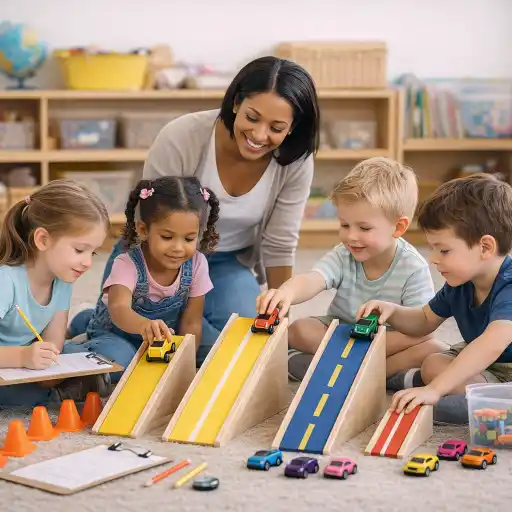
A short planning routine can make ramp investigations clearer without turning play into a worksheet exercise. Before the test, invite children to choose a question and make a prediction. Identify one feature to change and agree on what to observe. Then set up the materials together, conduct several trials when time and interest allow, and compare what happened with the prediction.
- Ask one testable question: “Will the car travel farther when this ramp is higher?”
- Choose one change: Adjust only the ramp height.
- Set the comparison: Keep the same car, surface, release point, and measuring approach.
- Predict and test: Invite children to say, draw, gesture, or point to what they expect.
- Document and discuss: Mark the stopping place, use blocks or picture symbols, or photograph each trial.
Make the setup accessible and engaging. A ramp can sit on a low table or another stable surface, and children can take different roles: releasing the car, placing a marker, observing, or recording. Offer ways to participate beyond spoken explanations, including drawings, gestures, home-language responses, or adult dictation.
Children’s reasoning matters more than a polished result. A ramp exploration activity recommends beginning with a pre-built ramp and gradually inviting children to build their own. This lets them gain familiarity before navigating more complex designs. Providers can also use a STEM-focused professional learning course  Buy Now $16.00 to extend thinking about developmentally appropriate exploration with younger children.
What common pitfalls can make ramp results confusing?
Ramp activities can become busy quickly: children are eager to swap cars, rebuild the track, and race toward the farthest marker. That energy is a strength, but a few predictable pitfalls can make it difficult to interpret a comparison. Rather than insist that children follow a rigid procedure, explain the purpose of the focused test and preserve time for free exploration before or after it.
- Changing multiple variables: If height, surface, and car all change, pause and choose one feature for the next comparison.
- Pushing one object: A push changes the starting conditions. Invite children to place the object at a clear mark and gently release it.
- Using different starting points: Mark where each object begins so trials are more comparable.
- Relying on one result: Try again when practical; repetition helps children notice whether a pattern is consistent.
- Overcorrecting children: Avoid saying that their play is “wrong.” Describe what changed and ask how they want to investigate next.
Also be mindful of safety and developmental fit. Secure ramps so they do not slip, supervise active play, and select objects appropriate for the children’s ages and mouthing behaviors. Small parts can pose a choking hazard for young children; choose safe alternatives and follow your program’s procedures. State requirements vary - check your state licensing agency.
Finally, do not treat a prediction that differs from the result as failure. Children are learning to use evidence. Ask, “What did we find out?” and “What would you like to try next?” Those questions invite revision and keep the investigation collaborative.
How can educators turn results into further learning?
Once children have tested a ramp, help them tell the story of their investigation. Revisit the question, prediction, setup, and result. Invite children to point to the trial that surprised them or explain what they noticed. Use simple representations—a line on the floor, a block placed where the car stopped, a drawing, or a photograph—to make comparisons visible.
Documentation does not need to be elaborate. A shared chart might include “What we changed,” “What we noticed,” and “What we might test next.” Record children’s exact words when possible, including uncertainty and disagreement. If one child thinks the higher ramp made the car go farther and another believes the smoother surface mattered, those ideas can become separate questions for future tests.
Ramp exploration can connect science with mathematics, language, and engineering. Children can compare near and far, count trials, describe surfaces, build stable structures, and explain how changing one part affects another. The ramps-and-blocks STEM discussion illustrates how extended play can support problem-solving and communication alongside physical science. Free exploration remains valuable; a focused fair test is one tool within a larger cycle of wondering, designing, testing, and revising.
To extend staff practice, consider [Tomorrow’s Einsteins: Infant and Toddler Science](https://www.childcareed.com/courses-tomorrow-s-einsteins-infant-and-toddler-science.html), [Enhancing STEM Education for Infants and Toddlers](https://www.childcareed.com/courses-enhancing-stem-education-for-infants-and-toddlers-3932.html), and [Children at the Wheel: Emergent Curriculum](https://www.childcareed.com/courses-children-at-the-wheel-emergent-curriculum.html). Each offers a different lens for supporting curiosity, exploration, and child-led learning in early childhood settings.
Conclusion: How do you keep ramp experiments fair and playful?
Keep ramp investigations fair by helping children focus a comparison: change one feature, notice or measure a clear outcome, and keep relevant conditions consistent. When children change several things at once, welcome the experiment as exploration, then invite them to choose one variable to test in a follow-up. This approach respects children’s creativity while strengthening their ability to connect evidence with an explanation.
Start with a question children care about, use simple materials, document what happens, and make room for repeated tries. Above all, treat unexpected results as useful information. A ramp investigation is not about producing a perfect race; it is an opportunity to practice #curiosity, #observation, #variables, #evidence, and #inquiry through joyful, hands-on learning.
Five relevant ChildCareEd courses
- Children at the Wheel: Emergent Curriculum
- CDA Bridge Bundle: Preschool
- 45 Hour School Age Methods and Materials
- CDA Bridge Bundle: Family Child Care
- CDA Bridge Bundle: Family Child Care without Portfolio Review
- CDA Bridge Bundle: Infant/Toddler without Portfolio Review
- CDA Bridge Bundle: Preschool without Portfolio Review
- CDA Bridge Bundle: Infant/Toddler
- Texas Director Credential
- CDA Certification en Español: Recursos y Consejos para Educadores Bilingües
- 💛🧩 ¿Cómo puedo hacer que mi enseñanza sea inclusiva para los niños con autismo?
- Recursos en Español sobre el Sueño Seguro del Bebé
- Proporciones de Cuidado Infantil y Tamaños de Grupo por Edad en Nueva Jersey (Guía Rápida para Centros y Hogares)
- Proporciones de Cuidado Infantil y Tamaños de Grupo por Edad en Virginia (Guía Rápida para Centros y Hogares)
- Por Qué la Supervisión Activa Es Clave para la Seguridad en el Cuidado Infantil
- Retraso del Habla en la Guardería: Cómo Pueden Ayudar los Proveedores
- Easy Ways to Add STEM to Your Preschool Classroom
- How can preschool teachers safely use summer weather and cloud activities with kids in Oklahoma?
- How can I use STEM activities in my Preschool and Pre-K classroom?
- How can child care providers use simple STEM activities with early learners?
- Celebrando la amistad en el cuidado infantil durante el Día de los Mejores Amigos
- Canciones, juegos y preguntas de círculo para niños
- La mejor manera de hacer seguimiento a la capacitación de su equipo de daycare How to Organize Staff Training for Your Child Care Center Cómo organizar la capacitación del personal para su centro de cuidado infantil
- Cómo simplificar la capacitación para sus empleados de daycare
- How can child care providers teach hands-on STEAM with everyday materials?
- How can we teach preschoolers to ask better questions and make predictions?
- How can we encourage scientific thinking through hands-on exploration?
- STEM for Preschoolers: What to Do When the Experiment Doesn’t Work
- How Can You Keep Ramp Experiments Fair When Children Change Several Things at Once?
