When a block rolls unexpectedly—or a can wobbles to a stop—children are already asking meaningful questions about shape, movement, and cause and effect. Try the Early Mathematics Through Play Buy Now $24.00 course to strengthen your strategies for bringing geometry, comparison, and mathematical reasoning into hands-on classroom experiences. The simple investigation below offers an easy starting point for turning everyday objects into a lively math inquiry.
Why does comparing how shapes travel matter?
Rolling, wobbling, sliding, and stopping are observable events that give young children a concrete way to explore geometry and motion. Instead of memorizing shape names in isolation, children examine what objects do, describe what they notice, and connect an object's features to its movement. A sphere and a cube are not only different labels: their surfaces and edges influence how they travel across a surface.
This kind of investigation supports several areas of learning at once. Children practice predicting, observing, comparing, sorting, using descriptive language, taking turns, and revising an idea when evidence surprises them. They may also count how many objects roll, mark results on a chart, or compare how far two objects travel. These experiences make #math visible in play and affirm that children can develop explanations through careful exploration.
Providers do not need elaborate equipment or a perfect lesson plan. A few safe, familiar materials and thoughtful questions can turn a short activity into a meaningful learning experience. The goal is not to get every child to state the same conclusion, but to help them notice patterns and communicate their thinking.
How can you set up a roll, wobble, or stop investigation?
Choose a clear, low-traffic area and gather a small collection of safe objects with different three-dimensional shapes. For example, use a soft ball, a large wooden cube, a short cardboard tube, a sturdy block, and a clean, empty container. Avoid small pieces with children who may mouth materials, and check that objects are clean, intact, and appropriate for the group.
Use a flat floor or a low ramp made from a sturdy board or tray supported securely by blocks. Keep the ramp low and stable, and have children release objects from the same starting line. First let each child inspect an object, name or describe its shape, and predict what it might do. Then test one object at a time and record the result with simple words, drawings, or symbols.
- Invite children to predict: “Will it roll, wobble, slide, or stay where it is?”
- Test each object under the same conditions, then repeat if its movement was hard to observe.
- Compare results and ask children what features they notice.
- 📏 Use a tape line or floor markers to compare how far objects travel, if appropriate.
Keep the experience flexible. Some objects may roll briefly, wobble, and then stop; more than one description can accurately capture what happened.
What do rolling, wobbling, and stopping reveal about shape?
A sphere can generally roll in many directions because its curved surface has no flat face that must remain against the floor. A cylinder can roll along its curved side, while its flat ends can help it stop or stand. A cube or rectangular block usually slides when pushed and may stay in place when set on a flat face. Yet real-world outcomes also depend on how an object is positioned, how strongly it is pushed, and the surface it travels across.
Wobbling is a useful observation, not a wrong answer. An object that is uneven, rounded in only one direction, or poorly balanced may move in an irregular path. Children can compare a round ball with an imperfect homemade ball and see how a change in shape affects its movement. The ball inquiry documented by Eastern Connecticut State University's Center for Early Childhood Education shows how children can develop more nuanced ideas as they repeatedly investigate movement, textures, ramps, and materials.
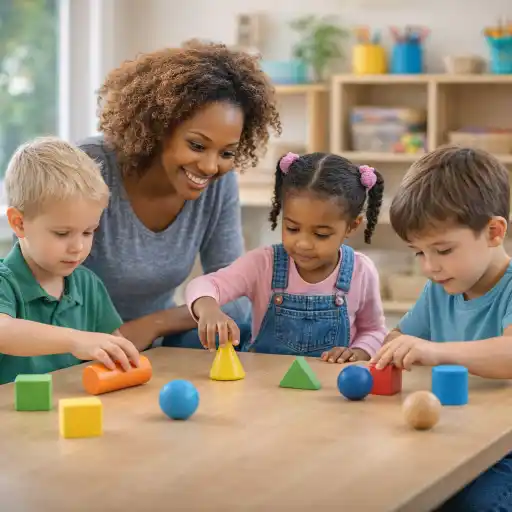
Introduce vocabulary in context: “curved,” “flat,” “edge,” “roll,” “slide,” and “wobble.” Pair the word with a gesture or demonstration, then encourage children to use whichever words communicate their observations. A useful reference for educators is the roll-or-slide shape activity, which emphasizes predicting whether three-dimensional forms will roll, slide, or remain in place.
How can you extend the activity with questions and variations?
Once children have tried the basic investigation, invite them to change one feature at a time. A gentle ramp can become slightly steeper, or objects can travel over a smooth mat and then a textured one. Ask children to predict what will change and compare the evidence. When the ramp's height or surface changes, children can notice that movement is influenced by more than shape alone.
- “What do you notice about the side touching the floor?”
- “Which object rolled most smoothly? What makes you think so?”
- “Did anything wobble before it stopped?”
- “What could we change to test your idea?”
- “How could we sort these objects in another way?”
Children can make a class chart with columns for roll, wobble, slide, and stay still. For younger learners, use pictures or place each object beside its result rather than asking for written labels. Older preschoolers might draw a result, count objects in each group, or explain a sorting rule. These options help providers respond to different developmental levels and communication styles.
Everyday connections make the concept stick. Look for cylinders, spheres, and box-shaped forms in the classroom, during a walk, or while putting away materials. NAEYC's everyday shapes ideas offer examples of noticing three-dimensional shapes in familiar objects such as cans, fruit, and cardboard tubes.
How can providers make the investigation inclusive and safe?
Plan access to the activity, not just access to the materials. Put objects within reach, provide a stable surface, and offer choices for participating: a child might point to a prediction, use a picture card, direct an adult to release an object, or describe a result verbally or through gesture. Children can work with partners, observe from a comfortable distance, or take a brief turn when ready. These adaptations preserve the central learning goal while honoring individual strengths.
Keep expectations clear and supervision active, especially when children are handling objects or using a ramp. Use large materials that are not choking hazards, keep the testing area uncluttered, and ensure the ramp cannot tip or slide. Set a simple boundary such as “Objects travel down the ramp; we do not throw them.” If children become excited, pause to reset the space and model safe handling.
Watch for common pitfalls: rushing to label every result, correcting children before they can explain, changing several conditions at once, or treating a prediction that differs from the outcome as a failure. Instead, say, “You thought it would roll; what did you notice?” and invite another test. State requirements vary - check your state licensing agency for applicable supervision, materials, and activity expectations.
Conclusion: What should educators take away?
How can children investigate which everyday shapes roll, wobble, or stop? Give them safe objects to handle, invite a prediction, test one variable at a time, and make room for close observation and discussion. Children learn that an object's shape can influence its movement, while the surface, position, and force also matter.
- Use everyday materials and a stable, low testing surface.
- Encourage predictions, comparisons, and explanations instead of focusing on right-or-wrong answers.
- Build vocabulary and early data skills through gestures, charts, drawings, and conversation.
- Adapt participation and materials so every child can explore safely.
Small investigations can create rich mathematical experiences when educators make children's thinking visible and follow their curiosity. For a broader set of practical approaches to geometry, measurement, and reasoning through play, explore the Early Mathematics Through Play course Buy Now $24.00.
Additional English-language ChildCareEd courses that may support related practice:
- No Such Thing as Boring Math
 Buy Now $24.00
- Math Foundations in Early Childhood Buy Now $16.00
- Basic Science in Early Childhood Buy Now $25.00
- The Best Promotion is Play Buy Now $24.00
Explore the ChildCareEd website for the Roll or Wobble Shape Investigation Mats, a resource to feature alongside this activity.
- 45 Hour Child Growth and Development
- CDA Home Visitor Subject Area 3 Part 3 Birth to 5
- CDA Home Visitor Subject Area 2 Part 3 Birth to 5
- CDA Bridge Bundle: Preschool
- Pediatric RSV First Aid & CPR/AED
- CDA Bridge Bundle: Family Child Care
- Texas Director Credential
- 45 hour Growth and Development Birth-age 12 ONLINE
- CDA Certification en Español: Recursos y Consejos para Educadores Bilingües
- 💛🧩 ¿Cómo puedo hacer que mi enseñanza sea inclusiva para los niños con autismo?
- 📜 ¿Qué es el Título 22 en el cuidado infantil de California?
- Requisitos Para Ser Maestra Principal En Un Daycare: Lo Que Necesitas Para Empezar
- Que es Título 22 en California?
- 10 Ejemplos de Cómo la Cultura Influye en el Desarrollo Infantil
- ¿Cómo solicito la licencia para una guardería en California?
- Proporciones de Cuidado Infantil y Tamaños de Grupo por Edad en Maryland (Guía Rápida para Centros y Hogares)
- Proporciones de Cuidado Infantil y Tamaños de Grupo por Edad en Nueva Jersey (Guía Rápida para Centros y Hogares)
- Proporciones de Cuidado Infantil y Tamaños de Grupo por Edad en Virginia (Guía Rápida para Centros y Hogares)
- Cómo Trabajar en el Cuidado Infantil en Carolina del Norte: Requisitos y Pasos
- Cómo Ser Maestra de Preescolar en Illinois
- Capacitación Previa al Servicio para Proveedores de Cuidado Infantil en California
- Celebrando la amistad en el cuidado infantil durante el Día de los Mejores Amigos
- Canciones, juegos y preguntas de círculo para niños
- Cómo simplificar la capacitación para sus empleados de daycare
- Pumpkin Math Without the Worksheets: Hands-On Pre-K Learning
- How Can One Floor Mat Offer Two Experiences for Crawlers and Walkers?
- How Can Children Design a Playground Sign That Stays Standing in the Wind?
- How Can Children Investigate Which Everyday Shapes Roll, Wobble, or Stop?
