A block structure left unfinished at pickup may be the beginning of a deeper investigation—not a project that has failed. With a few practical routines, you can help children return to their ideas while respecting their choices, your classroom’s shared space, and safety needs. The Spaces that Support Discovery  Buy Now $24.00 course offers a helpful next step for planning environments that encourage exploration and learning; keep reading for ways to put those principles to work with an evolving building project.
Why is it worth making time for children to revisit a building project?
Building across several days gives children a chance to hold onto an idea, try a strategy, and return with fresh thinking. When a tower falls or a bridge cannot span the gap, children can adjust the design, compare materials, and test another possibility. This process can bring together early engineering, spatial reasoning, measurement, language, and collaboration—without requiring an adult-designed final product.
Time matters, too. A child may leave a structure because the day’s schedule calls them away, because they need a break, or because a peer needs the materials. An unfinished project is not automatic evidence of lost interest. A return invitation and accessible materials can help the child pick up their thinking when the moment is right. In the NAEYC account of building bridges to understanding in the pre-K block center, children build, test, and redesign together as their community project develops.
Revisiting is not a requirement to finish. Children may transform the design, choose a different direction, or decide they are done. Their ideas and choices remain central; the educator’s role is to provide a safe, supportive setting and notice learning as it unfolds.
How can you save a project without making a promise you cannot keep?
Start by asking the child whether they want to save the construction, take a picture, or let it go. That brief check-in communicates respect for the child’s ownership while acknowledging that classroom space is shared. Some structures can remain in place; others need to be moved because of cleanup, safety, or room use.
Create a simple, consistent “work in progress” routine. A labeled tray, protected shelf, small project zone, or photograph can preserve continuity. Keep related blocks and loose parts together when possible, and make saved work easy for children to find again. If the project cannot stay assembled, involve the child in documenting it and deciding what might be kept or rebuilt.
- Agree on a practical place and time frame for saved work.
- Use a child’s name, photo, symbol, or drawing to identify the project, following program privacy practices.
- Keep pathways clear and store small or potentially hazardous pieces appropriately.
- Explain changes warmly: “We need this floor space for our next activity. Would you like a photo before we move the bridge?”
- 📸 A quick photo can help a child remember the design, even when the original structure must be taken apart.
Be realistic: a saved project is an opportunity to return, not a guarantee that it can remain untouched indefinitely. Consistency among staff helps children understand what to expect.
How can the classroom make returning to the project easier?
A thoughtful environment helps children recognize their project, locate materials, and re-enter play with less adult intervention. Reserve a small, visible area for ongoing work when feasible. Keep blocks and related materials within reach, use picture labels where useful, and provide a photograph or simple sketch that shows the previous stage. These modest supports can make an evolving project feel manageable rather than scattered.
Allow generous, uninterrupted play periods when the schedule permits. Children may need time to study the old structure, talk through an idea, and gather materials before building again. A project journal, question board, or brief note in the child’s own words can capture a next step: “I want the bridge to hold two cars.” Documentation is most useful when it helps children and teachers think—not when it becomes extra paperwork detached from play.
Offer flexible ways to participate. A child might rebuild, draw a plan, select blocks, explain a design, or invite a peer to help. For a group construction, keep the shared question visible and provide enough materials for children to work together without requiring identical contributions. The NAEYC discussion of planning play and empowering children reinforces the value of observing children’s interests and adjusting plans responsively.
Keep the area accessible and supervised, with clear routes through the classroom. The environment should invite children to continue their thinking while remaining comfortable and workable for everyone.
What can educators say to invite children back without taking over?
A good invitation names what the child did and leaves the next decision with them. Try: “Yesterday you were making a road to the store. Would you like to look at it again?” Or, “I saved the bridge photo. What do you notice about it today?” Then pause. Children may respond with words, gestures, a glance, or by moving toward the materials. They may also choose something else.
Open-ended prompts can support reflection without turning play into a quiz:
- “What were you hoping this part would do?”
- “What changed when you added that block?”
- “What could you try if you want the bridge to hold more weight?”
- “Would you like to keep building, change the plan, or leave it for now?”
Observe before stepping in. If a child is focused, waiting may be the best support. If they seem unsure, offer one useful material, a simple suggestion, or a demonstration of a technique—then give them room to decide. Avoid repairing or completing the structure for the child. The aim is to scaffold the child’s thinking while keeping the project theirs.
Children communicate in different ways and need different amounts of processing time. Make invitations accessible through visual cues, home languages, gestures, or communication supports as appropriate. If a child declines, accept the answer without repeated prompting. You can leave the option open when possible and turn your attention to the child’s current interests.
How can you extend learning while keeping the project child-led?
Watch what children are trying to figure out. A growing block city may raise questions about roads and neighborhoods; a bridge may prompt children to think about balance, length, or what can pass underneath. Brief, objective observations—what children said, tested, changed, or asked—can guide your next response and help the teaching team notice developing ideas over time.
Offer a small number of relevant additions rather than flooding the area with materials. Blocks of different shapes, cardboard tubes, fabric, toy vehicles, clipboards, paper, or measuring tools may open new possibilities, depending on children’s ages, interests, and program practices. Ask a question that connects to what is already happening, such as, “How will the people get from this building to the other one?” Then allow children to answer through building, drawing, discussion, or play.
Projects can also provide meaningful opportunities for collaboration. Children may negotiate where a building belongs, decide how to share materials, or test competing ideas. Notice and name these processes—planning, revising, explaining, and cooperating—not only the finished structure. The article on using project-based learning to deepen young children’s learning describes how sustained inquiry can connect children’s questions with hands-on investigation.
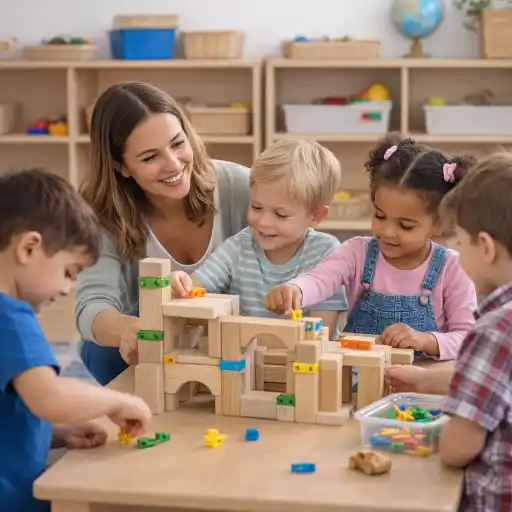
When space, access, or safety limits require a change, explain the reason and offer realistic choices: document the structure, preserve a piece, rebuild in a designated area, or move to a new idea. State requirements vary - check your state licensing agency for applicable safety and supervision expectations.
Conclusion: What helps a building project continue across days?
Children can return to a building project when educators protect a realistic opportunity to continue, make the work and materials easy to find, and invite rather than pressure. A photo, saved-work area, or short note about a child’s plan can provide continuity, while open-ended questions and attentive observation help the child decide what comes next.
Most of all, remember that learning is not measured only by whether a structure is completed. Children may persist, revise, collaborate, or move on—and each response gives educators useful information. By balancing children’s ownership with safety, access, and the needs of the whole group, providers and directors can make multi-day construction play a meaningful part of classroom life.
Explore five relevant ChildCareEd courses
- Spaces that Support Discovery Buy Now $24.00 — explore how classroom space can support learning and discovery.
- Project-Based Learning for Children Buy Now $16.00 — learn about inquiry and hands-on projects that develop over time.
- Creating Engaging and Meaningful Learning Experiences Buy Now $55.00 — strengthen planning for purposeful, choice-rich experiences.
- Children at the Wheel: Emergent Curriculum Buy Now $25.00 — explore a cycle of inquiry for responsive curriculum planning.
- Facilitating Learning in the Preschool Classroom Buy Now $35.00 — consider how environments, interactions, and materials support child-led learning.
- Basic Health & Safety and Breastfeeding Awareness
- 45 Hour Preschool Methods and Materials
- Pediatric RSV First Aid & CPR/AED
- CDA Bridge Bundle: Family Child Care without Portfolio Review
- Art from the Heart for Preschoolers: Open Ended Art Projects that Build Self-Esteem
- CDA Bridge Bundle: Infant/Toddler without Portfolio Review
- CDA Bridge Bundle: Preschool without Portfolio Review
- Texas Director Credential
- Wellness in Action: Teaching Healthy Habits to Children
- CDA Certification en Español: Recursos y Consejos para Educadores Bilingües
- 💛🧩 ¿Cómo puedo hacer que mi enseñanza sea inclusiva para los niños con autismo?
- Cómo Trabajar en el Cuidado Infantil en Carolina del Norte: Requisitos y Pasos
- Celebrando la amistad en el cuidado infantil durante el Día de los Mejores Amigos
- How can I use simple STEM activities to spark curiosity in preschoolers?
- Learning Through Choice: Why Do Classroom Choice Boards Work?
- How Can Child Care Providers Use Project-Based Learning to Deepen Young Children’s Learning?
- How Can Educators Use Emergent Curriculum and Project-Based Learning Effectively?
- How Can Everyday Classroom Problems Become Child-Led Investigations?
- What Can Providers Learn From the Toys Children Choose Repeatedly?
- How Can Child Care Providers Support Children Who Watch an Activity but Are Not Ready to Participate?
- What Should Effective Beginning-Sound Practice Include?
- How Can Dinosaur Coloring Become a Science and Language Experience?
- How Can You Follow a Preschool Interest Without Turning It into a Month of Busywork?
- How Can One Science Question Become a Preschool Investigation?
- “Save My Work!” How Can Child Care Providers Protect Unfinished Projects Between Days?
- How Can You Help Children Return to a Project They Abandoned Yesterday?
- How Can Child Care Providers Make Room for Floor Projects That Grow Beyond Their Starting Area?
- How Can Teachers Turn Everyday Classroom Problems Into Learning Opportunities?
- How Can You Help Children Revisit a Building Project Over Several Days?
