When a child returns to find a carefully built structure or artwork changed, the disappointment can be real—and the chance to continue meaningful thinking may be lost. A simple, consistent system for saving projects protects children’s ownership while helping peers practice respect and collaboration. Explore Creating Engaging and Meaningful Learning Experiences  Buy Now $55.00 to build practical skills in planning developmentally appropriate experiences that support children’s choice, independence, and learning.
Why does protecting unfinished work matter?
Young children often need more than one session to plan, build, test, and revise an idea. Preserving a project lets them return with their thinking intact and make decisions about what comes next. It communicates that their effort and ideas deserve time and attention—not just a quick display or a finished product.
Continuity can also deepen learning. When children revisit an earlier construction, drawing, or investigation, they can compare it with a new idea, recall what they tried, and decide whether to change their approach. Documentation and revisiting are common features of long-term inquiry: educators can use photographs, children’s words, and work samples to make evolving thinking visible. See the discussion of documentation and revisiting children’s work for examples of how records can support reflection.
For peers, a saved-work routine makes respect concrete. Rather than relying on a vague “be careful,” children learn what a sign means, how to check before touching, and how to make room for another child’s ongoing project. The routine can reduce conflict and help children feel more secure when they need to leave a center.
Protection should not mean that a project is permanently reserved or that other children lose access to materials. A clear, fair system balances ownership with shared classroom use. The goal is to protect a child’s opportunity to continue—not to promise that every object can be stored indefinitely.
What should a practical save-my-work system include?
Keep the process simple enough for children to use and staff to sustain. A visible “Work in Progress” sign or a set of planning cards can cue the steps: identify the project, mark it as saved, choose a safe place, and decide when to return. Use consistent words and pictures across relevant centers.
- Make signs durable, easy to see, and accessible where children build or create.
- Provide a few clearly labeled trays, shelves, or project zones for items that cannot safely remain on the floor or table.
- Use a child’s name, photo, or project sketch when helpful, while respecting privacy and classroom policies.
- Agree on a reasonable time for projects to remain saved, then review the plan with children if space is limited.
- Show children how to place a sign beside or on a project without disturbing it.
- 📸 Take a quick photo of large or fragile work before moving it to a protected storage area.
Planning cards can add a brief record of the child’s intention: “What am I making?”, “What do I want to try next?” or “What materials should stay with it?” Children may draw, dictate, point to picture choices, or use other communication supports to share their plan. This helps make the project understandable when the child returns or when another educator is supporting the group.
The signs are cues, not substitutes for supervision. Keep small parts and materials stored safely, maintain clear paths, and follow program procedures for accessible spaces and sanitation. Adapt the system to the children’s ages, abilities, and the kinds of projects underway.
How can educators introduce the routine and teach respect?
Introduce the routine during a calm moment, not only after a project has been disturbed. Model each step with a familiar block structure or artwork: “You’re still working on this. Let’s put your sign beside it and choose where it can stay safe.” Then explain what peers should do when they see a sign: pause, look, and ask the creator or a teacher before touching.
Practice with short, role-play examples. Invite children to act as the project creator, a classmate who notices the sign, and a teacher offering help. Use clear, respectful phrases such as “I see your project is saved,” “May I look without touching?” and “Let’s find another place to build.” Avoid framing the sign as a punishment or treating children as careless when they are still learning the routine.
Children also need to know that the sign does not create unlimited storage or guarantee that every project can stay exactly where it is. Explain the agreed time frame and what happens when an area must be reset. If an item needs to move, tell the child when possible, photograph it, and involve them in choosing a safe next step. This approach preserves agency while acknowledging the shared nature of the classroom.
Make the routine inclusive. Children may need visual directions, additional time, adapted signs, help dictating a plan, or a storage area within reach. Ask families about relevant names or language preferences, and use words and images children understand. A predictable routine supports participation without assuming that every child communicates or organizes work in the same way.
How can staff make saved projects part of meaningful learning?
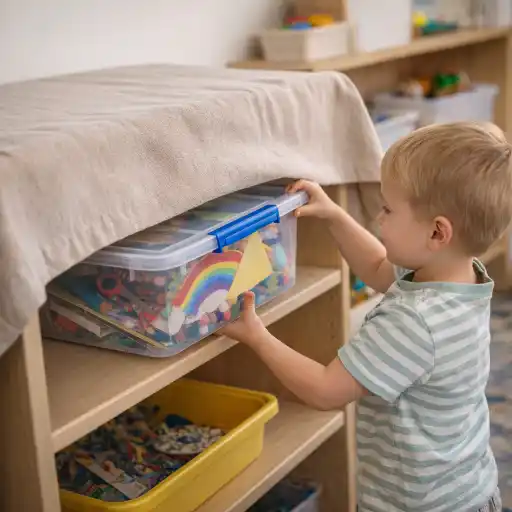
Saved work is more than a classroom-management tool; it can support a continuing investigation. When a child returns, invite them to revisit the plan: “What were you trying yesterday?” “What would you like to change?” or “What could help it stand?” These open questions recognize the child as a decision-maker while giving educators a window into their reasoning.
For a group project, planning cards can help children remember shared ideas and negotiate next steps. A class building challenge might include a sketch, a photo of the current design, and children’s brief comments. The project approach emphasizes children’s agency and the creation of personally meaningful outcomes; see the project approach overview for a description of planning, exploration, and culminating work.
Use light-touch documentation so the routine remains manageable. A photo and one sentence—“Ari added a wider base after the tower tipped”—may be enough to capture a change in thinking. Documentation can inform what materials to offer next, how to scaffold problem-solving, and how to share the child’s process with families. It should serve reflection and planning, rather than become a display task disconnected from the children’s experience.
- Offer children time to revisit saved work before introducing a new activity.
- Ask whether they want to continue alone, invite a peer, or change the plan.
- Notice persistence, revision, cooperation, and explanation—not only the final product.
- Use observations to decide whether materials, space, or adult support should change.
To expand your curriculum-planning toolkit, Project-Based Learning for Children Buy Now $16.00 explores inquiry and hands-on projects, while From Play to Planning: Building Culturally Competent, Child-Centered Curriculum Buy Now $55.00 addresses emergent learning, scaffolding, and inclusive curriculum. For observation and documentation practice, consider Tracking Progress, Shaping Futures: Observation & Assessment Skills Buy Now $55.00.
What common pitfalls should programs avoid?
A well-meant routine can become frustrating if its expectations are unclear or unevenly applied. Children need to understand what the sign means, how long work can stay, and where it can be kept. Staff need a shared response so the policy does not depend on which educator is present.
- Saving everything indefinitely: Set a practical time frame and make room for children to decide what to keep, photograph, or dismantle when a project is complete.
- Using signs without teaching them: Model the routine, practice peer responses, and revisit expectations as needed.
- Making the sign a guarantee: Explain that safety, sanitation, room use, and shared materials may require a project to be moved or changed.
- Protecting work but not access: Offer alternate materials or building spaces so other children can continue their own play.
- Over-documenting: Capture only useful details that help children revisit thinking or help staff plan next steps.
- Applying rules inconsistently: Agree as a team on terminology, time frames, storage, and how to handle accidental disturbance.
When a project is accidentally disturbed, respond with empathy. Acknowledge the child’s feelings, clarify what happened, and help them choose a next step—repair, rebuild, document, or begin something new. Avoid insisting that a child “just start over”; the project may represent substantial effort and personal meaning.
Directors can support consistency by keeping signs and storage materials available, including the routine in staff orientation, and discussing challenges during team reflection. State requirements vary - check your state licensing agency for applicable expectations about supervision, materials, and classroom safety.
How can a program start and refine the approach?
Begin with one area where unfinished work commonly creates stress, such as blocks, loose parts, or open-ended art. Choose a small number of signs and a safe storage option. Teach the routine, observe how children use it, and ask them what makes it easy or confusing. A simple trial is more useful than a complex system that staff cannot maintain.
After a week, review a few questions as a team: Are children able to mark their work without adult help? Do peers understand what the sign asks them to do? Is storage safe and practical? Are children returning to projects and extending their ideas? Use the answers to adjust wording, visuals, placement, or time limits.
Invite families into the learning story when appropriate. A brief note or photo can explain that returning to a project is part of planning, persistence, and problem-solving—not simply leaving a mess behind. Protect children’s privacy and follow program policies when sharing images or work samples.
Build the routine around relationships and respectful language. The sign is useful, but the larger learning comes from children seeing their work valued, communicating their plans, and learning to honor one another’s efforts. When educators combine consistent expectations with flexible supports, unfinished work becomes an opportunity for continuity rather than a source of conflict.
Conclusion: How can we protect unfinished projects between child care days?
Protecting unfinished projects begins with a clear, child-friendly routine: use a visible sign or planning card, identify a safe place, establish realistic time limits, and teach peers how to respond respectfully. Pair the routine with simple documentation and opportunities to revisit, revise, and discuss the work. This allows children to maintain ownership while the classroom remains safe, accessible, and shared.
Start small, model the steps, and adapt them to the children and materials in your program. With consistent support, a “Save My Work!” sign can do more than preserve a block tower: it can affirm children’s ideas, strengthen independence, and make ongoing learning visible.
- 45 Hour Child Growth and Development
- SIDS: Saving Babies: A Change of Position, A Change in Tradition
- SIDS: Saving Babies: A Change of Position, A Change in Tradition
- Bienvenido! Welcoming All Families
- Teach with Respect!
- Pediatric RSV First Aid & CPR/AED
- 45 Hour School Age Methods and Materials
- Art from the Heart for Preschoolers: Open Ended Art Projects that Build Self-Esteem
- Texas Director Credential
- 👶 ¿Cuáles son las proporciones y grupos requeridos en Dakota del Norte? 🏫
- Cómo usar tu certificación de 90 horas en Maryland para completar tu CDA
- Capacitación en Salud y Seguridad Preventiva en Línea para Proveedores de Cuidado Infantil
- Regulaciones de Licenciamiento de Cuidado Infantil en California para Centros y Hogares de Cuidado Infantil Familiar
- Proporciones de Cuidado Infantil y Tamaños de Grupo por Edad en Maryland (Guía Rápida para Centros y Hogares)
- Proporciones de Cuidado Infantil y Tamaños de Grupo por Edad en Nueva Jersey (Guía Rápida para Centros y Hogares)
- Proporciones de Cuidado Infantil y Tamaños de Grupo por Edad en Virginia (Guía Rápida para Centros y Hogares)
- Lista para Guardería en Casa en Texas: Cómo Iniciar una Guardería en el Hogar
- Cómo Trabajar en el Cuidado Infantil en Wisconsin: Requisitos y Pasos
- Cómo Ser Maestra de Preescolar en Wisconsin
- Cómo Ser Maestra de Preescolar en Maryland
- Capacitación Previa al Servicio para Proveedores de Cuidado Infantil en Dakota del Norte
- Capacitación Previa al Servicio para Proveedores de Cuidado Infantil en Wisconsin
- Capacitación CDA gratuita en Illinois
- Celebrando la amistad en el cuidado infantil durante el Día de los Mejores Amigos
- Cómo simplificar la capacitación para sus empleados de daycare
- How Can Child Care Providers Support Young Children’s Attention Span?
- “Save My Work!” How Can Child Care Providers Protect Unfinished Projects Between Days?
- How Can You Help Children Return to a Project They Abandoned Yesterday?
- How Can You Help Children Revisit a Building Project Over Several Days?
