When a child can say “I’m frustrated” or point to “worried,” a difficult moment can become a chance to connect and problem-solve. Explore the [Feelings for Kids Resource Buy Now $0.99] for expressive visuals children can use during check-ins, circle time, and calm-down routines, and consider [From Tantrums to Triumphs: Buy Now $25.00 Equipping Preschoolers with Self-Regulation Skills] for practical professional learning on supporting children through big feelings. The strategies below show how to make emotion words meaningful and available—not just words children repeat on cue.
Why does usable emotion vocabulary matter?
Children experience strong emotions before they have the language, perspective, and impulse control to explain what is happening inside. When adults help them connect bodily sensations, facial expressions, situations, and words, children gain a way to communicate needs and begin considering what could help. Naming a feeling does not instantly stop distress, but it gives the child and caregiver a shared starting point.
This work supports more than behavior management. A child who can say “I’m disappointed” may be better able to seek help, wait for a turn, or try another strategy. A child who notices a peer’s worried expression can learn to check in rather than assume. As described in recognizing and describing emotions, labeling feelings and connecting them with facial and body cues can help preschoolers express emotions and develop empathy.
For providers and directors, the practical goal is not to eliminate hard feelings. It is to build a classroom where all feelings are accepted, unsafe actions are guided, and children have repeated opportunities to practice communication and co-regulation. Keep the word #feelings linked to everyday experiences: arrival, play, transitions, stories, and peer problem-solving.
Which feeling words should we teach first?
Start with a small set of useful, familiar words—such as happy, sad, mad, scared, and calm. The right starting point depends on children’s ages, communication strengths, and experiences. Two or three choices may be enough for toddlers or children who are just beginning to use symbols or words. Preschoolers may be ready for words such as worried, frustrated, proud, excited, or disappointed once the basic vocabulary feels familiar.
Choose words children can use to express a need, not just identify a picture. Pair the word with a simple phrase: “I feel worried,” “I need help,” or “I want a quiet moment.” Adults can model these phrases in ordinary situations without making children responsible for adult emotions: “I’m feeling frustrated because the blocks fell. I’ll take a breath and try again.”
- Introduce only a few new words at a time, then revisit them across routines.
- Show the word with a photo, drawing, gesture, sign, or communication symbol.
- Include home-language words when families share them; expressions and ways of communicating vary.
- Let children point, gesture, use AAC, choose a card, or speak—each can be meaningful communication.
Use labels as invitations, not verdicts. Rather than saying “You’re angry,” try “You look upset. Are you mad, disappointed, or something else?” This respects the child’s own experience and strengthens their ability to make a choice. The ChildCareEd guidance on helping children identify and express emotions likewise emphasizes short, repeated language and visual supports.
How can adults turn visuals, books, and play into practice?
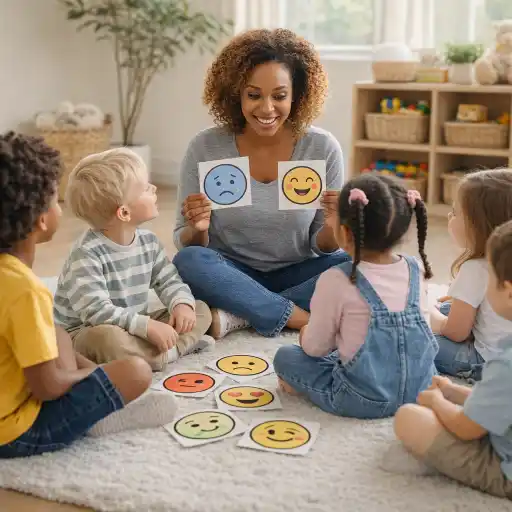
Visuals become useful when children can reach them and adults refer to them naturally. Place a feelings chart or cards at children’s eye level near a check-in area, reading nook, or calm space. Introduce the pictures when everyone is settled: model pointing to a face, name the feeling, and describe one clue—“Her eyebrows are close together; she may feel worried.” A visual is a prompt for conversation, not a test with one guaranteed answer.
Read-alouds let children explore emotions through characters at a comfortable distance. Pause briefly to ask, “What might the character feel? What clues do you notice? What could help?” Invite several interpretations and connect the story to a coping action without requiring children to disclose personal experiences. The books-and-play approach to building emotional vocabulary offers a helpful pattern: predict, pause to label, and connect.
Play provides low-pressure rehearsal. Keep activities short—often three to seven minutes—and focus on curiosity rather than correctness.
- Sort face cards into two or three feeling categories, then ask what clue informed the choice.
- Use puppets to act out waiting for a turn, losing a toy, or asking for help.
- Try mirror faces, emotion charades, or play-dough faces, with a choice to watch instead of participate.
- After naming a feeling, practice one response: breathe, ask for help, take space, or try again.
🙂 Make it playful: invite children to invent a movement for “excited” or “calm,” and explain their idea. The goal is repeated, joyful practice that helps #children connect words with experience.
How can we help children use the words during big feelings?
During distress, children may not be able to answer questions or use a new phrase. Prioritize safety and connection; teach and reflect after the child has begun to settle. A dependable sequence is Connect, Calm, Coach. Get low and close if safe, use a steady voice, and communicate presence: “I’m here. I’ll help keep everyone safe.” Then offer one familiar calming choice rather than a long list.
Once the child is more regulated, briefly connect the event with language and a practical alternative: “You were frustrated when the truck was taken. You can say, ‘I’m using it,’ or ask me for help.” Keep the explanation concise; the aim is rehearsal, not a lecture. The strategies in teaching children to name and manage emotions similarly recommend practicing coping tools during calm moments so they are more familiar when needed.
- Validate the feeling while setting a clear boundary: “You’re angry. I won’t let you hit.”
- Offer a communication alternative: words, a picture, a gesture, or a support device.
- Practice one strategy together when calm, such as slow breathing or asking for a turn.
- Notice small attempts: “You pointed to worried and came to me. I understood.”
A calm space should be presented as a supportive option, never as punishment or a requirement to hide feelings. Adults’ own calm, consistent language is part of the learning environment. Some children will need time, repeated modeling, or individualized communication supports before words become available in stressful moments.
How do we make emotion language inclusive and partner with families?
Children communicate feelings in varied ways. A child may use movement, facial expression, silence, a home-language word, a picture, a sign, or an assistive communication device. Avoid assuming that one facial expression means the same thing for every child or that eye contact is necessary to show understanding. Treat faces and body language as clues, then check your interpretation respectfully: “I wonder if you feel worried. Would you like to show me?”
Adapt activities so every child can participate with dignity. Offer two visual choices, quiet observation, movement-based options, or a puppet for indirect expression. Use images and stories that reflect the cultures, families, abilities, and communication styles of the children in your care. Ask families which feeling words, comfort routines, and calming strategies are familiar at home; their knowledge can make classroom supports more relevant.
Keep family conversations specific and strengths-based. Share what you observed, what support you offered, and how the child communicated—not a label or judgment. For example: “At cleanup, Sam pointed to the frustrated face. We offered help putting the blocks away, and Sam joined after a short pause.” With consent and appropriate confidentiality, align language and routines across home and care when families find that helpful.
Directors can support consistency by choosing a few shared phrases, making visuals available, and providing staff time to discuss observations. Track simple signs of growth, such as pointing to a feeling, using a phrase to request help, identifying a character’s emotion, or choosing a coping tool. State requirements vary - check your state licensing agency when considering documentation, training, or program practices.
What common pitfalls should providers avoid?
Well-intentioned emotion teaching can become less helpful when it feels like a quiz or correction. Children may interpret a situation differently from adults, and outward expressions do not always reveal exactly what someone feels. Stay curious and use a child’s response as information about what they understand or need.
- Teaching only during meltdowns: Practice during calm routines so the words and tools are familiar before stress rises.
- Introducing too many labels: Start with a few useful words and expand gradually.
- Correcting or denying a feeling: Replace “You’re not sad” with “You may be sad. Would you like to tell me or point?”
- Expecting one “right” interpretation: Ask what clues a child noticed and allow more than one possibility.
- Using visuals as compliance tools: Charts and calm spaces should support communication, not shame, reward, or punish children for feelings.
- Expecting words during peak distress: Support regulation first; revisit the event and practice language later.
Also avoid measuring success only by fewer outbursts. Progress can look like a child accepting adult support, gesturing toward a card, recovering a little sooner, or attempting a phrase after a difficult moment. Consistent practice is valuable, but children develop at different rates. When concerns persist or safety is affected, collaborate with families and consult appropriate program supports or specialists.
Conclusion: How can we build vocabulary children can actually use?
Children build usable emotion vocabulary through warm relationships, a small and meaningful set of words, accessible visuals, playful rehearsal, and calm adult coaching. The central question is not simply whether children can name a face; it is whether they can use words, gestures, or symbols to communicate what they feel and what support they need.
Start with a brief daily check-in, one feeling word in a story or play moment, and one coping phrase practiced when children are calm. Validate emotions, set safe limits on actions, adapt communication supports, and invite family knowledge. These small, repeated steps help children connect feelings with communication, empathy, and self-regulation—the foundation of a more responsive #classroom.
For ready-to-use visuals, explore the Feelings for Kids Resource Buy Now $0.75. For deeper professional learning, ChildCareEd’s From Tantrums to Triumphs Buy Now $25.00 training focuses on preschool self-regulation, calming strategies, and responding to challenging behavior. Explore the course details and check whether it fits your professional learning goals; state requirements vary, so confirm training requirements with your state licensing agency.
- 45 Hour Child Growth and Development
- Bienvenido! Welcoming All Families
- From Tantrums to Triumphs: Equipping Preschoolers with Self-Regulation Skills
- Birth to Five CDA Credential with Portfolio Review
- 45 Hour School Age Methods and Materials
- Art from the Heart for Preschoolers: Open Ended Art Projects that Build Self-Esteem
- Texas Director Credential
- Anxiety: Signs & Strategies
- National Grouch Day: Turning Grouches into Giggles, Teaching Kids about Handling Negative Emotions
- CDA Certification en Español: Recursos y Consejos para Educadores Bilingües
- 💛🧩 ¿Cómo puedo hacer que mi enseñanza sea inclusiva para los niños con autismo?
- 👶 ¿Cuáles son las proporciones y grupos requeridos en Dakota del Norte? 🏫
- 10 Ejemplos de Cómo la Cultura Influye en el Desarrollo Infantil
- Proporciones de Cuidado Infantil y Tamaños de Grupo por Edad en Maryland (Guía Rápida para Centros y Hogares)
- Proporciones de Cuidado Infantil y Tamaños de Grupo por Edad en Nueva Jersey (Guía Rápida para Centros y Hogares)
- Proporciones de Cuidado Infantil y Tamaños de Grupo por Edad en Virginia (Guía Rápida para Centros y Hogares)
- Cómo Trabajar en el Cuidado Infantil en Carolina del Norte: Requisitos y Pasos
- Celebrando la amistad en el cuidado infantil durante el Día de los Mejores Amigos
- Canciones, juegos y preguntas de círculo para niños
- Cómo simplificar la capacitación para sus empleados de daycare
- Can we tame the ‘monsters’ of big emotions in young children?
- How can friendly-monster crafts teach children about feelings?
- Feelings Activities for Toddlers: Building Social and Emotional Skills
- Beyond “How Are You?” Circle Time Questions Kids Actually Want to Answer
- How Can Puppets Support Communication and Literacy in Early Childhood?
- How Can a Feelings Chart Help Preschoolers Build Self-Regulation?
- How Can Child Care Providers Support Kindergarten Emotions on the First Day of School?
- How Can We Build an Emotion Vocabulary Children Can Actually Use?
