Introduction
In this article you will find simple steps you can use today to teach children to work together and be kind. We focus on #sharing, #cooperation, #empathy, #turns, and #play. These ideas are for child care providers and directors who want practical routines, short scripts, and ways to coach children while they learn social skills. Remember: state requirements vary - check your state licensing agency.
Why it matters:
1. Children who learn to share and cooperate make friends easier and calm down faster. 2. Small, daily chances to practice social skills turn into habits. Research and classroom guides like the sample Social Skills Lesson Plan Buy Now $0.00 and CSEFEL briefs show that repeated practice and attention help kids keep new skills.
How can I teach sharing without forcing it?
Answer: Use short scripts, choices, and quick practice moments so children learn to choose cooperation.
- 😊 Model short phrases every day. Say: "Can I have a turn?" "Your turn next." Practice these during calm play. See scripts in How can we teach sharing without forcing it?.
- Offer clear choices. Use a timer, a swap, or two pieces of the same toy so children decide how to solve the problem.
- Use role-play for 2–3 minutes. Let puppets practice asking and taking turns. ChildCareEd has guided play ideas at How can preschoolers learn to share....
- Notice small wins. Say exactly what you saw: "You handed the truck to Leo when he asked—thank you." CSEFEL materials explain why specific feedback helps children repeat good behavior (CSEFEL scripts).
- Teach alternatives to forcing: "I will play with this part while you play with that part" instead of taking a toy away. ChildCareEd and CSEFEL both warn that forcing can teach compliance, not cooperation.
Tip: Keep lessons short and repeated. Five-minute role-plays and frequent scripts work better than one long talk. For classroom-ready ideas and lesson plans, check the ChildCareEd social skills resources (sample lesson plan Buy Now $0.00).
What routines help children practice cooperation and empathy?
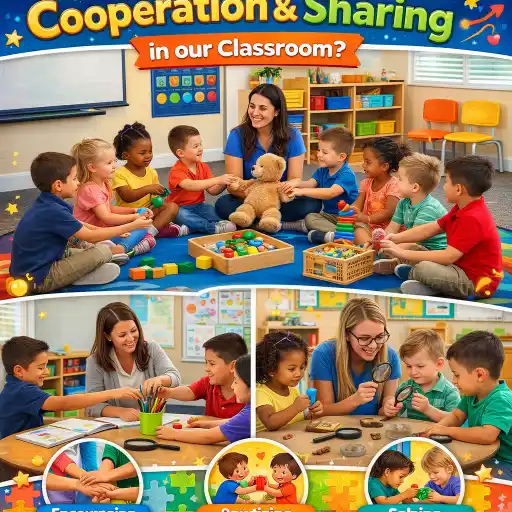
Answer: Routines give many low-pressure chances to practice. Use the day to teach, not just to tell.
- 😊 Morning greetings and buddy jobs
- Let children choose a greeting and assign simple jobs (snack helper, line leader). Jobs build responsibility and teamwork. ChildCareEd explains daily routines that teach caring (How Can We Teach Empathy...).
- 🧩 Guided small groups
- Plan 5–10 minute team tasks: build a track, make a group collage, or cook pretend food. Coach short scripts while they work. See guided play tips at ChildCareEd (Sharing, turns, and friends).
- 📚 Read-and-reflect
- Pause stories and ask: "How does that character feel? What could a friend do?" Books and discussion build emotion words and #empathy. Scholastic lists good read-alouds about sharing (7 Books to Encourage Sharing).
- 🏷️ Kindness spotting and visuals
- Keep a kindness board or jar. Use timers and picture cards so non-readers see whose #turn it is. CSEFEL briefs recommend prompting and acknowledgment to raise positive peer interactions (CSEFEL What Works Brief).
Why routines work: They give many chances to practice in low-stress moments. Short, frequent practice builds confidence and trust in the turn system.
How do I handle conflicts so children learn repair and keep friendships?
Answer: Treat conflicts as teaching moments. Use a short script, name feelings, offer choices, and ask for a small repair.
- 🛑 Stop and keep safe
- Use a short limit: "Hands down, safe bodies." This slows the moment so thinking can start.
- 🔍 Name the feeling and the problem
- Say: "You look upset because you both want the red truck." Labeling gives words. Use emotion charts or feelings posters from the ChildCareEd lesson plan (Name Your Emotions Chart Buy Now $0.00).
- 💬 Offer short choices and teach scripts
- Give 2 simple options: timer, trade, or another toy. Teach phrases like: "Can I have a turn after you?" Practice these during calm times so children can use them when upset. CSEFEL and RAND studies on SEL stress coaching and rehearsal (RAND PEDALS evaluation).
- 🔧 Repair the relationship
- Ask for a small fix: "Can you help put the blocks back?" or model a short apology: "I’m sorry. Are you okay?" Praise the repair: "You asked to take a turn after Sam—great job."
Keep coaching brief and specific. If the same child has repeated conflicts, collect notes, plan extra practice, and partner with families to keep strategies consistent at home and school.
How do I support children who need extra help joining in?
Answer: Use priming, role-play, buddies, environment changes, and peace corners to give extra scaffolding.
- Priming and scripts
- Before free play, tell the child who to ask and what to say: "Ask Ana, 'Can I play when you’re done?'" CSEFEL and ChildCareEd recommend priming as a simple, effective step (CSEFEL scripts, ChildCareEd sharing tips).
- Role-play and rehearsal
- Practice short scenes with puppets or peers for 2–3 minutes. Rehearsal builds confidence. Use social stories from ChildCareEd and other free story lists (Free social stories).
- Peer buddies and structured invitations
- Assign a buddy or "Friendship Helper" who invites and models how to join a game. This gives repeated, supported practice.
- Peace corners and regulation tools
- Offer a calm space with sensory tools and visuals so children can regroup before joining play. Guidance on setting up a calm or peace corner is available at Setting Up a Peace Corner.
- Adapt the environment
- Make play easier to join: bigger blocks, quieter corners, or step-by-step picture cards. Small changes lead to big gains in inclusion. The RAND PEDALS reports also note that teacher coaching and site supports help children with extra needs (RAND implementation).
Work with families. Send home one-line scripts and short notes about wins so families can mirror practice at home. For more classroom tools and courses, explore ChildCareEd trainings like Connections That Count  Buy Now $55.00.
Conclusion
Quick daily checklist (use every day):
- Model short phrases and role-play often.
- Use timers, visuals, and limited choices for #turns.
- Plan 5–10 minute guided practice sessions.
- Praise specific helpful actions right away.
- Partner with families and note progress.
Common mistakes and how to avoid them:
- Forcing sharing — avoid taking toys as punishment; teach options instead.
- Long lectures — use short scripts kids can remember.
- Ignoring small wins — notice tiny helpful acts so they grow.
FAQ
- Q: How fast will I see change? A: Expect small wins in weeks with daily practice; bigger shifts over months.
- Q: What if a child refuses scripts? A: Try priming, role-play, and a peer buddy. Collect notes and work with families.
- Q: Should I ever remove a toy to stop problems? A: Only for safety. Use choices and teach alternatives instead of forcing sharing.
- Q: Can children with special needs learn to share? A: Yes. Use visuals, repetition, small steps, and individualized supports. See CSEFEL briefs and RAND summaries for guidance.
- Q: Where can I find more lesson plans? A: ChildCareEd has lesson plans, articles, and courses on social skills and positive guidance (see ChildCareEd).
You are building lifelong skills. Small steps, short scripts, calm coaching, and consistent routines help children learn to share, take turns, and care for one another. Thank you for the patient work you do every day to support young #children in growing their social hearts.
- 45 Hour Child Growth and Development
- 45 Hour Preschool Methods and Materials
- Bienvenido! Welcoming All Families
- 45 Hour Infant and Toddler Methods and Materials
- 45 Hour School Age Methods and Materials
- Connections That Count: Building Relationships in Child Care
- Texas Director Credential
- Wellness in Action: Teaching Healthy Habits to Children
- CDA Certification en Español: Recursos y Consejos para Educadores Bilingües
- 10 Ejemplos de Cómo la Cultura Influye en el Desarrollo Infantil
- Proporciones de Cuidado Infantil y Tamaños de Grupo por Edad en Maryland (Guía Rápida para Centros y Hogares)
- Proporciones de Cuidado Infantil y Tamaños de Grupo por Edad en Nueva Jersey (Guía Rápida para Centros y Hogares)
- Proporciones de Cuidado Infantil y Tamaños de Grupo por Edad en Virginia (Guía Rápida para Centros y Hogares)
- How can rainy day indoor activities help preschoolers learn kindness and cooperation in Georgia?
- How can indoor creative play encourage teamwork for preschoolers in California?
- How can we encourage teamwork and cooperation in early childhood programs?
- Celebrando la amistad en el cuidado infantil durante el Día de los Mejores Amigos
- How can we use team activities to help preschoolers learn and cooperate?
- Can sports-themed play teach cooperation and build team spirit in young children?
- How can child care providers support friendships and peer relationships?
- Daycare Team-Building Activities That Encourage Cooperation
- Snip, Stick, Celebrate! What Easy Labor Day Crafts Can Toddlers Make?
- How Can Teachers Encourage Sharing Without Forcing It?
- What Are the Best Ways to Support Children Who Struggle with Sharing?
