When children can predict a sentence and name the animal on the page, reading together becomes an invitation to participate—not a performance. Pairing animal words with a simple repeating frame gives providers practical ways to build vocabulary, oral language, and early print awareness; the Understanding Print Knowledge in Preschool course  Buy Now $16.00 can deepen your understanding of how children notice and make meaning from print, with focused professional learning for classroom practice.
Why pair animal vocabulary with a repeated sentence pattern?
Animal words are concrete and visually supported: children can see a bear, point to a rabbit, or imitate a bird’s movement while hearing its name. A repeated sentence frame—such as “I see a ___” or “The ___ can ___”—keeps the language structure familiar while one important word changes. This blend of predictability and variation helps children attend to the new vocabulary without having to process a wholly new sentence on every page.
Repeated patterns also make participation accessible. A child may say the animal’s name, complete the final word, point to its picture, use a sign, make a sound, or simply listen and anticipate. These responses are meaningful contributions, not lesser versions of reading. As noted in ChildCareEd’s discussion of repetitive sentence patterns and early reading confidence, familiar language can give children a low-pressure way to predict, join in, and experience success.
Pairing words with pictures and actions supports understanding as well as naming. “The fox runs” can lead to a gesture, a brief conversation about movement, and a connection to the illustration. Keep the activity playful: the purpose is rich interaction, not testing whether every child can recall every animal.
How can providers choose useful animals and sentence frames?
Begin with animals that connect to children’s interests, classroom themes, family experiences, or books already in your reading area. Include familiar pets and local wildlife alongside less familiar animals, and avoid suggesting that every child has the same experiences with animals. If children share names or words from home languages, welcome those contributions and connect them to the classroom vocabulary.
Choose one short frame and make its repeated structure easy to hear. For example:
- “I see a ___.”
- “The ___ is ___.”
- “Look at the ___.”
- “A ___ can ___.”
Keep the changing word meaningful and clear. “A frog can hop” pairs an animal label with an action; “The elephant is big” offers a descriptive word. A small set of carefully selected terms is usually more useful than a long list. Introduce new words with photographs, toy animals, puppets, or movement, and give children time to look, listen, and respond.
The resource Emergent Readers - Land Animals is a possible classroom resource for connecting land-animal vocabulary with short patterned reading. Preview any material for age appropriateness, readability, representation, and fit with your children’s interests before using it.
How does this activity build vocabulary and print knowledge?
Children learn words through repeated encounters in meaningful contexts. They hear an animal name, connect it to an image or object, and may use it again in conversation or play. Repeating a sentence frame gives them a stable language structure in which to try a new noun, action, or describing word. Providers can extend learning by asking open prompts such as “What do you notice about the turtle?” or “How might this animal move?” and accepting children’s answers in words, gestures, home languages, or assisted communication.
- Read the sentence naturally, then point to the printed words as you reread.
- Invite children to notice which word changes from page to page.
- Connect a printed animal word to its picture, toy, or classroom label.
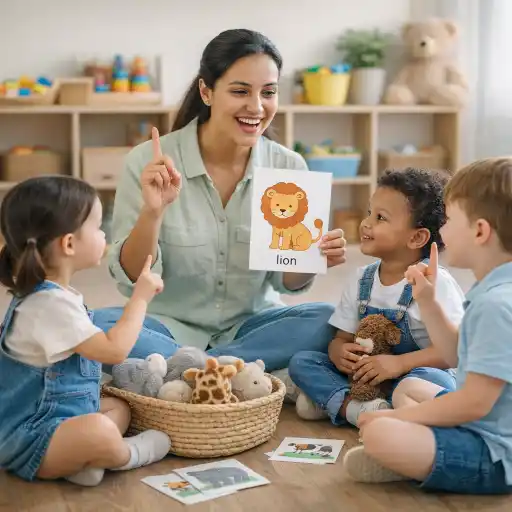
Keep attention on meaning and enjoyment. Print pointing is a brief demonstration, not a demand that preschoolers decode the text independently.
What does an engaging, inclusive read-aloud look like?
A useful routine is to reread with a different invitation each time. On the first reading, introduce the animals and enjoy the whole book. On the next, pause before the repeated word so children can supply it, point, or make a gesture. On a later reading, invite children to retell, act out the animal’s movement, or suggest a new page using the same sentence frame. This progression builds familiarity while giving children fresh reasons to attend.
Inclusive participation is broader than speaking aloud. Offer picture choices, tactile figures, animal sounds, signs, movement, AAC, or a chance to observe before joining. Use clear images and uncluttered pages where possible, and adapt the pace or number of pages to children’s attention and communication needs. For children learning more than one language, provide vocabulary in both languages when available and invite families to share names or stories about animals that matter to them.
Try extending the book beyond group time:
- 🦊 Place animal figures and matching picture-word cards in a play area.
- Invite children to sort animals by where they live or how they move.
- Make a class book: children choose an animal, dictate a sentence, and add a drawing.
- Use animal words during outdoor observations, dramatic play, or transitions.
These connections help children use vocabulary for real purposes and give providers chances to hear how language is developing across the day.
How can teams avoid common pitfalls and notice progress?
One pitfall is turning each page into a quiz: “What animal is this? What does it say? What letter does it start with?” Too many questions can interrupt the story and put children on the spot. Instead, model language, pause invitingly, and follow children’s interests. Another mistake is expecting every child to answer aloud or to use the exact target word. A point, approximation, sign, or thoughtful look can show engagement and understanding.
Also avoid teaching so many new animals at once that the words lose meaning. Select a manageable set, use accurate names, and revisit them across books, play, and conversation. Repetition is a bridge into literacy, not a replacement for varied stories, informational books, songs, and child-led talk.
Observe what children do rather than relying only on a formal response. You might notice whether a child:
- joins the repeated line or anticipates a word;
- matches an animal name to its picture or figure;
- uses a target word during play or conversation;
- attends to the printed words, turns pages, or retells part of the book.
Use these observations to decide what to repeat, clarify, or extend. If your program is tracking professional learning or curriculum expectations, state requirements vary - check your state licensing agency.
Conclusion: How can animal words and repetition support emerging readers?
Pairing animal vocabulary with simple repetitive sentences makes shared reading predictable, purposeful, and welcoming. A familiar frame gives children room to focus on a changing word, connect language with images and actions, and contribute in ways that suit their communication strengths. Providers can strengthen the experience by pointing out print naturally, revisiting vocabulary in play, and offering accessible ways to participate.
Start with a few interesting animals, one clear sentence pattern, and time for children to respond. Follow their curiosity, observe what they understand, and let the book be a joyful shared experience. To build a deeper foundation for intentional literacy practice, explore ChildCareEd’s Understanding Print Knowledge in Preschool Buy Now $16.00.
- 45 Hour Child Growth and Development
- Science of Reading Foundations in the Pre-K Classroom
- Reading Aloud and Storytelling
- Language and Literacy Foundations in Pre-K
- Birth to Five CDA Credential with Portfolio Review
- Setting the Stage: Story Time
- Texas Director Credential
- Building Vocabulary
- Classroom Tools for Emergent Literacy
- CDA Certification en Español: Recursos y Consejos para Educadores Bilingües
- Actividades de Motricidad Gruesa que Desarrollan el Equilibrio, la Coordinación y la Fuerza
- Proporciones de Cuidado Infantil y Tamaños de Grupo por Edad en Maryland (Guía Rápida para Centros y Hogares)
- Cómo Trabajar en el Cuidado Infantil en Carolina del Norte: Requisitos y Pasos
- Cómo Ser Maestra de Preescolar en Virginia
- Celebrando la amistad en el cuidado infantil durante el Día de los Mejores Amigos
- What No-Prep Activities Can Busy Early Childhood Teachers Use Tomorrow?
- How Can Picture Task Cards Support Emerging Readers?
- Why Are Repetitive Books Perfect for Building Reading Confidence?
- How Can Bilingual Printables Help Spanish-Speaking Families Feel Included?
- Why Do Simple Books Build Early Reading Confidence?
- How Can Printable Books Help Preschoolers Fall in Love With Reading?
- How Can You Teach Sight Words Through Games, Movement, and Play?
- How Do Repetitive Sentence Patterns Build Early Reading Confidence?
- How Can Predictable Ocean-Themed Text Build Reading Confidence?
- How Can Repetitive Text Introduce Farm-Animal Vocabulary?
- How Can Repetitive Early Readers Help Children Learn Color Words?
- How Can Healthy-Food Vocabulary Help Preschoolers Begin Reading?
- How Can Animal Vocabulary and Repetitive Sentences Help Preschoolers Become Confident Readers?
- A Child Has Memorized the Book: What Can You Teach Next?
