A more meaningful outdoor program does not require a construction project—small, intentional changes can turn the space you already have into a place for discovery. The Creating the Natural Outdoor Classroom  Buy Now $16.00 course helps child care providers plan nature-rich experiences using children’s senses and everyday materials; explore it for practical ideas to extend your teaching outdoors.
Why does outdoor learning matter, even in an ordinary playground?
Outdoor learning is not defined by elaborate equipment or acres of green space. A patch of concrete, a fence, a few containers, and the changing weather can invite rich exploration when educators make room for children to notice, test ideas, and play. A leaf can become a color sample, a shadow can prompt a question about the sun, and a puddle-free water-pouring station can lead to discoveries about volume and cause and effect.
Outdoor spaces also offer experiences that are difficult to reproduce indoors: changing light, moving air, uneven surfaces, natural sounds, and room for large-body movement. Children can practice balance, language, cooperation, and problem-solving within the same play episode. NAEYC’s outdoor learning resources highlight how outdoor play can support development beyond physical activity, including children’s thinking and social-emotional skills.
For providers and directors, this is a reassuring starting point: you do not need to wait for a renovation or a perfect garden. A few thoughtfully selected materials and predictable routines can help the existing #playground become a flexible learning environment. The goal is not to make every moment a formal lesson, but to notice what children are already exploring and respond with useful invitations.
How can you find learning potential in the space you already have?
Begin with an observation walk before purchasing supplies or rearranging equipment. Notice where children gather, what they return to, which areas are sunny or shaded, and where staff can maintain clear sightlines. Ask children what they like doing outside and invite families and staff to share ideas or spare materials.
Think in terms of small activity zones rather than a complete redesign. A portable basket can define a nature-investigation area; a blanket and book bag can create a temporary reading nook; a low table with reclaimed pots can prompt dramatic play. Chalk can mark a movement path or drawing space on pavement, while a few planters can bring growing plants into a hard-surfaced yard.
- Map the outdoor area and identify supervision-friendly locations for quiet, active, and messy play.
- Choose one or two zones to begin with; keep routes and exits clear.
- Use weather-resistant bins or a rolling cart for materials that need to come inside.
- Observe which items children use in unexpected ways before deciding what to add next.
This approach makes planning manageable and helps avoid unnecessary spending. Starting with what is available is not settling for less; it is a practical way to build a responsive #environment around children’s interests.
Which low-cost materials can transform an outdoor area?
Open-ended materials encourage children to invent uses, combine objects, and revisit ideas. Look for durable, age-appropriate items such as buckets, large scoops, sturdy fabric, clipboards, chalk, washable paintbrushes, magnifiers, and child-size gardening tools. Natural loose parts—such as leaves, pinecones, and larger sticks—can support sorting, building, storytelling, and sensory exploration, provided staff inspect them and consider choking, allergy, and other hazards.
Even a small collection can support a range of experiences. Provide pots, pans, and large utensils for pretend cooking with leaves and soil. Offer chalk and water with brushes for mark-making on pavement. Set out containers and funnels for supervised pouring and comparisons. A few logs or stable stumps may serve as seats or surfaces, but only after staff assess stability, splinters, placement, and the applicable safety requirements.
- 🌿 Nature basket: magnifiers, picture cards, a tray, and safe-to-handle natural objects.
- Art kit: chalk, paper attached to a secure surface, and washable brushes.
- Movement kit: cones, scarves, and picture prompts for hopping, stretching, or balancing.
- Garden kit: child-size tools, labeled pots, and plants selected for the setting.
How can you connect outdoor play with your curriculum?
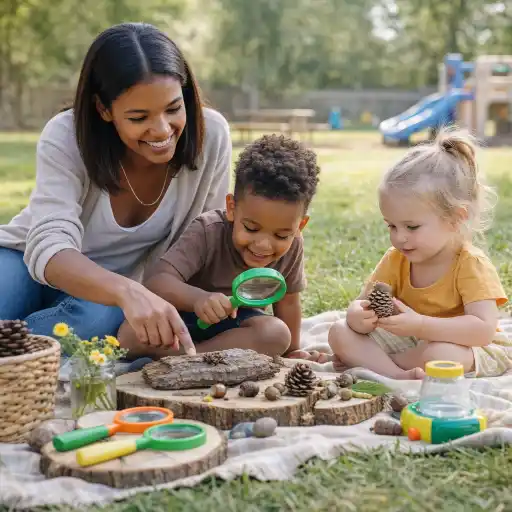
Choose a simple learning intention, then allow children’s curiosity to guide the experience. If the focus is comparison, children might sort leaves outdoors by size, texture, or color and later draw or discuss their groupings inside. For early math, count steps between landmarks, compare how many scoops fill different containers, or make a repeating pattern with large natural objects. For language, introduce words such as rough, smooth, damp, rustle, and sprout during real discoveries.
Outdoor learning is strongest when it uses what is distinctive about being outside—not simply when an indoor worksheet is carried outdoors. Build on wind, light, living things, movement, and changing weather. The ChildCareEd article creative ways to use nature as your classroom offers further examples of connecting nature exploration with art, science, math, and imaginative play.
A weekly plan can help staff prepare without over-scripting children’s play. The printable Indoor & Outdoor Kids Activity Calendar Buy Now $1.25 provides a one-page weekly format with activity ideas for both settings, making it a useful planning aid for balancing indoor and outdoor invitations.
- Offer an open-ended prompt: “What do you notice?” or “What might happen if…?”
- Adapt the activity for different ages, abilities, communication styles, and comfort levels.
- Use a brief note, child quotation, or photograph to capture learning and inform what comes next.
How can you keep outdoor learning safe and welcoming?
Intentional setup includes both learning opportunities and careful supervision. Before each outdoor period, scan the area for litter, broken materials, animal waste, standing water, unstable objects, hot surfaces, sharp edges, and other hazards. Check that boundaries and sightlines allow staff to see children, and position adults so that the whole group is actively supervised. Head Start’s outdoor-space guidance specifically calls attention to visibility, shade, standing water, choking hazards, and plant safety.
Inclusion starts with offering more than one way to participate. A child might observe before touching, point instead of speaking, use an adapted tool, or explore from a seated position. Provide shaded and quieter choices when possible, and prepare a weather-related alternative that preserves the learning goal. Share relevant routines with families, including clothing expectations and any program procedures for outdoor materials.
- Keep supervision assignments and boundaries clear before children enter the area.
- Use particular caution around water: even shallow containers require close, continuous adult supervision.
- Research plant toxicity and inspect natural materials; remove items that are damaged, contaminated, or unsuitable for the group.
- State requirements vary - check your state licensing agency before making changes to equipment, surfaces, schedules, or outdoor procedures.
Safety is not the opposite of exploration. Thoughtful checks and predictable routines help children engage with appropriate challenges while educators remain attentive to the group.
What common pitfalls should programs avoid?
One frequent mistake is assuming outdoor learning requires expensive structures. Large equipment can have a role, but children can investigate, create, and collaborate with simple materials and natural features. Another pitfall is putting out too many choices at once. A crowded space can make supervision, cleanup, and focused play more difficult; begin with a few invitations and rotate them in response to children’s interests.
Programs can also miss learning when adults direct every step or expect a polished product. Instead of demonstrating a single “right” way to build, paint, or explore, offer a thoughtful prompt and watch what children try. Their questions and repeated actions can guide future planning. At the same time, do not overlook maintenance: inspect portable materials regularly, store them safely, and remove anything that has become damaged or unsanitary.
Consistency is easier when outdoor planning belongs to the whole team. Use a short staff check-in to agree on the day’s invitation, supervision positions, materials, and weather backup. Directors can support educators by setting aside time to plan and making a small shared supply kit available. For a deeper look at designing nature-rich outdoor environments, the Creating the Natural Outdoor Classroom Buy Now $16.00 course offers focused professional learning; the related CDA: Creating the Outdoor Classroom Buy Now $16.00 course addresses intentional outdoor classroom design and implementation.
Conclusion: How can you begin without rebuilding?
You can add outdoor learning without rebuilding the playground by observing the space you have, creating a small number of flexible zones, and offering safe, open-ended materials that invite children to explore. Connect activities to curriculum goals without taking away the spontaneity that makes outdoor discovery engaging. Use a weekly planning aid such as the Indoor & Outdoor Kids Activity Calendar to generate ideas and keep experiences balanced across settings.
Begin with one practical change this week: a nature basket, a chalk invitation, a few planters, or a portable outdoor story spot. Watch what children do, make adjustments with your team, and build gradually. A thoughtfully used corner of the existing yard can become a meaningful #learning space—no major renovation required.
- Creating the Natural Outdoor Classroom
- CDA Bridge Bundle: Preschool
- CDA Bridge Bundle: Family Child Care
- CDA Bridge Bundle: Family Child Care without Portfolio Review
- CDA: Creating the Outdoor Classroom
- CDA Bridge Bundle: Infant/Toddler without Portfolio Review
- CDA Bridge Bundle: Preschool without Portfolio Review
- CDA Bridge Bundle: Infant/Toddler
- Texas Director Credential
- CDA Certification en Español: Recursos y Consejos para Educadores Bilingües
- 🥦✨ ¿Cómo apoyar a los niños selectivos a probar nuevos alimentos sin presión?
- 💛🧩 ¿Cómo puedo hacer que mi enseñanza sea inclusiva para los niños con autismo?
- 😅❌ ¿Cómo Puedo Manejar a un Niño que Dice “¡NO!” a Todo en el Aula?
- ❄️ ¿Qué actividades al aire libre funcionan bien para los niños de Illinois en cada estación? 🌷🍂
- 10 Ejemplos de Cómo la Cultura Influye en el Desarrollo Infantil
- Proporciones de Cuidado Infantil y Tamaños de Grupo por Edad en Nueva Jersey (Guía Rápida para Centros y Hogares)
- Proporciones de Cuidado Infantil y Tamaños de Grupo por Edad en Virginia (Guía Rápida para Centros y Hogares)
- ¿Cuál es la Diferencia Entre la Crianza Respetuosa y la Crianza Permisiva?
- Actividades de Otoño Fáciles para Preescolares esta Temporada
- Consejos de Supervisión Activa para Salones de Preescolar y el Juego al Aire Libre
- Celebrando la amistad en el cuidado infantil durante el Día de los Mejores Amigos
- Canciones, juegos y preguntas de círculo para niños
- Cómo simplificar la capacitación para sus empleados de daycare
- Can traditional child care programs add forest preschool activities without starting a new program?
- Active Supervision Examples: 10 Real Classroom Scenarios—Safe or Unsafe?
- Which Outdoor Play Activities Best Boost Gross Motor Development?
- How Can Photos Help Children Remember Classroom Routines?
- What Can Repeated Playground Near Misses Tell Your Team?
- How Can You Add Outdoor Learning Without Rebuilding the Playground?
