A basket of fallen leaves can spark far more than a one-day craft: it can lead children into a week of observation, questions, experiments, stories, and collaboration. The Creating the Natural Outdoor Classroom  Buy Now $16.00 course offers practical ideas for turning nature into a purposeful learning environment, helping you strengthen outdoor classroom practice while children’s discoveries guide what happens next.
Why can a simple leaf collection become meaningful curriculum?
Leaves are familiar, accessible materials that invite children to look closely and make comparisons. One child may notice color; another may wonder why some leaves curl or have different edges. Those observations can lead naturally into science, language, mathematics, art, movement, and social learning. Karen Worth’s discussion of early childhood science describes children’s curiosity about the natural world as a powerful starting point for inquiry, and notes that science experiences can also develop language, motor skills, mathematics, and collaboration.
The key is to treat the collection as a beginning, not a prescribed set of activities. Adults can prepare a safe, welcoming invitation, listen for children’s theories, and plan extensions that respond to their questions. This approach values the process as much as a finished product: comparing, predicting, testing, revising, and sharing ideas are all signs of learning.
A sustained leaf investigation can also help providers make learning visible without interrupting play. Photos, child quotations, drawings, and simple charts show how ideas develop over several days. A single group of leaves becomes a shared resource for #inquiry, #science, #math, #language, and #creativity.
How can educators prepare a safe and inviting leaf collection?
Start with a short walk or an outdoor observation. Invite children to select a few fallen leaves and notice where they found them, what they look like, and how they feel. Collect only materials that are appropriate for your setting; avoid unknown plants, mushrooms, animal waste, and items that may present choking or allergy risks. Check family information and program policies, and wash hands after handling natural materials.
Choose a manageable collection rather than filling every surface. Place leaves on a tray or in a basket with a few simple tools, such as magnifiers, sorting bowls, clipboards, crayons, and child-safe rulers. Keep choices limited at first so children can focus, then add materials as their questions develop. Offer real leaves where safe and suitable, with photographs or artificial examples as alternatives when needed.
- Ask children what they notice before introducing labels or explanations.
- Offer different ways to participate: touching, looking, pointing, drawing, describing, or using tongs.
- Provide visual supports and home-language vocabulary when helpful.
- Plan an indoor version if weather, air quality, or accessibility changes outdoor plans.
- 🍂 Make the collection a shared class resource: children can help organize, revisit, and care for it.
Set clear boundaries for collecting and use active supervision outdoors. State requirements vary - check your state licensing agency. The related ChildCareEd article fall hunt challenges for preschoolers offers additional ideas for safe, inclusive outdoor discovery.
How can one collection guide five days of child-led learning?
A five-day inquiry plan is a flexible rhythm, not a timetable children must complete. Follow what interests the group, repeat experiences when children want more time, and change the sequence as needed. A practical starting point is:
- Day 1 — Gather and wonder: Explore the leaves with eyes, hands, and magnifiers. Record children’s first observations and questions.
- Day 2 — Compare and sort: Invite children to sort by color, size, shape, texture, or another rule they choose. Ask how they decided what belongs together.
- Day 3 — Investigate change: Compare dry and damp leaves, or revisit a leaf after it has rested in the classroom. Encourage predictions, then describe what actually changed.
- Day 4 — Represent ideas: Make leaf rubbings, prints, drawings, patterns, or a collaborative arrangement. Keep art open-ended so children can make their own choices.
- Day 5 — Share and extend: Revisit the question board, talk about discoveries, and decide what the group might investigate next.
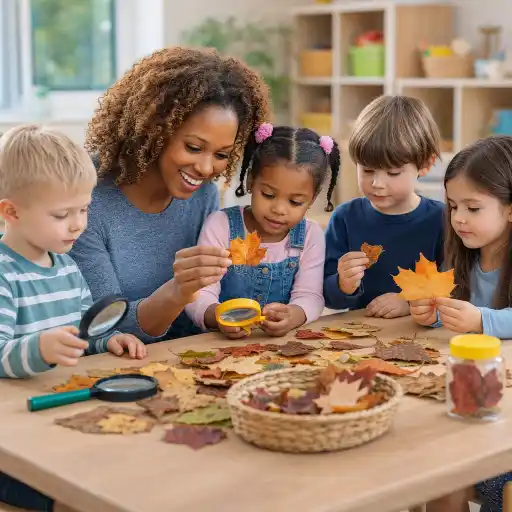
This sequence can combine with movement, storytelling, counting, and outdoor observation. For example, children may use leaves as story characters, make a class graph of colors, or compare leaf shapes with photographs. The ChildCareEd overview of leaf-based art and science activities includes more extensions across learning domains.
How can teachers support children’s questions without taking over?
Child-led learning does not mean adults step away from teaching. Educators support the investigation by noticing children’s interests, making useful materials available, introducing vocabulary in context, and asking questions that invite deeper thought. The goal is to scaffold children’s ideas without turning the experience into a quiz or rushing toward a single correct answer.
Try a simple routine: notice, wonder, predict, test, and reflect. If a child says, “This leaf is rough,” you might respond, “What do you feel on its surface?” If a child asks why one leaf is spotted, acknowledge the question and invite observation: “What do you notice about the spots? How could we compare it with another leaf?” Wait long enough for children to think and respond in their own way.
- “What do you notice that you didn’t see before?”
- “How are these leaves alike or different?”
- “What do you think might happen if this leaf gets wet?”
- “What evidence could help us explore that idea?”
- “What surprised you, and what do you wonder now?”
Accept speech, gesture, drawing, demonstration, and home-language contributions as meaningful participation. Early science is not about memorizing facts alone; it is also about learning how to explore and make sense of the world. For more structured support with inquiry-based teaching, explore Building Early Science Foundations Buy Now $16.00.
How can providers document learning and make the week inclusive?
Documentation can be brief and useful. Capture one photograph, a child’s exact words, and a short note about the action or idea you observed. For instance: “During sorting, Luis placed the pointed leaves together and said, ‘These look like stars.’” This records what happened without making a broad judgment about the child’s abilities. Revisit the photo or quote with children to help them remember, compare, and revise their ideas.
Keep participation flexible. A child who avoids touching leaves may use a magnifier or tongs; another may draw from a photograph or dictate an observation. Toddlers may focus on matching and sensory exploration, while preschoolers may make categories, count, measure, or explain a prediction. Offer accessible tools, visual choices, seating options, and peer collaboration where appropriate.
Common pitfalls are fixable: avoid overwhelming children with too many materials, insisting that everyone make the same product, or answering questions before children can investigate. Also avoid treating a single observation as a complete assessment. Look across experiences and consider each child’s communication, interests, and context.
- Record process as well as finished work: choices, questions, persistence, and collaboration.
- Keep documentation secure and follow program consent and privacy procedures for photos.
- Share a brief discovery with families and invite them to contribute local nature observations.
For additional professional learning, Children at the Wheel: Emergent Curriculum Buy Now $25.00 explores using children’s interests and a cycle of inquiry in planning, while Preschool Assessments & Observations Buy Now $24.00 focuses on objective observation and planning. Check course details and your local requirements when selecting training.
How can the leaf inquiry continue beyond the five days?
A child-led week does not need a tidy ending. When children’s interest continues, keep the collection available and follow the next question. A conversation about spots may lead to comparing leaves from different trees; a fascination with veins could inspire close drawing or leaf rubbings; noticing brittle leaves may prompt a discussion about weather and seasonal change. The next step should come from evidence of what children are attending to, not simply from a predetermined theme calendar.
Invite children to help decide how to share their discoveries. They might create a small leaf museum, a class book of observations, a picture graph, or a display pairing photographs with children’s words. Families can add observations from their own neighborhood, without needing to collect or purchase special materials. When possible, return natural materials outdoors respectfully after the investigation, rather than removing more than the class can use.
Conclusion: How can one leaf collection become a week of child-led learning? Prepare a safe, accessible collection; listen carefully to children’s questions; offer a flexible sequence of invitations; and document what children notice, test, and express. By making room for their ideas while providing thoughtful guidance, providers can turn a handful of fallen leaves into a rich, connected experience—and let children’s curiosity shape where learning goes next.
To build on these practices, explore Creating the Natural Outdoor Classroom Buy Now $16.00, Building Early Science Foundations Buy Now $16.00, Children at the Wheel: Emergent Curriculum Buy Now $25.00, Preschool Assessments & Observations Buy Now $24.00, and CDA: Creating the Outdoor Classroom Buy Now $16.00.
- 45 Hour Child Growth and Development
- 45 Hour Preschool Methods and Materials
- 45-Hour School Age Curriculum
- 45 Hours Director-Administration ONLINE
- 45 Hour Infant and Toddler Methods and Materials
- 45 Hour School Age Methods and Materials
- Sensitive Periods in Montessori: Guiding Natural Learning
- Texas Director Credential
- 45-Hour Infant and Toddler Curriculum
- CDA Certification en Español: Recursos y Consejos para Educadores Bilingües
- Cómo Abrir Una Quardería En Casa Sin Dinero?
- 10 Ejemplos de Cómo la Cultura Influye en el Desarrollo Infantil
- Proporciones de Cuidado Infantil y Tamaños de Grupo por Edad en Virginia (Guía Rápida para Centros y Hogares)
- Cómo Celebrar el Día Nacional del Kindergarten
- Actividades de Otoño Fáciles para Preescolares esta Temporada
- Lista para Guardería en Casa en Texas: Cómo Iniciar una Guardería en el Hogar
- Cómo Ser Maestra de Preescolar en Illinois
- Capacitación CDA gratuita en Illinois
- Canciones, juegos y preguntas de círculo para niños
- La mejor manera de hacer seguimiento a la capacitación de su equipo de daycare How to Organize Staff Training for Your Child Care Center Cómo organizar la capacitación del personal para su centro de cuidado infantil
- Cómo simplificar la capacitación para sus empleados de daycare
- Crunch, Stomp, Scoop! Fall Activities Toddlers Can’t Resist
- What’s Happening Outside? Fall Science Adventures for Preschoolers
- Can You Build It With Fall? Nature-Based Building Challenges for Preschoolers
- Can You Build a Leaf Bridge? Fall STEM Challenges for Pre-K
- Fall Detectives: 10 Questions Pre-K Kids Can Investigate This Season
- How Can Hands-On Fall Math Teach Children More, Fewer, and Equal?
- How Can One Leaf Collection Become a Week of Child-Led Learning?
