A child’s comment about a crunchy leaf or a windy walk can become the first line of a book the whole class is proud to read. An autumn dictation project gives children authentic reasons to describe, listen, and see their spoken language represented in print; Language Development in Early Childhood  Buy Now $16.00 offers practical strategies for supporting verbal and nonverbal communication. For additional ideas on interactive reading and storytelling, explore Reading Aloud and Storytelling Buy Now $16.00 as you plan a project that centers children’s voices.
Why turn children’s autumn words into a class book?
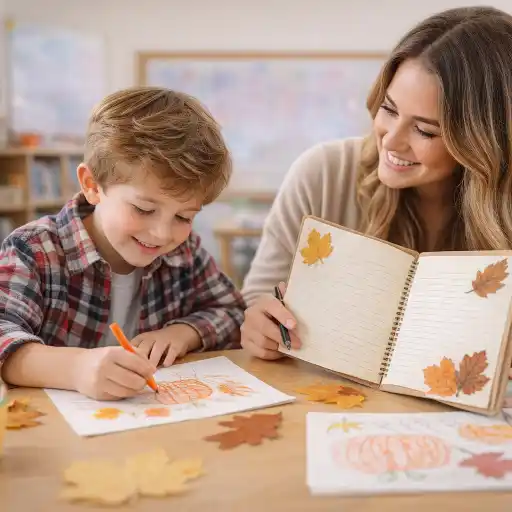
Dictation makes authorship possible before children can write conventional sentences. An educator records a child’s own words, reads them back, and invites the child to confirm or revise the message. The child remains the author; the adult acts as a responsive scribe. When the pages are collected in a class book, individual observations become a shared literacy experience with a real audience.
Autumn offers accessible topics children can observe directly: leaves changing or falling, rain, wind, seasonal foods, familiar walks, or imaginative stories about a pumpkin. The goal is not to teach one “correct” version of fall. Children’s locations, family traditions, and experiences differ, and a class book can make space for that variety.
The project supports oral language, vocabulary, print awareness, and a sense of belonging. Children see that spoken words can be written down, reread, illustrated, and shared. The Illinois Early Learning Project’s guidance on story dictation likewise describes how children can dictate stories and become authors even before they can write independently. A meaningful book values the child’s message—not polished handwriting or adult-level spelling.
- Children practice describing, recalling, and communicating ideas.
- They encounter the relationship between spoken language and print.
- A shared publication gives each contributor a valued place in the classroom community.
How do you invite children to contribute meaningful autumn words?
Begin with a shared experience or an open invitation, not a predetermined sentence everyone must repeat. Take a brief walk, examine classroom leaves, listen to rain, look at autumn photographs, or revisit a seasonal read-aloud. Ask children what they notice and allow time for them to respond. A comment such as “The leaf is crunchy” or “The wind took my hat” may be a complete page idea.
Use prompts that invite observation and imagination without turning the conversation into a quiz:
- “What do you notice outside today?”
- “What does this leaf look, feel, or sound like?”
- “What would you like someone reading our book to know?”
- “Would you like to tell me, draw it, point to a picture, or pass for now?”
Children may contribute in a home language, through a gesture, by pointing to an image, or with an augmentative communication system. If the words are not in English, preserve the child’s phrasing and work with family or staff language resources where helpful; avoid replacing the child’s meaning with a translation they have not confirmed. The ChildCareEd fall storytelling guide Buy Now $1.50 offers related ideas for seasonal vocabulary and flexible participation using words, gestures, pictures, and alternative communication.
Keep the project open to children who experience autumn differently. A child may dictate about a rainy day, a family tradition, an indoor observation, or an entirely invented fall adventure. Their interests provide the most engaging starting point.
How can you record a child’s words without taking over?
Listen closely and write the child’s message as they intend it. If a child says, “Wind make leaves go,” you can record those words as spoken rather than interrupting to correct grammar. Read the sentence back and ask, “Does that say what you wanted?” or “Would you like to add or change anything?” Make revisions the child requests, then read the updated version once more. This simple exchange communicates that the child controls the story.
Think aloud briefly when it helps make writing visible: “I’m writing your words so we can read them again.” Point to the words as you reread them, but do not make the dictation session a spelling lesson unless the child shows interest. The Education Endowment Foundation’s guidance on interactive writing in the early years describes practices such as rehearsing ideas, modeling, co-writing, and reflecting together.
Keep each entry manageable. One sentence, a short caption, or a few connected phrases can fit comfortably on a page. Offer the child choices about illustrating: drawing, painting, selecting a classroom photograph, or arranging a picture. They might also add their name, an initial, or a mark if they wish. Do not require children to copy the dictated sentence or produce the same kind of illustration.
- Record the child’s language accurately and respectfully.
- Read the text back and invite the child to confirm or revise it.
- Separate the child’s words from any adult-added title or context, if you include one.
- Preserve each child’s authorship and preferred way of participating.
How do you assemble the pages into an inviting class book?
Choose a simple format that suits your group: a binder with page protectors, a stapled booklet, or pages gathered in a classroom folder. Give the book a title that reflects children’s contributions, such as “Our Autumn Words,” “Things We Notice in Fall,” or a title chosen by the class. Include one child’s contribution per page when possible, with the dictated words easy to see alongside the child’s artwork or chosen image.
Make the book readable and welcoming rather than overly decorated. A cover, clear page order, and a consistent place for text help children recognize the book as a collection of messages. Invite children to help decide the order—perhaps by grouping observations about leaves, weather, and stories—without suggesting there is only one correct sequence. The class can add a simple contents page or child-created labels if those features serve a real purpose.
Before sharing the finished book, check that children are comfortable with their words and images being displayed. Follow your program’s privacy and family-consent practices, especially if photographs or identifying details are included. The book can live in the reading area, travel between classrooms, or be shared with families according to program policy. Consider using the Language and Literacy Foundations in Pre-K Buy Now $16.00 course for further professional learning about oral language, communication, and emerging literacy in everyday classroom experiences.
- Put the book where children can reach it and revisit it independently.
- Invite children to read their page aloud, have an adult read it, or simply listen.
- Welcome comments from peers that affirm the author’s ideas.
How can you make dictation inclusive and developmentally responsive?
There is no single way to be an author. Some children may offer a detailed sentence, while others point to a leaf, draw a picture, choose a symbol, or contribute a few words. Each form can carry meaning. Offer communication supports and materials suited to the children in your group, such as picture choices, large drawing tools, adaptive grips, translated key words, or a partner who can help record a message.
Give children time to think and do not pressure them to speak in front of a group. A one-to-one conversation or small-group invitation may feel more comfortable. Accept a child’s choice to observe or decline. If a child is still developing English, their home language is an asset; invite their words and use available resources to preserve the message accurately.
Common pitfalls are usually about adult expectations rather than children’s abilities. Avoid correcting pronunciation or grammar during dictation, insisting that every page follow the same prompt, or changing a child’s words into a more sophisticated adult sentence. These choices can unintentionally make the book about adult performance instead of children’s communication. Keep the focus on the child’s intended message, and follow program policies for materials, supervision, and family privacy. State requirements vary - check your state licensing agency.
- 🗣️ Accept words, signs, pictures, pointing, drawing, and alternative communication as valid contributions.
- Give children enough wait time to formulate or communicate an idea.
- Ask permission before recording or sharing personal stories and photographs.
- Use seasonal materials safely and follow classroom procedures for outdoor exploration.
How can you use the book to extend language and literacy?
Once the book is assembled, return to it often. Read it during a small group, invite children to find their own pages, or pause for them to recognize words and illustrations. Rereading gives children a chance to hear their ideas again and notice how their spoken language appears in print. It also creates natural opportunities for classmates to listen, ask questions, and make connections.
Extend children’s words into related play and inquiry. If a page describes a “swirly leaf,” look for movement outdoors or use scarves to represent swirling wind. If a child mentions rain, compare that observation with a window view or add a class drawing. Children may dictate a new page, revise an earlier idea, create a sequel, or act out one of the stories. Keep extensions responsive: the aim is to follow children’s curiosity rather than turn every page into a formal lesson.
Use brief observations to guide what comes next. Notice who is beginning to add descriptive words, sequence events, connect a picture with a spoken message, or participate in a preferred communication mode. A class book can also support family connections when children choose to share it. For targeted strategies on communication and language-rich interactions, explore Building Vocabulary Buy Now $16.00 and Science of Reading Foundations in the Pre-K Classroom Buy Now $16.00.
Most of all, treat the finished book as a living record, not a display that must be perfect. Children can keep adding pages as the season unfolds, building a growing collection of observations and stories.
Conclusion: What makes an autumn dictation project successful?
An autumn dictation project succeeds when children’s own words remain at its center. Invite observations and imaginative ideas, record them accurately, read them back for confirmation, and give children meaningful choices about illustrating and sharing. Assemble the contributions into an accessible class book that children can revisit with pride.
The project supports communication, vocabulary, emergent writing, and belonging without requiring conventional spelling or one uniform product. Make room for different languages and communication styles, respect each child’s choice to participate, and follow program policies when displaying work. From the first spoken observation to the pages classmates read together, the central goal is simple: help children experience their words as worthy of being heard, written, and shared.
- 45 Hour Child Growth and Development
- 45 Hour Preschool Methods and Materials
- What Makes Me Special: An Overview of Autism and ADHD
- 45 Hour Infant and Toddler Methods and Materials
- 45 Hour School Age Methods and Materials
- Art from the Heart for Preschoolers: Open Ended Art Projects that Build Self-Esteem
- Texas Director Credential
- 45-Hour Infant and Toddler Curriculum
- CDA Certification en Español: Recursos y Consejos para Educadores Bilingües
- 💛🧩 ¿Cómo puedo hacer que mi enseñanza sea inclusiva para los niños con autismo?
- Curso de Comunicación de 9 Horas de Maryland
- 10 Ejemplos de Cómo la Cultura Influye en el Desarrollo Infantil
- Cómo Trabajar en el Cuidado Infantil en Carolina del Norte: Requisitos y Pasos
- Cómo Trabajar en el Cuidado Infantil en California: Requisitos y Pasos
- Celebrando la amistad en el cuidado infantil durante el Día de los Mejores Amigos
- Canciones, juegos y preguntas de círculo para niños
- How Can Printable Books Help Preschoolers Fall in Love With Reading?
- How Can Fall Literacy Activities Build Early Language and Communication Skills?
- How Can Fall Classroom Projects Build Stronger Family Partnerships?
- How Can Child Care Providers Bring Autumn Indoors Through Texture Hunts and Open-Ended Art?
- Why Do Some Preschoolers Struggle to Listen and Follow Directions During Group Games?
- How Can Preschoolers Tell Evergreen Trees from Trees That Change Color?
- How Can Leaf Piles Become Preschoolers’ Next Great Story Adventure?
- What Should You Record During Child-Led Fall Play?
- How Can Woodland Mail Make Fall Dramatic Play a Meaningful Writing Experience?
- Why Is Matching Shadows More Than a Simple Preschool Game?
- How Can You Turn a Child’s Autumn Words into a Class Book?
