When preschoolers are asked to sit and listen for too long, even a thoughtful lesson can lose its spark. Short, active circle times can turn songs, stories, visuals, and children’s ideas into meaningful participation; for a deeper foundation in planning playful experiences, explore ChildCareEd’s Creating Engaging and Meaningful Learning Experiences  Buy Now $55.00 course. To strengthen your ability to adapt activities for different communication styles, languages, and abilities, consider Planning for Every Child: Responsive Strategies in Action Buy Now $55.00 as a next step.
For Michigan providers, the state’s Early Childhood Standards of Quality offer a framework for supporting children’s development while recognizing individual learning trajectories. These seven adaptable activities are designed for children ages 3–5 and make participation more active, inclusive, and joyful.
Why should circle time be brief, purposeful, and responsive?
Circle time can help children greet one another, practice listening and turn-taking, share ideas, and explore a topic together. Yet gathering everyone in one place is a teaching format—not a test of how long young children can sit still. NAEYC recommends adapting the approach to children’s needs and using whole-group time for focused purposes; a short gathering of five to ten minutes may be enough for one clear goal.
Engagement also looks different from child to child. A preschooler may listen while standing, contribute with a gesture, watch from the edge, or hold a prop instead of answering aloud. Those forms of participation can be meaningful. If the group begins to drift, treat that as useful information: shorten the activity, add movement, offer a choice, or move part of the experience to a small group.
Michigan’s standards support attention to the full range of children’s backgrounds and developmental expressions. In practice, this means planning with flexibility rather than expecting every child to respond in the same way. A clear purpose, a lively pace, and room for individual differences help circle time build connection instead of becoming a daily struggle.
Which seven activities invite children to participate?
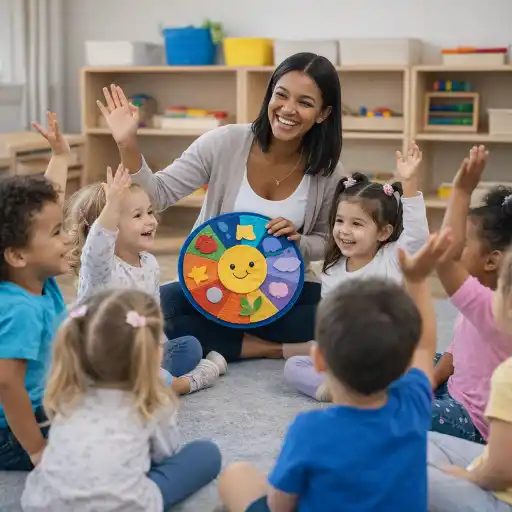
Choose one or two ideas at a time, connect them to children’s interests, and make sure each child has something to do—not just something to watch. The activities below combine movement, songs, storytelling, visual supports, and child-led conversation.
- 1. Greeting song with a choice: Sing each child’s name and invite them to answer with a wave, gesture, spoken greeting, or movement. A child can choose how to respond, supporting belonging without pressure.
- 2. Rhyme-and-move round: Say a familiar rhyme while children clap, tap, sway, or stomp to the beat. Try ChildCareEd’s Rhyme & Move: Nursery Rhymes, Rhythm, and Listening Activity Buy Now $1.75 for printable ideas that combine listening with action.
- 3. Story sound effects: Read a brief story and give children a sound or motion to add when a repeated word or event occurs—rain can bring finger taps, and a character’s footsteps can invite quiet marching.
- 4. Picture-card story sequence: Use three or four pictures to show what happens first, next, and last. Children can arrange the cards, retell the story, or point to the part they remember.
- 5. Mystery object discussion: Hide a safe, familiar item in a bag. Offer clues and ask, “What do you notice?” or “What might it be used for?” Children may guess, describe, or point to a choice.
- 6. Move-and-freeze listening game: Play or make a simple rhythm. Children move in place while they hear it and freeze when it stops. Offer seated actions, such as arm movements or tapping, too.
- 7. Child-led question of the day: Invite a child to choose a picture, classroom object, or topic for a short conversation. Ask peers what they notice, wonder, or have experienced, and record a few ideas for later exploration.
How can visuals and choices make the activities inclusive?
Visuals make the sequence easier to understand and reduce the need for repeated verbal reminders. A simple picture schedule might show “hello song,” “story,” “movement,” and “goodbye.” Point to each picture as the group moves through the routine, and remove or turn over cards as activities finish. Song boards or picture choices can also let children select what comes next.
Offer several ways to join in: talking, pointing, signing, moving, holding a prop, using a communication system, or watching nearby. Consider flexible positions and seating, including a chair, cushion, standing space, or a quiet spot close to the group. These options help children participate without requiring identical posture or eye contact.
Choose books, images, songs, and discussion prompts that reflect children’s home languages, families, and communities. Invite families to share familiar rhymes or greetings when appropriate, and avoid asking one child to speak for an entire culture. Pair spoken directions with a brief demonstration, gesture, or visual cue. Such adjustments make participation more accessible while preserving the shared experience.
How can educators keep the pace smooth and avoid common pitfalls?
Prepare the materials before inviting children to gather: place picture cards in order, choose the book, and check that props are safe and easy to pass. A predictable opening and closing cue can help children transition, while the middle activities remain flexible. Alternate quieter moments with active ones, and end while children are still engaged rather than waiting for attention to fade completely.
Common pitfalls are often invitations to adjust the plan:
- Too much talking? Replace a long explanation with a demonstration or a child’s turn.
- Too many agenda items? Choose one main purpose and save the rest for centers or small groups.
- Only one way to respond? Add pointing, movement, picture choices, or an option to pass.
- Children are restless? Shorten the gathering or insert a movement reset instead of increasing reminders.
- One child is not joining? Offer a low-pressure role, such as holding a card, or welcome watching nearby.
NAEYC’s discussion of circle time and small groups underscores that educators can adapt the format rather than expecting children to fit a long whole-group routine. State requirements vary - check your state licensing agency.
How can teams plan and learn from circle time?
Start with observation: Which songs prompt children to join? What stories lead to questions? When does attention shift? A brief note after circle time can capture what worked, which children contributed in different ways, and one adjustment to try next time. Use those observations to select activities linked to children’s emerging interests and developmental goals.
Connect the gathering to the rest of the day. A story about animals might lead to animal figures in dramatic play; a discussion of rhythm can continue with instruments at a music center; a question about snow or puddles can inspire outdoor noticing or a science exploration. The circle becomes a launch point for hands-on learning, not the only place where learning happens.
Directors and teaching teams can share activity ideas, prepare common visual materials, and reflect together on what engagement looks like for individual children. The Planning for Every Child: Responsive Strategies in Action Buy Now $55.00 course explores observation-informed planning, differentiated instruction, and accessible environments. For broader support in designing purposeful play and active experiences, the Creating Engaging and Meaningful Learning Experiences Buy Now $55.00 course offers related professional learning.
Conclusion: What makes Michigan preschool circle time engaging?
Engaging circle time for Michigan preschoolers ages 3–5 is brief, interactive, and responsive. Movement, songs, storytelling, visual supports, and child-led conversations give children different ways to participate while strengthening community and curiosity. The seven activities here can be adapted to your group’s interests, abilities, languages, and energy on any given day.
Choose one idea to try, watch how children respond, and adjust without judgment. A child who moves, points, listens, or contributes a question is part of the shared learning. When circle time follows children’s cues and connects to meaningful experiences across the classroom, it can become a joyful routine that supports everyone’s growth.
- Moving About the Classroom: Effective Transitions for Everyday
- Playful Learning: Infant & Toddler Activities
- Playful Learning: Infant & Toddler Activities
- CDA Preschool Credential with Portfolio Review
- 45 Hour Preschool Methods and Materials
- What Makes Me Special: An Overview of Autism and ADHD
- Children at the Wheel: Emergent Curriculum
- CDA Bridge Bundle: Preschool
- Setting the Stage: Story Time
- Lesson Planning for Preschoolers
- How can Michigan early childhood educators include children with Down syndrome?
- How can I teach colors, shapes & numbers through play in Michigan classrooms?
- How do I start portfolio assessment in Michigan early childhood programs?
- How can Michigan childcare and preschool programs support gifted children?
- How can circle time stay fun and keep children engaged?
- How can Michigan childcare providers build trust with families from day one?
- Circle Time Activities That Build Listening and Social Skills
- Circle Time Songs, Games, and Questions for Kids
- Canciones, juegos y preguntas de círculo para niños
- How Can I Make Circle Time Activities Work for Preschoolers?
- How can Michigan PreK classrooms support inclusion and children with special needs?
- How can I build family engagement in my Michigan program year-round?
- How can I create a daily schedule that meets Michigan's active learning expectations?
- How can my Michigan program build a simple mentoring system for new staff?
- How can Michigan child care programs effectively support children with hearing or vision impairments?
- What are age-appropriate Fourth of July activities for daycares?
- How can assessment results be used to plan meaningful activities in early childhood programs?
- How Long Should Circle Time Be for Preschoolers?
- What Are 10 Playful Literacy Activities for Michigan Preschoolers Ages 3–5?
- How Can Michigan Preschool Circle Time Keep Children Engaged?
