Short, thoughtfully planned celebrations can keep young children safe, included, engaged, and learning during the Fourth of July. This guide helps directors and providers create a calm, meaningful holiday experience for #preschoolers using low-mess crafts, sensory choices, movement breaks, concrete language, and clear communication with families. Educators can keep activities manageable by offering two or three stations and using brief periods of circle time rather than planning one long celebration. ChildCareEd’s self-paced online course The Best Promotion is Play  Buy Now $24.00 can help educators design playful experiences that support children’s physical, cognitive, social, and emotional development. Providers can also explore From Play to Planning: Building Culturally Competent, Child-Centered Curriculum Buy Now $55.00 for strategies to create intentional, inclusive activities that reflect children and families. For quick planning templates and ready-to-use ideas, see How to Celebrate the Fourth of July in Your Center or Daycare and the Stars & Stripes Celebration resources.
Why it matters:
Holidays add sensory load, crowding, and risk (especially fireworks). A simple plan protects little bodies and ears while honoring families. State requirements vary - check your state licensing agency.
1) How do I design a calm, inclusive Fourth of July plan for my daycare?
- 📋 Decide the length: schedule 2–3 activity blocks, 10–20 minutes each for preschoolers. See the short-block approach in ChildCareEd's celebration guide.
- 🎯 Choose 2–3 goals (example: color words, counting, turn-taking).
- 🧭 Pick 2–3 stations: craft, sensory, movement; include a quiet retreat for children who need it.
- 📝 Assign roles: one adult per station plus a floater for transitions and cleaning.
- 📣 Communicate: send families a one‑page schedule and permission form; keep language optional ("some families..."), as recommended in the ChildCareEd planning posts.
Tip: post photo cues at each station for substitutes. Use ready-made packets like ChildCareEd's Independence Day activity collection to reduce prep time (resource Buy Now $0.00).
2) What age-appropriate activities balance learning and safety?
- 🎨 Crafts (fine motor & choice)
- Paper-strip flags or sponge-painted flags for toddlers and preschoolers (ChildCareEd crafts).
- Pom‑pom flag sticks and pinwheels as tidy parade wands.
- 🧪 Sensory (hands‑on learning)
- Red/white/blue sensory bin with scoops and tongs; discovery bottles for a calm option.
- Shaving‑cream "fireworks" tray (supervise and set cleaning stations).
- 🎵 Movement (gross motor)
- Short parade with scarves or ribbon wands; bubble‑wrap stomp for energy release.
- 📚 Circle time: one short book, one concrete question; keep to 8–10 minutes.
Rotate small groups to avoid crowding. For age‑by‑age adaptations (infant, toddler, preschool), see the ChildCareEd Stars & Stripes guide (Stars & Stripes).
You can also borrow hands-on, inquiry-based station formats from ChildCareEd's Winter Holiday Fun STEM Activities to adapt safe, developmentally appropriate experiments and explorations to a Fourth of July theme.
3) How do I manage health, allergies, and food safely during celebrations?
- 📋 Collect written permissions for any food, repellent, or off‑site plans and post allergy lists at stations.
- 🧑⚕️ Follow CDC guidance on food allergies: have individualized plans, staff training, epinephrine readiness, and emergency steps (CDC: Food Allergies in Schools).
- 🥗 If families bring food, they require pre‑approval, ingredient labels, and strict hand‑washing routines.
- 🧴 For insect repellents or sunscreen, apply only with written permission and according to the label; document who applies and when.
- 🚑 Keep first‑aid supplies, incident report forms, and a clear 911 script accessible; practice the script in a brief staff huddle before the event.
State requirements vary - check your state licensing agency before food or medication changes. For staff training modules on illness, medications, and allergies, ChildCareEd has courses and checklists to support these steps.
4) How do I reduce fireworks/noise risks and support children with sensory needs?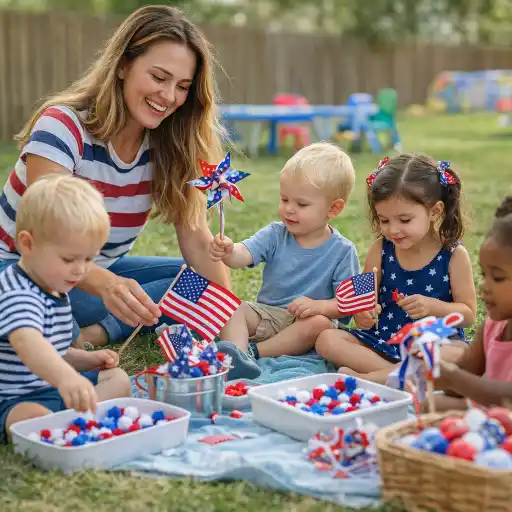
Fireworks and loud noises are the most common holiday hazards. Protect hearing and support sensory differences with layered strategies:
- 🚫 Policy first: no real fireworks or sparklers on program property; communicate this in family notes. ChildCareEd safety posts recommend pretend alternatives (see guide).
- 🔉 Offer choices: a muted/previewed fireworks video, glowing sticks, ribbon wands, and a supervised parade instead of live pyrotechnics.
- 🎧 Hearing protection: provide child-sized earmuffs and a quiet indoor retreat with soft lighting and calming toys for sensitive children (refer to AAP and ChildCareEd hearing guidance in state posts).
- 🧑🤝🧑 Staff supports: assign a staff buddy to any child who prefers one-on-one reassurance; label the quiet space and script staff on how to invite children there.
- 🩺 Emergency readiness: review burn and hearing‑injury steps and where to document exposures; practice scenarios in the pre‑event huddle.
For state‑specific safety guidance and community display advice, consult local ChildCareEd state posts (e.g., North Dakota, Minnesota, Michigan).
5) How can I involve families and avoid common mistakes?
Family involvement builds community when it is clear and low‑pressure. Use these numbered practices and watch for common pitfalls:
- 📨 Send a one‑page family note with times, pick‑up adjustments, and clear rules (no fireworks on site). Include a short learning note after the event and photos in a private group.
- 🤝 Offer optional, simple family roles (brief garden parade helper, read‑aloud volunteer) and collect permissions and visitor rules in advance.
- 🎒 Send home one take‑home (book list, coloring page, conversation prompt: "How does your family celebrate?").
Common mistakes & fixes:
- ❌ Too many stations → ✅ Limit to 2–3 rotating spots.
- ❌ Long, lecture-style circle time → ✅ Keep to 8–10 minutes with visuals.
- ❌ Allowing sparklers or loud devices → ✅ Insist on no on-site fireworks and offer safe props instead.
Quick FAQ for staff (4 questions):
- Q: Can we show fireworks videos? A: Yes—preview for loud sounds and offer an opt‑out.
- Q: How long should activities run? A: 8–20 minutes, usually 10–15 for preschoolers.
- Q: Can families bring food? A: Only with program policy and state licensing permission—state requirements vary; check your licensing agency.
- Q: What if a child is upset by noise? A: Offer the quiet space, earmuffs, or a staff buddy; reassure families about your plan.
Conclusion
Keep celebrations short, supervised, and choice‑driven: 2–3 stations, one short book, and a calm parade replace risky options. Prioritize #safety, offer #sensory alternatives, use simple #crafts to teach skills, and communicate clearly with #families and staff. Document permissions, post roles, and remember state requirements vary - check your state licensing agency. For ready lesson plans, station signs, and craft templates, use ChildCareEd resources like the Stars & Stripes Celebration and Independence Day activities (activity collection Buy Now $0.00).
- 45 Hour Preschool Methods and Materials
- 45 Hour School Age Methods and Materials
- CDA Bridge Bundle: Preschool without Portfolio Review
- Emergent Learning & Development
- Play with Purpose: Supporting Children with Autism
- Creating Engaging and Meaningful Learning Experiences
- Sensitive Periods in Montessori: Guiding Natural Learning
- Texas Director Credential
- Montessori Cultural Activities: Exploring the World Through Play and Learning
- Enriching Education: Field Trips
- 4th of July Fun Facts
- Que es Título 22 en California?
- Regulaciones de Licenciamiento de Cuidado Infantil en California para Centros y Hogares de Cuidado Infantil Familiar
- Normas de Licenciamiento de Cuidado Infantil en Virginia para Centros Diurnos Infantiles y Hogares Diurnos Familiares
- Proporciones de Cuidado Infantil y Tamaños de Grupo por Edad en Maryland (Guía Rápida para Centros y Hogares)
- Proporciones de Cuidado Infantil y Tamaños de Grupo por Edad en Wisconsin (Guía Rápida para Centros y Hogares)
- Proporciones de Cuidado Infantil y Tamaños de Grupo por Edad en Nueva Jersey (Guía Rápida para Centros y Hogares)
- Cómo Celebrar el Día Nacional del Kindergarten
- Lista para Guardería en Casa en Illinois: Cómo Iniciar una Guardería en el Hogar
- Las Mejores Ideas de Excursiones para Guarderías en Texas
- How to Celebrate the Fourth of July in Your Center or Daycare
- Calabazas, hojas y manzanas: actividades de otoño para preescolares
- How can Minnesota child care providers keep young children safe around Fourth of July fireworks?
- How can child care programs keep kids safe on the Fourth of July in North Dakota?
- How can my New York program help sensory-sensitive children cope with fireworks noise?
- What are age-appropriate Fourth of July activities for daycares?
- How Can Child Care Providers Integrate Counting into Seasonal Art Activities?
- How Do Wearable Crafts Support Fine-Motor Skills and Classroom Celebration?
- How Can Child Care Providers Teach Holiday Vocabulary with Context and Care?
- How Can a Fourth of July Activity Pack Blend Literacy and Math?
