When children practice kindness in small, predictable ways, ordinary classroom moments can become opportunities for belonging, empathy, and cooperation. A Supporting Social Learning: Creating Classrooms that Care  Buy Now $24.00 course can help providers connect a kindness calendar to relationship-based practice, problem-solving, and open dialogue while building relevant professional knowledge and training hours.
Why Do Kindness Challenges Matter for Classroom Community?
A classroom community is more than a group of children sharing a room. It is a network of relationships in which children and adults feel valued, psychologically safe, and responsible for one another’s well-being. NAEYC describes caring communities as environments grounded in positive relationships among children, educators, colleagues, and families. Head Start similarly emphasizes helpfulness, respect, cooperation, comfort, and empathy as skills children need to participate fully in group learning.
Kindness challenges make these abstract values visible. A calendar might invite children to greet a friend, help clean up, include someone in play, or notice a feeling. Each action creates a brief rehearsal of a social skill. Repeated over time, these rehearsals can strengthen children’s ability to communicate, cooperate, and repair relationships.
The goal is not to produce perfect behavior or reward children for being compliant. The goal is to create shared experiences that help children recognize their influence on the group. Thoughtfully designed challenges can also give quieter children, children with disabilities, dual language learners, and new enrollees accessible ways to participate.
How Can Providers Design an Age-Appropriate Kindness Calendar?
Begin with developmental expectations rather than a long list of adult-defined tasks. Infants may participate through responsive exchanges, gentle touch with permission, or offering an object to a distressed peer. Toddlers can practice greeting, helping, waiting, and using simple caring words. Preschoolers may suggest inclusive play, comfort a friend, collaborate toward a goal, or identify an unfair situation.
- Choose one brief action per day or several actions per week.
- Use concrete verbs such as “invite,” “help,” “listen,” and “thank.”
- Offer multiple ways to complete each challenge: words, gestures, drawing, movement, or assistance.
- Include self-kindness and care for the classroom environment, not only peer-directed acts.
- Adapt prompts for children’s language, sensory, motor, and communication needs.
For example, a weekly sequence might include: greet someone by name; help return materials; invite a peer to join; notice how someone feels; and thank a classroom helper. The calendar should function as a prompt, not a test. Children should never be pressured to hug, share treasured possessions, disclose feelings, or perform kindness publicly.
Use #kindness as an invitation to notice relationships, not as a label attached to particular children. A strengths-based approach recognizes effort, growth, and many forms of contribution.
How Should Teachers Introduce and Facilitate the Challenge?
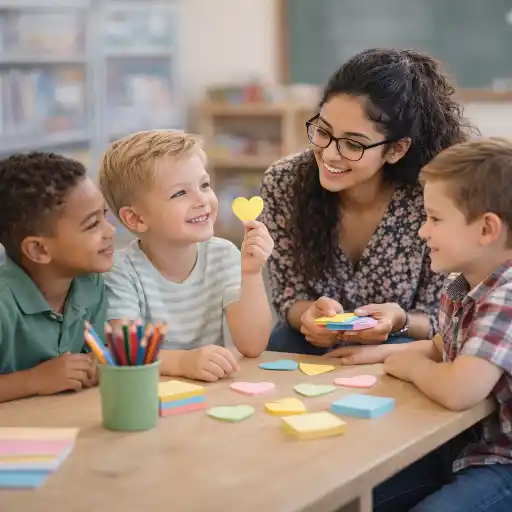
Launch the calendar during a short group conversation. Ask children what kindness looks like, sounds like, and feels like in their room. Record their ideas with photographs, drawings, symbols, or children’s words. This shared chart communicates that the community belongs to everyone.
Adults then model the prompt in real time. If the challenge is “help a friend,” a teacher might say, “I see that Jordan is carrying many blocks. I can ask, ‘Would you like help?’” Modeling makes the social process explicit without turning it into a lecture. During play, educators can narrate impact: “You moved over so Ana could join. Now there is space for two more friends.”
Keep the challenge visible and brief. Spend two or three minutes reviewing the prompt at morning meeting, then look for natural opportunities throughout the day. At closing, invite children to share an observation, drawing, or gesture rather than requiring every child to report an act.
- 😊 Use puppets to act out a kindness challenge before children try it.
- Provide sentence stems: “Can I help?”, “Do you want to play?”, and “Are you okay?”
- Use visual cards for children who benefit from concrete cues.
- Celebrate the process with specific feedback rather than prizes.
These routines align with social learning practices that prioritize relationships, problem-solving, and open dialogue. Providers seeking additional support may explore Social Foundations and Responsive Classrooms Buy Now $24.00, which addresses prosocial behavior, positive guidance, conflict resolution, and age-appropriate problem-solving.
How Can Challenges Promote Inclusion Rather Than Exclusion?
A kindness challenge strengthens community only when every child can participate as a respected member. Avoid prompts that assume one communication style, family structure, physical ability, or cultural practice. “Give someone a hug,” for example, can be replaced with “Offer a greeting that feels comfortable,” allowing a wave, sign, spoken greeting, smile, or shared object.
Review each prompt for hidden barriers. Can a child with limited mobility participate? Can a child who is learning English understand the request? Is there a nonverbal option? Would the activity unintentionally identify a child as the person who always needs help? Inclusive planning protects dignity while expanding participation.
- Use photographs, gestures, translated words, and home-language labels.
- Offer quiet participation, partner participation, and whole-group participation.
- Pair children thoughtfully, with adult support when needed.
- Represent diverse families, cultures, languages, and abilities in books and displays.
- Invite families to contribute ideas without requiring attendance or materials.
Family partnership can extend the challenge without making home participation an assignment. Send a short note such as, “This week we are noticing helpful actions. What helpfulness looks like at home may be different, and we would love to hear your family’s ideas.” This respects families as experts and avoids presenting one cultural definition of kindness as universal. State requirements vary - check your state licensing agency.
For deeper guidance on relationships with diverse families, consider Community and Family Engagement in Childcare Buy Now $24.00.
How Can Educators Respond When Kindness Challenges Do Not Go as Planned?
Children will refuse, forget, misunderstand, or complete a prompt imperfectly. That is not failure; it is information about the support they need. A challenge should never replace supervision, direct teaching, or responsive intervention when safety is involved.
When conflict occurs, use a concise sequence: stop unsafe behavior, name the problem, acknowledge feelings, offer two possible solutions, and support repair. For example: “Hands are safe. You both want the truck. You are frustrated. You can use the timer or choose another truck. How can we fix the blocks that fell?” This approach teaches children what to do next instead of shaming them for what happened.
Common pitfalls include:
- Competition: Avoid ranking children or counting who performed the most acts. Cooperation is the purpose.
- Forced kindness: Do not require apologies, sharing, touch, or emotional disclosure. Teach authentic repair and consent.
- Vague praise: Replace “Good job” with “You noticed her tower fell and offered a block.”
- Inconsistent adult language: Select a few shared phrases and practice them during staff meetings.
- Ignoring context: Consider fatigue, hunger, sensory overload, language differences, and developmental expectations.
A course such as You’re Not My Friend Anymore: Learning Conflict Resolution Buy Now $16.00 can complement a calendar by helping providers teach children developmentally appropriate ways to solve peer problems.
How Can Directors Evaluate the Impact of a Kindness Challenge?
Evaluation should focus on classroom climate and children’s developing skills, not on collecting impressive totals. Before beginning, identify one or two observable goals: more peer invitations during free play, more children using help-seeking language, smoother clean-up, or increased participation by children who are often overlooked.
Use brief observation notes. Record the date, context, children’s words or actions, adult support, and what happened next. Review patterns weekly with staff. Ask: Which prompts created meaningful interaction? Which children needed visual or peer support? Did the challenge unintentionally reinforce popularity, gender expectations, or adult definitions of helpfulness?
- Track examples of cooperation, invitations, comfort, and repair.
- Collect children’s drawings or comments about belonging.
- Invite family feedback through a short, optional question.
- Revise prompts that are too difficult, repetitive, public, or culturally narrow.
- Share group growth without publicly comparing individual children.
Documentation can also support curriculum planning and professional reflection. A director might use staff meeting time to examine how adult tone, room arrangement, transitions, and material access affect social behavior. The question is not simply, “Did children complete the calendar?” but “What conditions helped children care for and learn with one another?”
Conclusion: Can a Kindness Challenge Really Strengthen Classroom Community?
Yes—when it is brief, inclusive, developmentally appropriate, and embedded in warm relationships. A kindness calendar does not create community by itself. Adults create the conditions through modeling, responsive guidance, equitable participation, family partnership, and repeated opportunities to practice cooperation and repair.
Start with five prompts, one shared script, and one method for noticing growth. Invite children’s ideas, offer meaningful choices, and treat every challenge as a learning opportunity rather than a compliance exercise. With patience and consistency, small acts of #empathy can help children experience #belonging, strengthen #communication, and build a more caring #classroom.
For a practical next step, explore the Supporting Social Learning: Creating Classrooms that Care Buy Now $24.00 course to deepen your team’s approach to community building, relationships, problem-solving, and dialogue.
Frequently Asked Questions
How long should a kindness challenge last?
One to four weeks is manageable, but the underlying practices should continue throughout the year.
Should children receive prizes?
Usually not. Specific acknowledgment, reflection, and meaningful participation reinforce the value of kindness without turning it into a contest.
What if a child does not want to participate?
Offer observation, drawing, partner work, or another respectful option. Participation should not require touch or public performance.
Can infants and toddlers participate?
Yes. Adapt prompts to responsive exchanges, turn-taking, offering objects, noticing emotions, and helping with simple routines.
- CDA Home Visitor Subject Area 3 Part 3 Birth to 5
- From Tantrums to Triumphs: Equipping Preschoolers with Self-Regulation Skills
- The ABCs of Behavior: Turning Challenges into Learning Opportunities
- The Best Promotion is Play
- Brighter Futures: Social Emotional Development
- Creating Environments that Nurture Growth and Community
- The Right Kind of Influence for Young Children
- Stay Alert! Steps to Emergency Prep Online Version
- Supporting Families and Caregivers in Language and Literacy
- Moving About the Classroom: Effective Transitions for Everyday
- Celebrating International Women's Day
- Building Social Foundations
- The Family Day Care Chronicles: Tales of Laughter, Learning, and Unexpected Adventures
- Gift of Gratitude: Fostering Emotional Intelligence in Children through Acts of Kindness
- Deck the Halls with Emotional Wellness: Family Traditions That Foster Connection
- 10 Ejemplos de Cómo la Cultura Influye en el Desarrollo Infantil
- Cómo Trabajar en el Cuidado Infantil en Carolina del Norte: Requisitos y Pasos
- How can rainy day indoor activities help preschoolers learn kindness and cooperation in Georgia?
- Nurturing Hearts: Helping Children Grow with Kindness and Care
- How can child care programs host inclusive family celebrations that welcome every family?
- How can I create clubs and interest groups for school-age children?
- How Can We Teach Children the Value of Kindness Through Everyday Moments?
- How Can Child Care Programs Best Support Families Observing Ramadan?
- How Can I Celebrate Lunar New Year Respectfully and Effectively in My Classroom?
- After School Lesson Plans That Don’t Feel Like More School
- Mawlid Around the World: How Kids Can Explore Different Traditions and Celebrations
- Rosh Hashanah Kindergarten Lesson Plans: 5 Days of Apples, Kindness, and New Beginnings
- How Can Kindness Challenges Strengthen Classroom Community?
- How Can Child Care Providers Teach Empathy and Kindness in the Classroom?
- How Can Early Childhood Programs Introduce Juneteenth in Developmentally Appropriate Ways?
