How Can I Celebrate Lunar New Year Respectfully and Effectively in My Classroom?
Want to welcome the #Lunar festival in a way that builds cultural understanding, meets program goals, and supports every child’s sense of belonging? Celebrating Lunar New Year can strengthen classroom routines, teach #culture respectfully, and provide meaningful learning across language, math, art, and social-emotional domains. If you want a practical next step, explore ChildCareEd’s Cultures in the Classroom  Buy Now $24.00 course for planning culturally responsive lessons and family partnerships, and consider Bridging Cultures: Family Communication & Collaboration Buy Now $55.00 to build respectful family engagement. Both will help you gain usable strategies and clock hours for professional growth.
What is Lunar New Year and why should my program include it?
At its heart, the #NewYear celebrated across East and Southeast Asia is about family, renewal, and traditional values (like respect, gratitude, and good wishes). Introducing the festival in early childhood settings supports cultural competence, anti-bias learning, and real-world social studies. Why it matters: young children form ideas about other people through early experiences—celebrations that are calm, accurate, and inclusive reduce stereotypes and build empathy.
Practical benefits for your program include:
- Curriculum connections: language, storytelling, counting (zodiac animals), and movement.
- Family engagement opportunities that honor home traditions.
- Low-prep sensory and dramatic play that meet developmental objectives for infants through school-age children.
Tip: Keep messages simple and family-centered—use “some families” language and avoid assuming every family celebrates. For activity ideas tuned to birth–5, see resources such as Lunar New Year Activities (Ages 0–5) Buy Now $0.00 as part of planning culturally appropriate options.
How can I design developmentally appropriate Lunar New Year activities for different ages?
Match the same theme to each age level with different expectations. Use “same theme, different challenge” to make planning manageable in mixed-age groups.
- Infants: brief sensory experiences with safe red/gold fabric or scarves, simple picture books, and calming music (under constant supervision).
- Toddlers: short parades, lantern stamping, sorting red/gold manipulatives; keep steps short and repetitive to match attention spans.
- Preschool: pattern-making with red/yellow shapes, a simple “wishes” mural where children draw or dictate one wish, and a mini lion/dragon parade using simple instruments.
- School-age: research projects about zodiac animals, mapping where celebrations occur, or leadership roles in a classroom parade.
Safety note: avoid small items for infants and be mindful of food allergies when offering snacks. State requirements vary - check your state licensing agency. For guided lesson planning that integrates culture into learning goals, ChildCareEd’s Montessori Cultural Activities Buy Now $24.00 course has practical, play-based ideas you can adapt.
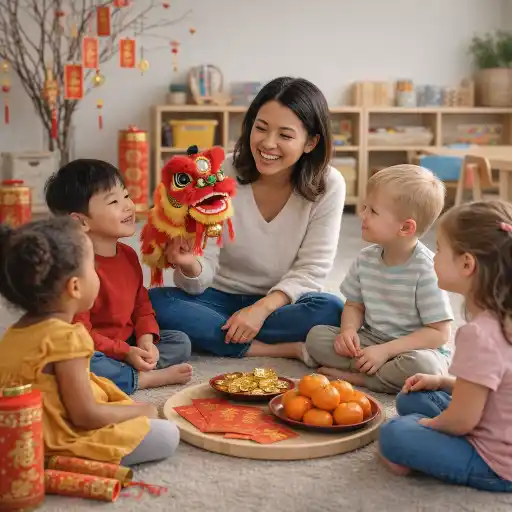
How do I involve families and avoid cultural appropriation?
Family partnership is essential. Invite families to share stories, foods, or photos—always with an option to decline. Share a brief note explaining what the classroom will do and why; offer ways families can participate (bring a book, suggest music, or provide a cultural artifact to show).
Practical steps:
- 🎉 Ask open-ended questions: “Would you like to share a family tradition?”
- Offer choices so families can participate at their comfort level (photo vs. food vs. story).
- Purchase decorations and materials from local Asian-owned businesses where possible to avoid commodifying culture.
To keep celebrations authentic and respectful, avoid using stereotypical costumes or treating the holiday as a costume party. If you’re unsure about a practice, ask a family ally or community member. For communication strategies and culturally responsive family engagement, consider ChildCareEd’s Bridging Cultures Buy Now $55.00 course to strengthen relationships and co-create classroom experiences.
How should I set up materials, transitions, and the classroom environment to support meaningful learning?
Design the environment so materials tell a story and invite exploration: thematic book displays, a sensory bin with red/gold textures, a role-play area with lantern-making prompts, and music for a short dragon parade. Intentionally place language supports—picture labels, simple dual-language words, and zodiac animal visuals—so children can access meaning independently.
- Rotation idea: short, supervised stations (art, sensory, movement, story) allow children to practice different skills without long transitions.
- Include documentation: photos of children’s work, captions, and learning goals to share with families and administrators.
- Accessibility: provide materials at child height, sensory-friendly spaces for children who may feel overwhelmed, and visual schedules to ease transitions.
For support in building culturally responsive environments and materials, ChildCareEd’s Creating Environments that Nurture Growth and Community Buy Now $55.00 and Building Bridges for Dual Language Learners Buy Now $25.00 offer concrete strategies for inclusive displays, dual-language supports, and sensory planning. If you are considering Montessori approaches, learn more about how Montessori can be inclusive for every child.
What common mistakes should I avoid, and how can I know if the celebration succeeded?
Common mistakes:
- Compressing complex traditions into a one-off spectacle—avoid turning meaningful rituals into props.
- Using stereotypes (e.g., fake accents, misused symbols) instead of teaching values and context.
- Forcing children or families to participate—participation must be voluntary and respectful.
How to avoid pitfalls:
- Collaborate with families and community members for accuracy.
- Center activities on shared values (family, kindness, new beginnings) rather than exoticizing elements.
- Offer alternatives and quiet options for children who need them.
Measuring success: look for evidence of learning (children using words from the theme, counting or pattern work tied to the festival, or showing empathy in sharing activities). Collect brief observations, photos (with consent), and family feedback.
If you want structured training to reduce mistakes and deepen impact, consider the Training Guide for Families from Diverse Language and Cultural Backgrounds Buy Now $24.00 to improve communication and inclusion.
FAQ — Practical Questions from Providers
- Q: How long should a Lunar New Year unit last? A: Short and meaningful—one to two weeks is often enough to integrate multi-domain learning without overemphasizing the holiday.
- Q: Can I include food? A: Yes, but keep it optional, label allergens, and secure family permission. Offer familiar alternatives so all children can participate.
- Q: What if I don’t have families who celebrate the holiday? A: Frame it as learning about how some families celebrate; invite any family to share if they wish, and use community resources (books, videos, community performers).
- Q: Should I teach the zodiac? A: Yes—use it as a math/literacy hook (sorting, sequencing, stories) rather than as a personality label for children.
Conclusion: What are the main takeaways?
Thoughtful Lunar New Year celebrations are small but powerful opportunities to promote #inclusion and deepen children’s cultural awareness. Prioritize respectful family partnerships, developmentally appropriate activities, and accessible environments. Use simple language (e.g., “some families…”) and focus on universal values like kindness and new beginnings. If you want structured guidance, ChildCareEd courses such as Cultures in the Classroom Buy Now $24.00, Bridging Cultures Buy Now $55.00, Montessori Cultural Activities Buy Now $24.00, Building Bridges for Dual Language Learners Buy Now $25.00, and Training Guide for Families from Diverse Language and Cultural Backgrounds Buy Now $24.00 will support your planning, family communication, and inclusive practice. Remember: small, accurate, and respectful celebrations help every child feel seen, and every family feels respected.
- Building Bridges for Dual Language Learners
- Building Bridges for Dual Language Learners: For Workforce Solutions
- Know Me For My Abilities: For Workforce Solutions
- Engaging Parents in the Montessori Toddler Classroom
- CDA Bridge Bundle: Family Child Care without Portfolio Review
- Classroom Setup for Child Care
- Texas Director Credential Renewal
- Texas Director Credential
- Cultures in the Classroom
- Building Bridges for Dual Language Learners
- What is Shavuot, Eid al Adha & Juneteenth
- Celebrating Diverse Cultures: Upcoming Holidays from Around the World
- CDA Certification en Español: Recursos y Consejos para Educadores Bilingües
- 👶 ¿Cuáles son las proporciones y grupos requeridos en Dakota del Norte? 🏫
- Lunar New Year in the Classroom: Hands-On Activities and Learning Ideas
- Recursos en Español sobre el Sueño Seguro del Bebé
- 10 Ejemplos de Cómo la Cultura Influye en el Desarrollo Infantil
- Capacitación en Salud y Seguridad Preventiva en Línea para Proveedores de Cuidado Infantil
- Proporciones de Cuidado Infantil y Tamaños de Grupo por Edad en Maryland (Guía Rápida para Centros y Hogares)
- Proporciones de Cuidado Infantil y Tamaños de Grupo por Edad en Nueva Jersey (Guía Rápida para Centros y Hogares)
- Proporciones de Cuidado Infantil y Tamaños de Grupo por Edad en Virginia (Guía Rápida para Centros y Hogares)
- Lista para Abrir una Guardería en Casa en Dakota del Norte: Cómo Empezar
- Lista para Guardería en Casa en Illinois: Cómo Iniciar una Guardería en el Hogar
- Lista para Guardería en Casa en Texas: Cómo Iniciar una Guardería en el Hogar
- Retraso del Habla en la Guardería: Cómo Pueden Ayudar los Proveedores
- Cómo Trabajar en el Cuidado Infantil en Wisconsin: Requisitos y Pasos
- Celebrando la amistad en el cuidado infantil durante el Día de los Mejores Amigos
- Diversión fresca de verano: actividades del Día Nacional del Helado para niños
- Cómo simplificar la capacitación para sus empleados de daycare
- How Can I Celebrate Lunar New Year Respectfully and Effectively in My Classroom?
