Ocean-themed sensory bins and water play are powerful, low-cost learning tools that encourage curiosity, language development, and hands-on practice with early math, science, and motor skills. For child care providers and directors, the key is balancing open-ended exploration with intentional learning goals, active supervision, and appropriate safety procedures. This article provides practical, evidence-informed steps for creating ocean-themed sensory experiences that are developmentally meaningful, inclusive, and licensing-friendly. Educators can strengthen their planning through ChildCareEd’s Environments That Inspire Independence and Exploration  Buy Now $55.00, which explores play-based learning, scientific inquiry, early mathematics, inclusion, and environments that support safe exploration. The Creating Safe & Healthy Child Care Environments Buy Now $55.00 course can also help providers maintain engaging classroom experiences while prioritizing children’s health and safety.
Sensory and water play engage multiple systems, including touch, vision, and proprioception, while supporting self-regulation, vocabulary growth, cooperation, and social problem-solving. When providers plan these activities with purpose, they can document children’s learning, meet curriculum goals, and reduce potential risks. Throughout the article, readers will find useful ChildCareEd resources and examples from experienced early childhood educators. State requirements vary, so always check with your state licensing agency.
1) How do ocean sensory bins and water play support learning and development?
2. Targeted developmental gains (enumerated):
- Fine motor skills — scooping, pinching, and using tongs strengthen pre-writing muscles.
- Language — labeling sea creatures, describing textures, and answering open questions builds vocabulary.
- Early math/science — sorting shells, measuring cups of water, and sink-or-float experiments foster counting and hypothesis testing.
- Self-regulation — repetitive, calming actions (pouring, sifting) help children manage emotions.
- Social skills — cooperative roles at the water table (captain, scientist) encourage turn-taking and negotiation.
3. Evidence-based practice: Sensory play is explicitly promoted in early childhood resources and trainings; for practical classroom connections, see How to Create a Sensory Bin for Exploration.
Use a single learning goal per session to keep play focused. Example: "Today we’ll count seashells into five cups" ties the fun to a measurable skill. Inline hashtags: this work directly supports #sensory #ocean #waterplay #preschool #safety.
2) What materials and taste-safe fillers should I choose for ocean themes?
- Safety first — avoid small choking hazards for young toddlers; prefer large shells and big scoops.
- Allergy-aware — when edible fillers are considered, confirm family permissions and center policy. For lists of taste-safe options, consult Speech Room News.
- Durability and cleanability — choose materials and tools that can be sanitized or replaced easily.
2. Recommended ocean-friendly bases and props (enumerated and practical):
- Base options: dry rice, colored aquarium gravel, play sand, or dyed pasta (🍚 rice and sand are inexpensive and tactile).
- Water options: shallow water in tubs or water tables, sea-themed gel (gelatin for supervised edible play) — see edible sensory examples at Fantastic Fun & Learning.
- Props: plastic ocean animals (Toobs), shells, measuring cups, strainers, droppers, and magnifiers.
3. Taste-safe alternatives & therapy-friendly options: if you need non-food options for allergic groups, try cornstarch cloud dough or soapy sea foam recipes from lesson plans like Sea Foam Sensory Bin. For bite-sized filler lists and therapy use,s see Speech Room News.
3) How do I design, set up, and link ocean activities to learning goals?
- Choose one measurable learning goal (e.g., counting to five, describing texture, taking turns).
- Select a base and 2–3 props that support that goal (e.g., rice + shells + scoops for counting).
- Plan setup and supervision: position the bin on trays, label tools, and establish a staff zone for active supervision.
- Write 1–2 open-ended prompts to guide adult-child interaction: "Which shell is heavier? How many can you scoop?"
- Observe, document one learning note per child, and adjust next week (rotate theme or complexity).
Practical examples and inspiration: for quick theme ideas, see What easy sensory bin themes, and for water table practice, refer to The Water Table. For literacy or alphabet links in a bin, explore alphabet water activities and ABC ocean bins like those at Fantastic Fun & Learning.
Use enumeration in documentation: 1 observation, 2 supports, 3 next steps — quick, useful, and shareable with families.
4) How can I plan for water safety, supervision ratios, and licensing compliance?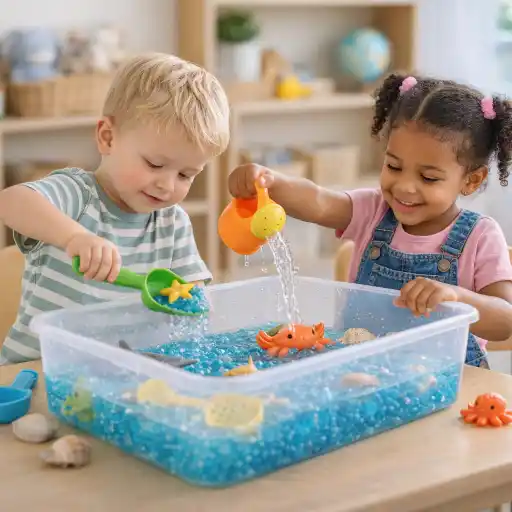
1. Core safety actions (enumerated):
- Active supervision — staff must be positioned to see and reach children immediately during any water play. ChildCareEd emphasizes active supervision in Water Safety.
- Arm’s-reach rule — keep infants and young toddlers within arm’s reach for tubs or shallow water bins.
- Quick-empty policy — empty water tables and buckets immediately after use; store lids and secure areas.
2. Staff training and emergency readiness:
- 🩺 Ensure staff have current Pediatric First Aid & CPR (ChildCareEd offers blended first aid resources).
- 📱 Keep emergency contacts and a phone accessible; post a brief water-safety checklist near the activity.
3. Licensing and program rules: state requirements vary - check your state licensing agency. Confirm maximum container sizes, ratios for water activities, and documentation expectations with your licensing specialist.
4. Practical supervision tools and routines:
- Assign zones and an explicit counting routine before and after play.
- Use visual markers for capacity and designated tools for each child.
- Choose shallow sensory-water experiences (trays, squish bags, or sealed sensory bottles) for centers where full water tables are impractical.
For program-level planning, pair written policies with on-the-floor coaching so practice matches policy; ChildCareEd resources on outdoor learning and summer safety provide operational examples: Beach and ocean-themed summer activities. For providers seeking concrete supervision practices for seasonal programming, review our supervision guidance for summer programs in the Dallas metro area for examples of staffing ratios, on-site routines, and family-communication templates. For city-specific supervision guidance and practical staffing routines for summer programs, see Nurturing Safe and Engaging Experiences: The Essential Role of Child Supervision in Houston's Summer Activities.
5) How can I involve families, avoid common mistakes, and extend learning beyond the bin?
1. Family and community engagement (enumerated):
- 📣 Share a one-page family note with photos and a learning tip: "Today your child counted shells to five! Try a shell hunt at home."
- 🐚 Ask families for safe donations (towels, sunglasses, plastic sea toys) and permission for edible fillers if used.
- 🏛️ Invite community partners — aquariums, lifeguards, or park rangers for a short talk or field trip (plan with safety ratios and permission slips).
2. Common mistakes and fixes (quick list):
- ❌ Too many small parts — Fix: scale props by age; keep large shells and scoops for toddlers.
- ❌ Unclear goals — Fix: pick one learning target and a prompt for staff to use.
- ❌ Weak cleanup plan — Fix: label bins, keep the cleaning kit nearby, and train staff on wash cycles.
3. Extending learning (enumerated):
- Turn a bin into a mini inquiry: "Which items sink? Which float?" Document predictions and results.
- Connect to books and music — add a read-aloud with props to spark language and pretend play. For themed crafts, simple DIY projects, and classroom-ready activities to pair with your sensory bin or send home with families, see our World Oceans Day resources.
- Send home a short activity sheet for families: shell-counting, nature walk prompts, or simple crafts.
FAQ (quick):
- Q: Can I use edible fillers? A: Only with family permission and allergy checks; many programs avoid food fillers for group bins (see safety tips).
- Q: How often rotate a station? A: Weekly or when interest fades — quick swaps keep engagement high.
- Q: What if air quality is poor? A: Move activities indoors and use non-water ocean sensory options like tissue-paper waves or squish bags.
- Q: Who must be trained for field trips? A: Supervising staff should have first aid/CPR and clear emergency plans; consult your licensing agency.
Conclusion
Ocean-themed sensory bins and water play are joyful, accessible ways to advance the goals of early childhood programs when planned with intention. Use simple planning loops (goal → materials → prompts → observation), choose age-appropriate and taste-safe materials, and embed clear water-safety routines. Involve families, document one clear learning note per child, and rotate themes to sustain interest. For practical training and deeper guidance, start with ChildCareEd resources like The Water Table and How to Create a Sensory Bin for Exploration.
- Balancing Physically Active Play in Child Care
- Building Early Science Foundations
- From Play to Planning: Building Culturally Competent, Child-Centered Curriculum
- Art from the Heart for Preschoolers: Open Ended Art Projects that Build Self-Esteem
- Effective Approaches for Autism and Inclusion
- Play with Purpose: Supporting Children with Autism
- Texas Director Credential
- 10 Hour Health and Safety Orientation Training
- Montessori Cultural Activities: Exploring the World Through Play and Learning
- Family Child Care: Building, Premises, and Outdoor Safety
- Indoor and Outdoor Activities
- Pumpkin Spice and Sensory Delight: Easy Autumn Sensory Bins for Early Learners
- CDA Certification en Español: Recursos y Consejos para Educadores Bilingües
- Recursos en Español sobre el Sueño Seguro del Bebé
- Proporciones de Cuidado Infantil y Tamaños de Grupo por Edad en Virginia (Guía Rápida para Centros y Hogares)
- Actividades de Otoño Fáciles para Preescolares esta Temporada
- How can I use beach and ocean-themed summer activities in my California early childhood classroom?
- How do I plan a California beach and tide pool field trip for early childhood classrooms?
- Autumn Activities for Toddlers and Preschoolers
- Celebrando la amistad en el cuidado infantil durante el Día de los Mejores Amigos
- Canciones, juegos y preguntas de círculo para niños
- Easy Pool Noodle Sea Creatures for Ocean Theme Activities
- Simple Field Trip Ideas Without Leaving the Classroom
- Summer Preschool Activities for Art, Science, and Sensory Play
- Summer Crafts and Activities for Preschool Classrooms
- How can ocean-themed sensory bins and water play boost learning while staying safe in preschool programs?
- Can your program go screen-free with engaging analog activities?
- How can inexpensive sensory bins boost language, fine motor, social-emotional, and cognitive development?
- Hello, Fall! Cozy Activities to Help Babies Explore the Season
- How Can Sensory Bin Ideas Promote Early Language Skills?
