Introduction
Teaching small children to notice and care about others is possible with short, steady steps. This article gives quick, easy ideas you can use every day in your #preschoolers room. It explains why empathy matters, simple routines to try, what to say during conflicts, and how to bring families in. For more depth, see Teaching empathy to young children from ChildCareEd.
Quick note: state requirements vary - check your state licensing agency.
Why should we teach empathy every day?
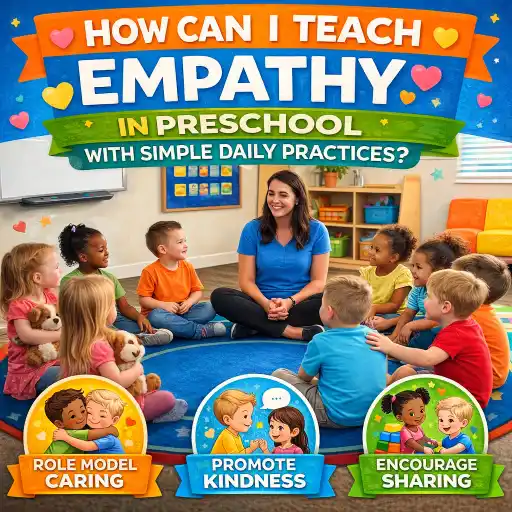
Why it matters:
- Children who learn to notice feelings get along better. This creates a calmer #classroom where children can #learn more (ChildCareEd: Teaching empathy).
- Empathy helps children solve problems and build friendships. It leads to fewer fights and more play that stays positive (ChildCareEd: Daily routines).
- When adults model caring, kids copy it. Small moments add up to big change (ChildCareEd: Social skills in action).
In short, teaching empathy builds safer spaces, stronger friendships, and better learning. That is why short daily practices are worth the small time they take.
What simple daily routines build empathy?
Use short, repeatable routines so empathy becomes part of your day. Try these ideas (each takes 1–10 minutes):
- 😊 Feelings check-in: At circle, ask each child to show a face or pick a feeling card. Name the feeling out loud and validate it. See sample scripts in Teaching empathy to young children.
- 🧸 Notice-and-name during play: Say things like, “Ava looks sad. I wonder how we can help.” This models how to spot feelings (ChildCareEd: Routines).
- ⏳ Helper jobs: Give one child a job to invite others or pass materials. Rotate jobs so everyone practices helping.
- 📚 Story pauses: Read a short book. Ask, “How does this character feel? What could a friend do?” Books are great practice for perspective-taking (ChildCareEd: Stories and play).
- 🎵 Kindness rituals: Use a kindness jar, wall, or a daily shout-out to notice helpful acts.
Tips:
- Keep language simple and repeat the same phrases often.
- Use visuals (feeling cards, photos). Young children need concrete clues to learn feelings well.
- Be consistent—small steps every day help empathy grow.
How do I coach empathy during conflicts without long talks?
Conflicts are practice. Use short, calm steps you can repeat when tensions rise. A simple script is: Stop, Name, Problem, Pick a Fix, Repair.
- 🛑 Stop: “Hands down. Safe bodies.” This keeps children safe instantly.
- 🔍 Name: “You look mad. He looks sad.” Label feelings so children learn words to use (ChildCareEd: Emotions in Motion).
- 💬 Problem: “Two friends want the red truck.” Say the issue in one sentence.
- ✅ Pick a fix (offer 2 choices):
- “Ask for a turn.”
- “Use the timer.”
- “Trade or find another toy.”
- 🔧 Repair: Ask a small fixing action: “Can you say, ‘Are you okay?’ or bring a bandage?” Praise the repair.
Why this works:
- It is quick—keeps the child calm.
- It teaches feeling words and helpful choices instead of blame.
- It practices repair, so children learn to fix friendships.
Note: Some children have big feelings tied to trauma or stress. Use trauma-informed strategies and training such as Trauma-Sensitive Care  Buy Now
 $16.00$11.00 to adapt responses.
How can I include families so empathy grows at home too?
Families are partners. Share simple words and small tasks they can use at home. Try these steps:
- 📩 Send short notes: “Today Sam helped Lina when she fell.” These pride-filled notes repeat the behavior at home (ChildCareEd ideas).
- 👨👩👧👦 Share scripts families can use: “How do you think your friend felt?” or “What can we do to help?”
- 🎯 Kindness challenges: A 7–14 day kindness calendar with one small act a day. ChildCareEd has a free sample: 14 Days of Valentine Kindness.
- 📚 Home reading prompts: Send book ideas with 1 or 2 questions to ask during story time.
- 🤝 Invite family volunteers for a short activity so adults model caring in the classroom.
Keep notes short and positive. Encourage families to model words and to notice kind acts. This creates the same message at school and home. Also share resources or trainings if families want more support.
Common mistakes and how to avoid them
- ❌ Forcing children to share—teach offers, trades, and turn-taking instead.
- ❌ Long lectures—use short scripts and practice moments.
- ❌ Ignoring small wins—notice and name them right away to build habits.
Quick FAQ
- Q: How long before I see change? A: Small steps show in weeks; steady change in months with daily practice.
- Q: What if a child is left out? A: Teach simple inclusion phrases and use peer buddies to invite them in (ChildCareEd).
- Q: Can children with delays learn empathy? A: Yes—use visuals, repeat scripts, and extra practice.
- Q: Where to get more ideas? A: Explore ChildCareEd courses and articles linked above for lesson scripts and activities.
Conclusion
Teaching empathy in preschool does not need long lessons. Use short daily routines, simple scripts during play and conflict, and involve #families so caring becomes normal. Small moments—naming feelings, offering choices, praising repairs—help children grow into kind, helpful people. For more practical tools and trainings, visit ChildCareEd resources such as How Can We Teach Empathy and Trauma-Sensitive Care.
Your daily practice matters. Keep it short, clear, and kind. Your #routines, your words, and your example will shape how children care for one another in your #classroom.
- Supporting Social Relationships Among Young Children
- Gift of Gratitude: Fostering Emotional Intelligence in Children through Acts of Kindness
- How can rainy day indoor activities help preschoolers learn kindness and cooperation in Georgia?
- How can I build a respectful classroom culture?
- Helping Children Learn Kindness, Empathy, and Belonging
- What Should California Child Care Providers Watch For in Preschool Social Skills?
- Celebrando la amistad en el cuidado infantil durante el Día de los Mejores Amigos
- “Remember the Alamo: Teaching Texas Young Children Courage, Teamwork, and Classroom Community”
- What Does Michigan's Overdose Decline Mean for Trauma-Informed Child Care?
- First Aid Lessons for Kids: Simple Skills They Can Learn
- Which activities and routines best help children develop empathy, self-regulation, and resilience?
- How can we teach kindness and friendship in our classroom?
- How can child care providers teach sharing and turn-taking without forcing it?
- How can I teach Black history to young children year-round?
- How Can We Teach Young Children to Care for the Environment?
- How can I build leadership skills in preschoolers using simple classroom strategies?
- How Can We Teach Young Children the Difference Between Fair and Equal?
- How Can You Create a Classroom That Teaches Kindness Without a Lesson Plan?
