Want to move beyond a single-month approach and teach Black history in ways that are respectful, developmentally appropriate, and sustainable? This article offers practical classroom strategies, activity ideas, and family-engagement approaches that help child care programs make Black history part of everyday learning. For a focused next step, consider ChildCareEd’s Diversity, Equity, and Inclusion in Education  Buy Now $16.00 to build culturally responsive practices and earn continuing training hours; preschool leaders may also find Building Equity: Inclusionary Practices in Preschool Buy Now $10.00 directly applicable to classroom routines and materials.
Why should we teach Black history all year—and why does it matter?
Teaching #BlackHistory year-round matters because representation and context shape how young children understand fairness, identity, and community. Introducing stories, music, and accomplishments across the year normalizes diversity and avoids tokenism. Young children make sense of big ideas through repeated, concrete experiences: seeing people like themselves in books, hearing diverse music in circle time, and learning everyday examples of fairness helps build social-emotional skills and civic awareness.
Why it matters in practice:
- Children develop positive identity formation when they regularly see diverse role models.
- Repeated exposure reduces stereotypes and supports empathy and inclusion.
- Programs that integrate Black histories into routines create more equitable learning climates for all children.
Practical note: state requirements vary - check your state licensing agency when recording CEUs or meeting training obligations.
How can I make lessons developmentally appropriate for toddlers and preschoolers?
Young children learn through play, repetition, and sensory exploration. Keep lessons short, concrete, and anchored to familiar routines. For infants and toddlers, prioritize images, music, and everyday language that communicates belonging—simple board books, photos of families, and music that invites movement. For preschoolers, add hands-on art, dramatized stories, and predictable rituals (e.g., a monthly “historical helper” spotlight or a “community builders” board) that reinforce concepts across time.
Classroom strategies:
- Use self-portraits and skin-tone color-mixing at the art table to honor identity (adapted from the Black History Month Activity for Kids Buy Now $0.00).
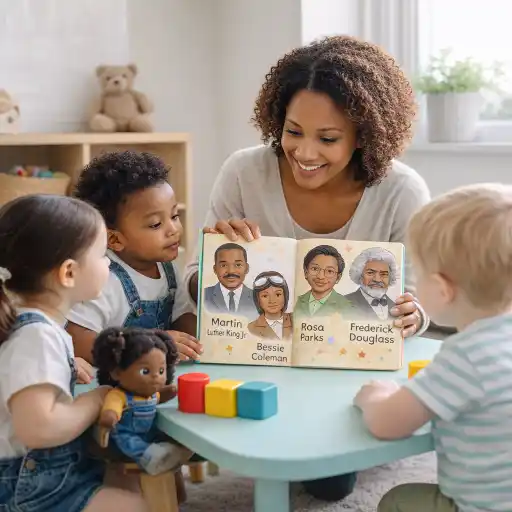
- Integrate short, repeatable read-alouds that show Black families and achievements; repeat the same selection across the week so children internalize content.
- Offer sensory bins, rhythm instruments, and movement breaks that connect to topics (e.g., dance and rhythm tied to cultural celebration).
- Plan invitations to play that reflect everyday roles—store, doctor, community helpers—with diverse props and images.
What materials and media best support year-round learning—how do I choose books, music, and activities?
Choose materials that center Black voices, show varied experiences, and avoid single-story stereotypes. Look for picture books that emphasize joy, creativity, and accomplishment as well as accurate biographies simplified for young learners. Balance historical figures with contemporary role models and everyday stories of Black families. Scholastic and other educator lists can help you identify age-appropriate titles, and ChildCareEd provides classroom-ready activities and free resources to adapt for mixed ages.
Selection checklist:
- Are the characters portrayed with full, human complexity (not only through struggle)?
- Do illustrations show Black families in everyday, joyful contexts?
- Is the language age-appropriate and open to conversation and questioning?
- Does the activity invite hands-on exploration and repetition?
Suggested ChildCareEd supports: the free Black History Month Activity for Kids Buy Now $0.00 offers an easy art invitation you can repeat any time. For broader historical grounding, consider the course Rooted in History: Early Childhood Buy Now $24.00 to connect historical context with classroom practice.
How can I engage families and the community to strengthen learning?
Partnerships with families and local organizations deepen learning and model respect for multiple perspectives. Start by auditing family bookshelves and asking families to share favorite songs, stories, recipes, or photographs. Host informal “culture share” family nights or create a rotating “community stories” display where families contribute artifacts or simple biographies. Invite local artists, musicians, or family members to lead short demonstrations or storytimes to make connections between home and classroom.
Practical tips for family engagement:
- Share a weekly photo or book list to invite home conversation.
- Offer take-home extension activities tied to classroom play (e.g., a simple family interview worksheet).
- Partner with local libraries or cultural centers to rotate materials or plan field trips.
- 📣 Use multimedia: audio recordings of family songs or brief video storytelling contributed by caregivers.
Remember: honor family choices and be strengths-based—what families already do is a resource for learning. If you need targeted strategies for linguistic diversity, see ChildCareEd’s Building Bridges for Dual Language Learners Buy Now $25.00.
How do I measure impact and avoid common mistakes?
Measuring impact in early childhood focuses on observable changes: children’s language, play themes, social interactions, and comfort with diverse peers. Use anecdotal records, simple checklists (e.g., children name a Black role model, include diverse people in block play), and staff reflections during planning meetings. Rotate responsibilities so all teachers add to and learn from observations.
Common mistakes—and how to avoid them:
- Avoid teaching Black history only in February—embed stories and representations into daily materials and routines.
- Don’t reduce lessons to stereotyping or single narratives; present a range of roles (artists, scientists, community leaders, families).
- Don’t over-expose very young children to traumatic content; balance truth with age-appropriate framing and agency.
- Neglecting family input—invite and honor family knowledge rather than assuming one correct narrative.
FAQ: Practical questions from providers
- Q: How often should I rotate books and displays? A: Rotate weekly or biweekly so children repeatedly see diverse images; keep a few permanent items that signal belonging all year.
- Q: How do I respond to a child’s question about racism? A: Keep answers short, truthful, and focused on fairness and safety: e.g., "Sometimes people are treated unfairly; we try to be fair and help others."
- Q: Can I use Black History Month materials any other time? A: Yes—re-purpose activity kits, biographies, and songs throughout the year to avoid tokenization.
- Q: What if staff feel uncertain teaching history topics? A: Invest in staff training—courses like Diversity, Equity, and Inclusion in Education Buy Now $16.00 or Building Equity: Inclusionary Practices in Preschool Buy Now $10.00 help build confidence and practical tools.
Conclusion
Teaching Black history year-round strengthens classroom inclusion, supports positive identity development, and helps children build empathy and civic understanding. Practical steps include selecting representative books and media, designing repeatable, hands-on activities, engaging families, and investing in staff learning. Use simple observation and reflection to monitor progress, and avoid tokenistic or stereotyped lessons by centering joyful, accurate, and diverse stories. For additional, structured training and CEUs, explore ChildCareEd’s offerings such as Diversity, Equity, and Inclusion in Education Buy Now $16.00, Building Equity: Inclusionary Practices in Preschool Buy Now $10.00, and the free Black History Month Activity for Kids Buy Now $0.00. Together, these steps help make Black history a meaningful and ongoing part of high-quality early childhood practice for children, families, and educators. #inclusion #children #books #families
- 45 Hour Preschool Methods and Materials
- Math Foundations in Early Childhood
- CDA Bridge Bundle: Family Child Care without Portfolio Review
- Connections That Count: Building Relationships in Child Care
- Texas Director Credential
- Wellness in Action: Teaching Healthy Habits to Children
- Montessori Cultural Activities: Exploring the World Through Play and Learning
- Supporting Families and Caregivers in Language and Literacy
- Moving About the Classroom: Effective Transitions for Everyday
- Theories on How I Grow
- Celebrate Juneteenth in Baltimore
- 🔍 ¿Qué ves cuando observas a un niño aprender?
- Activities for Black History Month: Classroom Ideas for Kids (Ages 2–8)
- Proporciones de Cuidado Infantil y Tamaños de Grupo por Edad en Nueva Jersey (Guía Rápida para Centros y Hogares)
- Proporciones de Cuidado Infantil y Tamaños de Grupo por Edad en Virginia (Guía Rápida para Centros y Hogares)
- Cómo Celebrar el Día Nacional del Kindergarten
- Lista para Guardería en Casa en Illinois: Cómo Iniciar una Guardería en el Hogar
- Cómo Trabajar en el Cuidado Infantil en Carolina del Norte: Requisitos y Pasos
- Cómo Trabajar en el Cuidado Infantil en Wisconsin: Requisitos y Pasos
- Celebrando la amistad en el cuidado infantil durante el Día de los Mejores Amigos
- Canciones, juegos y preguntas de círculo para niños
- Cómo simplificar la capacitación para sus empleados de daycare
- How Can You Celebrate Black Culture and Music Effectively in Your Program?
- How can I teach Black history to young children year-round?
- Crayon Colors Meaning: Favorite Color, Feeling, or Just the Crayon They Grabbed?
- How Can Early Childhood Programs Introduce Juneteenth in Developmentally Appropriate Ways?
- How Can Child Care Programs Celebrate Juneteenth Through Respectful, Child-Centered Art?
- How Can Coloring Pages Spark Meaningful Historical Conversations About Juneteenth?
- How Can Meaningful Juneteenth Vocabulary Support Early Writers?
- How Can Drawing and Dictation Help Children Respond to Juneteenth?
