Fall mushrooms can turn an ordinary walk into a rich science investigation—but children can explore them safely without touching or collecting them. Use photographs, careful questions, and comparison mats to build observation skills, and consider Basic Science in Early Childhood Buy Now $25.00 for practical guidance on supporting children’s scientific reasoning through intentional, developmentally appropriate experiences. Keep reading for a simple way to make fungi fascinating while reinforcing a clear safety boundary.
Why is observing fungi worthwhile for preschoolers?
Mushrooms invite children to slow down and look closely. Their varied caps, stems, colors, sizes, and growing places offer visible features to describe and compare. A photograph-based investigation can support early science practices—observing, sorting, asking questions, and sharing evidence—without requiring children to handle specimens.
Fungi also offer a chance to broaden children’s understanding of living things. Mushrooms are fungi, not plants; fungi do not make food through photosynthesis in the way green plants do. For preschoolers, a simple distinction is enough: “A mushroom is a fungus, and it grows in different places, such as on soil or wood.” Keep explanations accurate but brief, then return attention to what children can see.
The activity can also connect science with language and early math. Children can describe a picture as round, spotted, pale, or tall; group images by a visible feature; and explain how they decided. These conversations value children’s thinking without turning the experience into a test. Offering photographs rather than specimens also models respect for nature and gives children a meaningful way to investigate while leaving organisms undisturbed.
- Invite children to notice shape, color, size, texture shown in the image, and location.
- Use comparison words such as same, different, larger, smaller, smooth, and bumpy.
- Make room for “I wonder…” statements; curiosity is a strong starting point for inquiry.
How can mushroom photographs become a focused investigation?
Begin with a small set of clear, age-appropriate photographs: mushrooms growing on a log, in grass, or among leaves, for example. Choose images that show different forms without asking children to identify species. The aim is visual observation, not foraging knowledge or a judgment about which mushrooms are safe.
Introduce the activity with a simple prompt: “We are looking with our eyes, not picking.” Display one image at a time or place a few pictures on mushroom and forest science sorting materials Buy Now $0.00 for children to compare. Ask open questions, allow wait time, and accept answers through speech, pointing, drawing, gestures, or home-language words.
A useful inquiry routine is notice, compare, and represent. First, children say or show what they notice. Next, they compare two images. Finally, they record an idea by drawing, sorting picture cards, or dictating a short observation. If children wonder why mushrooms appear in some places, acknowledge the question and explain that photographs can show where they were found, but the class is not testing or identifying wild specimens.
- What do you notice first in this picture?
- What looks the same or different between these two images?
- What details help you explain your comparison?
How can observation and comparison mats support learning?
Observation and comparison mats give children a visual structure for organizing their thinking. A mat might include two picture spaces, simple prompts such as “I notice” and “I wonder,” and room for a child’s drawing or dictated words. Children can compare photographs by one feature at a time—cap shape, color, apparent size, or where the mushroom is growing—so the task stays manageable.
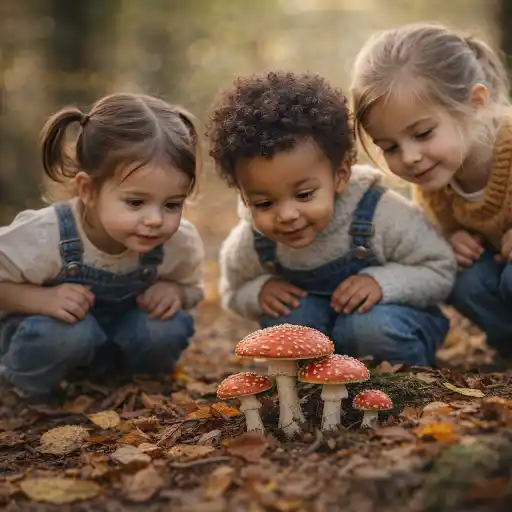
Keep the mat open-ended rather than treating it as a worksheet with one correct answer. A child may notice that one pictured mushroom is on a tree trunk while another is in grass. Another may focus on spots or color. Both observations are useful when they are grounded in the images. Educators can extend thinking by asking, “What did you see that helped you decide?” and recording children’s exact words.
For an easy small-group setup, provide a few photographs, large picture cards, crayons, and a shared comparison mat. Invite children to place images side by side, indicate a similarity or difference, and represent their thinking. Avoid magnifiers or other tools if they add complexity without helping children see the photographs more clearly.
- Offer only a few photographs at first, then add more if children remain engaged.
- Use picture cues and descriptive vocabulary to support multilingual learners and emerging communicators.
- 🍄 Celebrate a child’s careful noticing, even when it differs from a peer’s observation.
How should educators establish a no-touch safety boundary?
A clear, calm rule protects children while allowing genuine exploration: wild mushrooms are for looking at, not touching, picking, tasting, or collecting. Adults cannot reliably determine whether a wild mushroom is safe by appearance, and toxic and non-toxic varieties may look alike. Poison-control guidance recommends preventing children from eating wild mushrooms and supervising them closely outdoors.
Before an outdoor observation walk, inspect the area and decide whether photographs or viewing from a designated path are the safest option. Maintain active supervision, establish boundaries, and keep children from putting outdoor items in their mouths. If a mushroom is present in a play area, follow program policy for removing access safely; do not ask children to handle it. Wash hands after outdoor play as part of routine hygiene.
If a child may have eaten a wild mushroom, act promptly: contact Poison Help at 1-800-222-1222 in the United States and follow the poison center’s instructions. Do not wait for symptoms. Keep your program’s emergency procedures accessible and communicate with families according to policy. State requirements vary - check your state licensing agency.
- Use a consistent phrase: “We look at wild mushrooms; we never touch or taste them.”
- Choose photo cards or classroom images when outdoor conditions or supervision make a walk unsuitable.
- Make sure all staff know the program’s response steps for possible ingestion.
How can educators make the activity inclusive and extend it?
Children can participate in observation in many ways. Some may describe details aloud; others may point, match pictures, draw, use assistive communication, or listen while a peer shares. Offer accessible seating, large-print or high-contrast images where useful, and visual prompts. Pair children thoughtfully so every child has time and a meaningful way to contribute.
Extend the investigation through connected classroom experiences. Children might sort fungi and plant pictures, create a class chart of observed features, or make a shared book with drawings and dictated captions. The ChildCareEd fall nature STEM activities guide offers related ways to encourage inquiry through seasonal observation. For broader professional learning, explore Building Early Science Foundations  Buy Now $16.00, Creating the Natural Outdoor Classroom Buy Now $16.00, and Active Supervision: A Strategy That Works Buy Now $35.00.
Documentation can remain simple: save a photograph of the mat, write down one child’s observation, and note a possible follow-up question. Revisit the record later to see whether children notice new details or refine a comparison. This reinforces that science grows through careful attention and shared thinking, not just through collecting objects.
Conclusion: How can preschoolers learn about fungi without picking them?
Preschoolers can explore fall fungi safely by using photographs, clear comparison prompts, and a firm no-touch boundary. Invite them to notice visible features, compare images, represent their ideas, and ask new questions. Keep the focus on observation rather than identifying wild mushrooms as edible or poisonous.
With thoughtful supervision and accessible ways to participate, a mushroom photo investigation can support science, language, early math, and respect for living things. Start with a few images and one open-ended question; children’s careful observations can lead the next step.
Five relevant ChildCareEd courses
- 45 Hour Child Growth and Development
- What Makes Me Special: An Overview of Autism and ADHD
- Staff Supervision, Observation & Feedback
- Children at the Wheel: Emergent Curriculum
- CDA Bridge Bundle: Family Child Care without Portfolio Review
- CDA Bridge Bundle: Infant/Toddler without Portfolio Review
- CDA Bridge Bundle: Preschool without Portfolio Review
- Staff Supervision, Observation & Feedback
- Recursos en Español sobre el Sueño Seguro del Bebé
- Actividades de Motricidad Gruesa que Desarrollan el Equilibrio, la Coordinación y la Fuerza
- 10 Ejemplos de Cómo la Cultura Influye en el Desarrollo Infantil
- Proporciones de Cuidado Infantil y Tamaños de Grupo por Edad en Maryland (Guía Rápida para Centros y Hogares)
- Proporciones de Cuidado Infantil y Tamaños de Grupo por Edad en Virginia (Guía Rápida para Centros y Hogares)
- ¿Cuál es la Diferencia Entre la Crianza Respetuosa y la Crianza Permisiva?
- Actividades de Otoño Fáciles para Preescolares esta Temporada
- Calabazas, hojas y manzanas: actividades de otoño para preescolares
- Celebrando la amistad en el cuidado infantil durante el Día de los Mejores Amigos
- Canciones, juegos y preguntas de círculo para niños
- Cómo simplificar la capacitación para sus empleados de daycare
- What’s Happening Outside? Fall Science Adventures for Preschoolers
- Go on a Fall Hunt! Outdoor Learning Challenges for Preschoolers
- How Can Fall Nature STEM Activities Spark Preschoolers’ Scientific Thinking?
- How Can Preschool Teachers Use Fall Experiences to Support Individual Learning Needs?
- What Can Preschoolers Build to Catch the Breeze?
- How Can You Extend Fall Dramatic Play into November Without Starting Over?
- What Can Preschoolers Learn by Watching Trees Change Throughout the Fall?
- How Can You Create a Fall Listening Walk for Toddlers?
- How Can Preschoolers Observe Fall Mushrooms Without Picking Them?
