Why does a fall classroom vote matter?
A poll about whether to play leaf hunt, pumpkin roll, or acorn toss gives preschoolers a meaningful reason to count and interpret information. Rather than completing an abstract exercise, children gather data about a question that matters to them. They can see each response represented and use the results to discuss what the class might do next. That real purpose helps make early math concrete and memorable.
Voting also blends learning domains. Children practice making a choice, waiting for a turn, listening to peers, and using words such as “more,” “fewer,” “same,” “most,” and “least.” They may explain a preference verbally, point to a picture, or place a marker. Each form of participation can contribute to the shared investigation.
For providers, the activity offers a low-preparation way to observe developing skills. Notice whether a child connects one marker to one vote, counts items in a column, compares two groups, or explains what the display shows. A class graph can reveal useful next steps without making the experience feel like a test. The goal is not simply to identify a winning game; it is to help children notice how choices become information.
How should you prepare a fair, child-friendly poll?
Start with a clear question: “Which fall game should we play?” Offer a small number of distinct choices—perhaps leaf hunt, pumpkin roll, and acorn toss—and pair each with a recognizable picture or object. Avoid options that overlap or require children to understand unfamiliar terms. If the group is new to voting, two or three categories are usually enough to keep the display readable.
Choose a voting method that fits the children and classroom. Each child might place a name card, picture token, or sticker under one option. A ballot box can provide privacy, while a visible board makes the process easier to follow. Explain the rules in simple language before collecting votes: each child gets one vote, the poll closes at a stated point, and the results will help inform the plan. Be honest that adults still make final decisions when safety, weather, or schedules require it.
- Make each category visually distinct and label it with a picture and a few words.
- Use identical markers and a consistent space for each vote.
- Offer access through pointing, gesture, speech, home language, communication devices, or supported card placement.
- 🍂 Invite children to look at the options and ask questions before voting begins.
Keep the materials safe and appropriate for your age group. If using small loose parts, consider mouthing risks and follow supervision practices. A printable option such as the Pumpkin Patch Voting Booth activity Buy Now $0.00 can provide ballots, a voting board, and graphing mats for a seasonal classroom poll.
How can children cast votes and build the graph?
Model the process once before inviting children to participate. Point to each choice, name it, and demonstrate how one marker represents one vote. Then give children time to decide independently. Avoid asking them to justify a preference unless they want to share; the purpose is to record their choice, not to persuade them toward a particular answer.
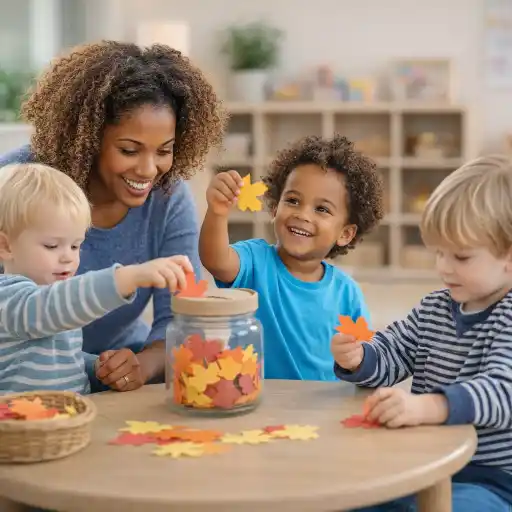
As votes come in, place each marker in a consistent row or column. A picture graph with one icon for each vote is especially concrete: children can match, move, and count the symbols. Keep icons the same size and spacing so the appearance does not distort the totals. The graph’s title should make the question clear, and each category should be easy to identify.
When the poll closes, count the votes together. Touch or point to each marker as the group counts aloud, matching one number word to one vote. For children who are ready, write the number beside each category or compare two columns. Do not rush to announce a winner before children have had a chance to inspect the display; the process of making the graph is part of the learning.
- Ask each child to place one marker, or support the child in indicating a choice.
- Count one category at a time, tracking each mark to support one-to-one correspondence.
- Check that the number of markers matches the number of children who voted.
- Keep the completed graph visible so children can revisit and discuss it.
How can you help preschoolers read and discuss the results?
Begin with observation rather than supplying conclusions. Ask, “What do you notice?” or “Which column looks like it has more?” Then encourage children to check their ideas by counting. Questions can be adapted to different levels of experience: a child might point to the largest group, count a category, or compare two totals with support.
Use everyday math language while discussing the graph. “Leaf hunt has more votes than pumpkin roll,” “Acorn toss has fewer,” and “These two choices have the same number” connect comparison words to visible quantities. For children ready for an additional challenge, ask how many votes separate two choices or how many votes the class cast altogether. Accept gestures, pointing, home-language responses, and demonstrations as meaningful ways to communicate reasoning.
- Which game has the most votes? How can we tell?
- Which has the fewest? Are any choices tied?
- How many children voted altogether?
- What would change if one more person voted for leaf hunt?
Use the result as a starting point for a thoughtful classroom decision, not as a measure of which children or preferences matter most. If the most popular choice cannot be played that day, explain why and offer a realistic alternative. Revisit the graph afterward: “We voted for pumpkin roll, and today we played it. What did we find out?” This closes the loop between data and classroom experience.
How can you make voting inclusive and developmentally responsive?
A fair process gives every child a meaningful way to participate. Some children may choose by speaking; others may point, use a communication device, sign, look toward a picture, or ask an adult to place their chosen token. Allow enough processing time, and avoid treating a spoken explanation as the only evidence that a child understands or has made a choice. For multilingual learners, include familiar images and, when possible, labels or discussion in children’s home languages.
Differentiate the math without separating children from the shared activity. A child who is beginning to count can help place one marker at a time. Another child may count a column, compare totals, or explain the difference. Keep the group question consistent while adjusting the supports, number of choices, or complexity of prompts. These adaptations help children participate together while working at appropriate levels.
Keep the poll emotionally safe. Avoid questions about private family matters, personal appearance, or comparisons that could single out a child. Do not pressure children to change votes because of peer opinions, and do not imply that the most popular option is automatically the best. If a child changes a vote while the poll is open, follow the rule stated at the start and update the graph visibly. Clear, consistent expectations support trust as well as data understanding.
What common mistakes should providers avoid?
Several small planning choices can make a classroom poll confusing or discouraging. Too many categories may overwhelm children and make the graph difficult to read. Unclear pictures or inconsistent labels can leave children unsure what they are choosing. Unequal icons, irregular spacing, or multiple markers for one child can make a display appear to show a different result than the actual count.
Another common pitfall is turning the activity into a contest. A popular choice can be interesting data, but the result should not imply that children who chose differently were wrong. Likewise, avoid praising only children who count quickly or answer verbally. The learning lies in noticing, representing, checking, and explaining—not in speed or a single response style.
- Keep the poll question and categories brief and understandable.
- Use one same-sized marker per vote and align markers consistently.
- Do not alter the graph without explaining and recounting the change.
- Do not promise the vote will decide the outcome if practical or safety concerns may affect the plan.
- Observe how children reason, not just whether they name the correct total.
After the activity, note one skill children demonstrated and a possible next step—for example, “Several children counted each vote accurately; next time, invite them to compare how many more votes one game received.” Directors can support staff by sharing reusable graph materials and planning a consistent routine for introducing choices, collecting votes, and interpreting results. State requirements vary - check your state licensing agency when aligning curriculum, documentation, or professional development with local expectations.
Conclusion: Which fall game should we play?
A classroom vote can help answer “Which fall game should we play?” while giving preschoolers a hands-on way to collect and read information. Keep the question simple, offer accessible choices, represent each vote consistently, and count the results together. Then invite children to describe what they notice using comparison language and their own ways of communicating.
The most valuable outcome is more than a winning game. Children experience how individual choices can be organized into shared data, and educators gain a window into counting, comparison, communication, and reasoning. Use the graph to guide a practical decision when possible, while making clear that adults remain responsible for safety and classroom logistics. With a few picture choices and thoughtful prompts, a fall game poll can become a joyful, inclusive math investigation.
Related professional learning: Math Foundations in Early Childhood  Buy Now $16.00; Early Mathematics Through Play Buy Now $24.00; No Such Thing as Boring Math Buy Now $24.00; Letter & Number Planning in Child Care Buy Now $24.00; Lesson Planning for Preschoolers Buy Now $24.00.
- 45 Hour Child Growth and Development
- Early Mathematics Through Play
- CDA Preschool Credential with Portfolio Review
- 45 Hour Preschool Methods and Materials
- What Makes Me Special: An Overview of Autism and ADHD
- Birth to Five CDA Credential with Portfolio Review
- CDA Bridge Bundle: Preschool
- 45 Hour School Age Methods and Materials
- Lesson Planning for Preschoolers
- CDA Certification en Español: Recursos y Consejos para Educadores Bilingües
- 😫🧸 ¿Qué hacer cuando un bebé no quiere dormir la siesta en el aula?
- ❄️ ¿Qué actividades al aire libre funcionan bien para los niños de Illinois en cada estación? 🌷🍂
- Juegos de Motricidad Gruesa
- Recursos en Español sobre el Sueño Seguro del Bebé
- ¿Cuáles son las mejores actividades del Día de la Tierra para niños en casa o en el aula?
- Actividades de Motricidad Gruesa que Desarrollan el Equilibrio, la Coordinación y la Fuerza
- 10 Ejemplos de Cómo la Cultura Influye en el Desarrollo Infantil
- Proporciones de Cuidado Infantil y Tamaños de Grupo por Edad en Maryland (Guía Rápida para Centros y Hogares)
- Proporciones de Cuidado Infantil y Tamaños de Grupo por Edad en Nueva Jersey (Guía Rápida para Centros y Hogares)
- Proporciones de Cuidado Infantil y Tamaños de Grupo por Edad en Virginia (Guía Rápida para Centros y Hogares)
- Actividades de Otoño Fáciles para Preescolares esta Temporada
- Retraso del Habla en la Guardería: Cómo Pueden Ayudar los Proveedores
- Celebrando la amistad en el cuidado infantil durante el Día de los Mejores Amigos
- Canciones, juegos y preguntas de círculo para niños
- Ice Cream Day Crafts, Games, and Learning Activities
- Can a Classroom Graph Mislead Children? How Picture Size and Spacing Shape What They See
- What Should You Do When a Child Changes Their Vote on the Classroom Graph?
- How Can a Pumpkin Delivery Game Turn Fall Movement Into Real Problem-Solving?
- Which Fall Game Should We Play? How Can Preschoolers Collect and Read Classroom Votes?
