When a child checks “Is it good?” after every mark, they may be looking for reassurance, not a grade on their drawing. Learn how to respond in ways that build confidence and keep the child’s ideas in the lead; Open Heart, Open Art  Buy Now $16.00 offers a deeper look at how open-ended art supports social-emotional development, while Power of Art: Building Self-Esteem & Positive Behavior for All Abilities Buy Now $24.00 explores inclusive, confidence-supporting art practices.
Why might a child ask for approval after every mark?
“Is it good?” can mean several things: “Do you like me?” “Am I doing this right?” or “Should I keep going?” A child may have learned that adults evaluate artwork by how recognizable, neat, or attractive it looks. They may also be uncertain, comparing their work with peers, or simply inviting connection. There is no single explanation, so begin with curiosity rather than assuming the child lacks confidence.
Young children’s mark-making develops through exploration. Scribbles, repeated lines, dots, and color experiments can be meaningful experiences even when they do not depict a recognizable object. If adults answer every check-in with a score—“Yes, that’s good” or “No, try again”—the child may begin to rely on adult judgment to decide whether to continue. A supportive response instead communicates that the child’s choices and effort matter.
This is not a reason to withhold warmth. Children deserve genuine connection, and educators can offer it without judging the product. Process-focused responses help preserve children’s #confidence, nurture #creativity, and support #agency in the art-making process.
- Notice what the child may be seeking: encouragement, help, attention, or a chance to share.
- Respond warmly, but avoid making your preference the measure of success.
- Remember that some children may want feedback; offer it thoughtfully and specifically.
What can you say instead of judging the artwork?
Start by acknowledging the child’s question, then shift toward observation or reflection. Descriptive language tells children what you notice without defining whether the work is “good.” It can also invite them to notice their own decisions and decide what they want to do next.
- “You’re wondering what I think. I notice you made three long lines.”
- “You chose to add another mark right beside the first one.”
- “What do you think about how it’s going?”
- “Would you like to tell me what you were trying, or would you rather keep drawing?”
- “There isn’t one right way to make this. You can decide what to try next.”
Keep your tone sincere and your comments specific. Generic praise such as “You’re so talented” or “That’s perfect” may sound kind, but it can imply that approval depends on performance. Likewise, rapid-fire questions can turn an open art experience into a quiz. Ask one inviting question, then give the child time to answer—or to continue working without talking.
If a child asks for a concrete opinion, respond honestly without ranking the art. You might say, “I like spending time with you while you make it. I’m curious what you like about it,” or describe a particular feature you genuinely appreciate. The goal is not to avoid conversation; it is to make room for the child’s own view. For more strategies on open-ended creative practice, explore ChildCareEd’s Open Heart, Open Art Buy Now $16.00 course.
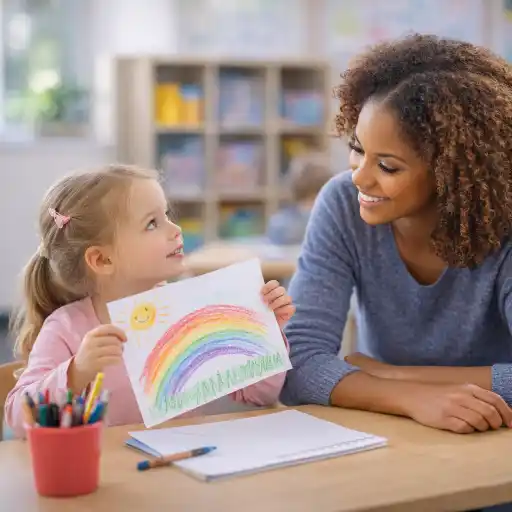
How can educators support self-evaluation without taking over?
Children can learn to notice their own choices when adults invite reflection without demanding a “correct” answer. Rather than acting as the final judge, help the child pause, observe, and decide. A prompt such as “What part would you like me to notice?” respects that the child may have a purpose—or may simply enjoy making marks.
Try a short, predictable exchange:
- Connect: “You’re checking in with me.”
- Observe: “I see you added small green marks beside the orange ones.”
- Return the decision: “What do you think? Would you like to add more, change something, or be finished?”
Some children may not yet have words for their preferences. They can point, gesture, use a communication device or home language, add another mark, or choose from simple picture options. A child’s response need not be verbal to show agency. If they ask you to choose for them, you can offer manageable options—“Would you like to keep this part or try another color?”—without taking the tool from their hand.
Reflection cards can make these conversations more accessible and consistent across a classroom team. The sellable resource My Art Decisions Reflection Cards can be used to support child-led reflection: invite children to consider their choices, feelings about the process, or what they might try next. Use cards as an invitation, not a test; children should always be free to decline or answer in their own way.
How can the art environment reduce pressure for approval?
Children are more likely to explore when art is not treated as a performance for adults. Provide time, accessible materials, and opportunities to return to work. Avoid showing a finished sample that implies one expected result. Instead, demonstrate how to handle materials safely on your own paper, then let children direct their own making.
- Offer a few appealing choices of paper, tools, colors, and materials rather than overwhelming children with everything at once.
- Make materials accessible and adapt tools or surfaces so children with varied abilities can participate.
- Allow children to pause, continue later, change direction, or decide they are done.
- Ask before writing on, photographing, displaying, or sending a child’s artwork home.
- 🎨 Keep some art experiences open-ended, with no model to copy and no single correct outcome.
These practices make choice visible. They also help children experience mistakes and unexpected marks as part of exploration rather than evidence that they have failed. If the child asks “Is it good?” again, respond consistently and kindly: notice a choice, invite their perspective, and give the decision back. Over time, predictable responses can help shift attention from adult approval toward the child’s own ideas.
What common responses can unintentionally increase dependence on praise?
Adults often respond automatically to a child’s request for reassurance. “It’s perfect!” can settle the moment, but if it is the only response, the child may return for the same verdict after each mark. “That doesn’t look like a dog” or “You need to color inside the lines” can communicate that art has a narrow standard and that adults determine whether a child is succeeding.
Consider these common pitfalls and alternatives:
- Rating every mark: Replace “good” or “bad” with a specific observation or a question about the child’s own view.
- Guessing what the image represents: Describe visible features and let the child decide whether to name the work.
- Correcting or finishing the picture: Model a technique on separate paper, or offer help only when the child wants it.
- Praising only attractive results: Notice persistence, experimentation, material choices, and problem-solving—not just appearance.
- Pressuring the child to explain: Make sharing optional; silence can simply mean the child wants to keep creating.
Providers can discuss these patterns at a staff meeting and agree on a few shared phrases. Consistency matters more than finding one perfect sentence. If an artwork or a child’s comment raises a separate concern about safety or well-being, follow program procedures and consult appropriate supervisors; do not treat artwork alone as a diagnosis. State requirements vary - check your state licensing agency when planning art experiences and selecting materials.
Conclusion: How can we answer “Is it good?” while keeping the child in charge?
When a child asks “Is it good?” after every mark, respond with warmth, describe what you notice, and invite the child to reflect on their own choices. Offer specific feedback when it is genuinely useful, but avoid turning yourself into the authority who determines whether the drawing deserves approval. Choice, time, accessible materials, and optional reflection give children room to make art on their own terms.
The central goal is not to stop children from seeking connection; it is to help them experience connection without making adult approval the measure of their creative work. Keep a few thoughtful prompts nearby, invite children to use My Art Decisions Reflection Cards when helpful, and consider Open Heart, Open Art Buy Now $16.00 for focused professional learning about open-ended art and children’s social-emotional development. These small shifts can make the art area a place where children feel safe to experiment, decide, and trust their own ideas.
- Notice and describe instead of rating.
- Ask for the child’s perspective and accept nonverbal responses.
- Offer meaningful choices and avoid a model that children must copy.
- Respect each child’s decision about explaining, changing, or sharing their work.
Five ChildCareEd courses for continued learning:
- Open Heart, Open Art Buy Now $16.00
- Power of Art: Building Self-Esteem & Positive Behavior for All Abilities ONLINE Buy Now $24.00
- Art from the Heart for Preschoolers: Open-Ended Art Projects that Build Self-Esteem Buy Now $35.00
- Open Ears: Listening in Child Care Buy Now $16.00
- Supporting Children’s Independence Buy Now $24.00
- 45 Hour Child Growth and Development
- 45 Hour Preschool Methods and Materials
- CDA Family Child Care Credential with Portfolio Review
- CDA Bridge Bundle: Preschool
- 45 Hour School Age Methods and Materials
- CDA Bridge Bundle: Family Child Care
- CDA Bridge Bundle: Family Child Care without Portfolio Review
- CDA Bridge Bundle: Infant/Toddler
- Texas Director Credential
- CDA Certification en Español: Recursos y Consejos para Educadores Bilingües
- 😫🧸 ¿Qué hacer cuando un bebé no quiere dormir la siesta en el aula?
- Recursos en Español sobre el Sueño Seguro del Bebé
- Que es Título 22 en California?
- Regulaciones de Licenciamiento de Cuidado Infantil en California para Centros y Hogares de Cuidado Infantil Familiar
- Retraso del Habla en la Guardería: Cómo Pueden Ayudar los Proveedores
- Celebrando la amistad en el cuidado infantil durante el Día de los Mejores Amigos
- CDA Practice Test Questions Explained: How to Choose the Best Answer
- CDA Practice Test by Competency Area: What Should You Study?
- How Can Child Care Directors Make Inclusive Practices Consistent Across Every Classroom?
- How Can Bingo Games Support Turn-Taking and Social Skills?
- Why Are Self-Checking Clip Cards Great for Independent Practice?
- How Can Child Care Providers Make Transitions Easier for Children With Different Needs?
- How Can One Science Question Become a Preschool Investigation?
- How Can Child Care Providers Respect Families Who Decline Handmade Classroom Gifts?
- How Can We Help School-Age Children Explain the Facts They Copy?
- What Should You Ask Families Before a Classroom Winter Celebration?
- How Can Home-Language Words Enrich Shared Reading?
- How Can Child Care Providers Support Children Who Need More Time to Respond to Questions?
- How Can Educators Respond When a Child Asks “Is It Good?” After Every Mark?
