When a child can copy red-blue-red-blue, the next step is not simply a longer worksheet—it is helping them notice the rule and make choices of their own. Early Mathematics Through Play Buy Now $24.00 offers child care providers practical ways to connect patterns with reasoning, routines, and hands-on learning. Read on for a classroom-ready progression, and explore the course for a broader foundation in playful early math.
Why does moving beyond copying matter?
Copying is a meaningful starting point: a child attends to a model, matches elements, and reproduces a sequence. But pattern understanding grows when children can explain what repeats, anticipate what comes next, and use a rule in a new context. These actions bring children from surface matching toward mathematical structure and early generalization.
Patterns provide an accessible way to explore relationships. A repeating sequence can be built with colors, shapes, sounds, movements, or natural materials. Children may discover that clap-stomp-clap-stomp has the same structure as red-blue-red-blue, even though the materials differ. Research and curriculum guidance connect this work with foundational algebraic thinking: children observe regularity and describe how a sequence is organized.
This progression also supports language, confidence, and agency. When educators invite a child to decide what their own pattern will be, the child becomes a maker of mathematical ideas—not just a follower of directions. For #preschoolers, these experiences should remain playful, concrete, and responsive to their interests. The aim is not to rush toward abstract notation but to make children’s reasoning visible through talk, action, and materials.
What is a useful progression from copying to creating?
Children often benefit from moving through connected experiences rather than being expected to invent a complex pattern immediately. The progression is flexible: children may move back and forth between steps, and an individual’s experience with materials, language, and motor tasks can shape what feels accessible.
- Notice: Look at a short sequence and discuss what seems to repeat. “I see red, blue, red, blue.”
- Copy: Reproduce a model with matching materials or actions, paying attention to the order.
- Continue: Extend the sequence by predicting what comes next, including when the model ends partway through its repeating unit.
- Describe: Identify the smallest part that repeats—for example, red-blue—rather than naming every item separately.
- Create: Choose a rule and materials, then repeat the unit enough times to show that the sequence is intentional.
For example, model a big-small pattern with two sizes of toy animals. Invite children to copy and continue it, then ask, “What part happens again?” A child might then choose two different animals but keep the big-small rule. This change of material while keeping the structure is a useful step toward generalizing an idea. The sequence should be sustained for several repetitions so adults can tell whether the child is applying a rule rather than arranging objects at random.
How can educators scaffold without taking over?
Scaffolding means providing just enough support for a child to take the next step while keeping the child’s thinking at the center. Begin by observing what the child does independently. Then choose a prompt, model, or material adjustment that helps them attend to the relationship in the sequence—not merely to the answer adults expect.
Use clear, brief questions and allow wait time. Naming the first few elements aloud can support children who are still learning to track a sequence. If a child is unsure, point to the repeating part, offer two possible next objects, or demonstrate how to move one complete unit along the line. Reduce support as the child gains confidence.
- “What do you notice happening again?”
- “Which part is your repeating part?”
- “What do you think comes next? What makes you think that?”
- “Can you make the same pattern using different objects?”
- “Would you like to make a pattern for a friend to continue?”
- 🧩 Invite a child to change one feature—such as color—while keeping the sequence rule the same.
Accept speech, gesture, movement, pointing, and object placement as ways to communicate thinking. Avoid turning each interaction into a quiz or correcting before you understand the child’s intention. A child may be using a different rule from the one you modeled; asking them to explain or show their idea protects their agency and gives you valuable information about their understanding.
Which materials and activities make pattern ideas accessible?
Use familiar, easy-to-handle materials so children can focus on the pattern instead of a difficult motor task. Identical objects in contrasting colors or sizes can make the sequence easier to see. Loose parts, blocks, large beads, toy animals, leaves, and stones can all work when selected and supervised safely. Some children may benefit from starting with large objects laid out in a line before trying threading, gluing, or other fine-motor activities.
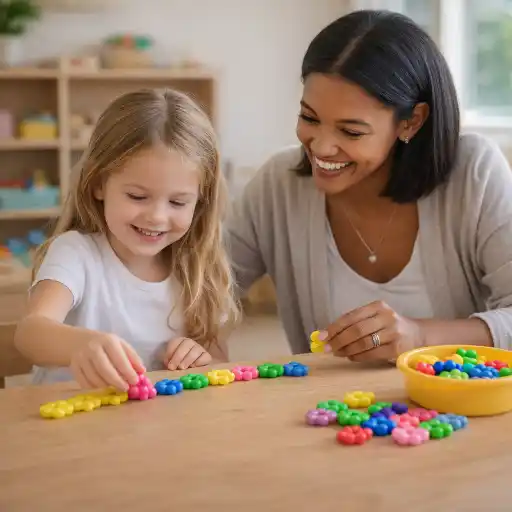
Vary the mode so children encounter the same mathematical idea in different forms. A movement sequence such as jump-clap-jump-clap, a rhythm such as drum-shaker-drum-shaker, and a row of two colors all make repetition tangible. Everyday opportunities count too: repeated phrases in books, rhythms in songs, and visible arrangements in nature or the classroom can prompt casual pattern talk without interrupting play.
- Objects: Set out two or three kinds of large, safe loose parts and invite children to make a repeating design.
- Movement and sound: Let one child create a short body-percussion pattern and another echo or extend it.
- Outdoor exploration: Notice and collect suitable natural materials, then sort and arrange them together.
- Peer collaboration: Take turns making a sequence for a partner to copy, continue, or adapt.
Introduce complexity gradually. After children are comfortable with AB, explore structures such as ABC, AABB, or ABB, while making clear that repeated elements do not have to alternate one by one.
How can providers notice progress and adapt support?
Observe children during play across different materials and contexts. A single activity is only a snapshot; a child may copy successfully with blocks but need support to recognize the same structure in sounds. Record what the child actually does, the support provided, and a practical next step. This makes observation useful for planning without turning a playful experience into a high-stakes test.
For example, a note might say: “During loose-parts play, Maya copied red-blue-red-blue and continued the line after the educator named the first two colors.” A possible next step could be offering two shapes and inviting Maya to choose a rule. Notice whether the child can identify or sustain a repeating unit, predict a next element, repair a deliberate error, or create a pattern that another person can follow. These are useful observations, not labels of fixed ability.
Adjust the experience to provide access and an appropriate challenge. Some children may need fewer choices, larger materials, a shorter sequence, a high-contrast display, visual cues, or a modeled first step. Others may be ready to represent a movement pattern with objects or create a pattern that ends partway through its unit. Support home languages and varied communication styles; children can show understanding by arranging, pointing, moving, drawing, or speaking.
For leaders, a shared approach can help staff plan consistently: agree on a simple progression, keep adaptable materials available, and share brief observations during team reflection. State requirements vary - check your state licensing agency when aligning documentation or professional learning with local expectations.
What common pitfalls should educators avoid?
A common pitfall is treating pattern work as decoration: children may make attractive rows without being invited to notice or explain a repeating relationship. Another is assuming that copying demonstrates independent understanding. Copying is valuable evidence, but educators also need opportunities for children to continue, describe, and create patterns in varied forms.
- Moving to complexity too quickly: Confirm that children can attend to a short, clear pattern before adding more elements.
- Over-directing the design: Offer a prompt and materials, then let children make choices and explain their rule.
- Equating every sequence with a repeating pattern: A routine has an order, while a repeating pattern has a recurring structure; both can be explored, but they are not identical.
- Focusing only on verbal answers: Observe actions, gestures, and how children arrange materials.
- Overlooking access or safety: Adapt material size and sensory demands, and supervise loose parts appropriately.
If a child’s arrangement does not match the adult’s model, pause before calling it a mistake. Ask, “Tell me about your design,” or invite the child to show what they intended to repeat. The conversation may reveal a different rule, an emerging idea, or a useful next teaching step. A supportive classroom makes room for experimentation, mistakes, and revision as normal parts of mathematical thinking.
Conclusion: How can children become confident pattern creators?
Children move from copying toward creating when they receive repeated chances to notice a pattern, reproduce it, continue it, describe its repeating unit, and choose a rule of their own. Educators can make that progression practical with accessible materials, playful questions, and observation that informs the next step rather than judging a child’s ability.
Keep the goal in view: children are learning to recognize relationships and communicate ideas, not simply to produce a neat row. Invite patterns with objects, sounds, actions, nature, and everyday routines; adjust the challenge to children’s interests and ways of participating. With time and thoughtful scaffolding, a copied sequence can become a child’s own mathematical creation.
For more ways to embed patterns and broader mathematical thinking into classroom life, explore Early Mathematics Through Play Buy Now $24.00. You may also find these ChildCareEd courses useful for complementary practice:

- 45 Hour Child Growth and Development
- Children at the Wheel: Emergent Curriculum
- CDA Bridge Bundle: Family Child Care without Portfolio Review
- CDA Bridge Bundle: Infant/Toddler without Portfolio Review
- CDA Bridge Bundle: Preschool without Portfolio Review
- Texas Director Credential Renewal
- Texas Director Credential
- 45 hour Growth and Development Birth-age 12 ONLINE
- 45-Hour Infant and Toddler Curriculum
- CDA Certification en Español: Recursos y Consejos para Educadores Bilingües
- 💛🧩 ¿Cómo puedo hacer que mi enseñanza sea inclusiva para los niños con autismo?
- Juegos de Motricidad Gruesa
- ¿Cómo incluir a niños con necesidades especiales en cuidado infantil? Guía práctica y sencilla
- ¿Cuáles son las mejores actividades del Día de la Tierra para niños en casa o en el aula?
- 10 Ejemplos de Cómo la Cultura Influye en el Desarrollo Infantil
- Proporciones de Cuidado Infantil y Tamaños de Grupo por Edad en Nueva Jersey (Guía Rápida para Centros y Hogares)
- Proporciones de Cuidado Infantil y Tamaños de Grupo por Edad en Virginia (Guía Rápida para Centros y Hogares)
- Lista para Guardería en Casa en Illinois: Cómo Iniciar una Guardería en el Hogar
- Celebrando la amistad en el cuidado infantil durante el Día de los Mejores Amigos
- Diversión fresca de verano: actividades del Día Nacional del Helado para niños
- Canciones, juegos y preguntas de círculo para niños
- Free CDA Portfolio Example PDF: How to Use a Sample Without Copying It
- Circle Time Topics Beyond Weather, Days of the Week, and the Calendar
- What Should Providers Do When Children Copy Each Other’s Challenging Behaviors?
- How Can Flag Design Help Children Explore Symbols, Patterns, and Individual Expression?
- How Can We Help School-Age Children Explain the Facts They Copy?
- What Should Educators Do When a Child Copies Another Child’s Challenging Behavior?
- Juego Compartido y Autismo: Cómo Fomentar la Participación sin Exigir Contacto Visual
- How Can Children Move from Copying a Pattern to Creating Their Own?
