When one child’s hitting, yelling, or refusal suddenly becomes a group pattern, educators need to protect safety without turning the behavior into a performance. The ABCs of Behavior: Turning Challenges into Learning Opportunities  Buy Now $55.00 course offers practical ways to examine what happens before and after behavior and respond with positive guidance. For additional classroom strategies, explore Social Foundations and Responsive Classrooms Buy Now $24.00 as you consider why imitation happens and how to help children copy positive skills instead.
Why might a child copy a peer’s challenging behavior?
Young children learn by watching. They notice what peers do, how adults react, and whether an action seems to gain attention, a toy, a delay, or a laugh. Imitating a peer is not necessarily deliberate defiance; it can be a way to explore social expectations, join the group, or test what appears effective. Children may copy a shout that draws an adult’s attention or a grab that seems to secure a popular toy.
This perspective does not mean ignoring harm or blaming the child who acted first. It helps providers consider how the whole situation may be shaping the pattern. The key question is not simply, “Who started it?” but, “What makes this behavior attractive or useful to the children watching?” NAEYC’s guidance on challenging behavior emphasize relationships, supportive environments, and explicit teaching.
- Notice whether peers are watching, laughing, joining, or repeating the behavior.
- Consider whether the behavior brings access to materials, attention, excitement, or escape from a routine.
- Check whether children have the skills to ask for a turn, wait, join play, or get help.
- Look for predictable triggers such as transitions, crowding, long waits, or sensory overload.
Behavior can reflect many influences, including development, communication, stress, sensory needs, and the environment. Respond with #empathy and curiosity rather than labels such as “copycat” or “bad.”
What should educators do when several children begin copying?
Begin with safety, then keep the response calm and brief. If children are hitting, biting, throwing objects, or damaging materials, interrupt the action, create space, and follow program safety procedures. Attend to anyone who is hurt. Lengthy lectures, repeated public corrections, and visible frustration can unintentionally create an audience or add attention to the behavior.
- 🛡️ Position yourself to supervise the group and prevent further harm.
- State a concise limit: “I won’t let you hit. Hitting hurts.”
- Describe what children can do: “Keep your hands on your own body.”
- Offer a useful alternative: “Say ‘my turn,’ show the turn card, or ask me for help.”
- Once everyone is safe, redirect attention toward children using the expected skill.
If several children are involved, a brief group reset may work better than a long correction for each child. Pause the activity, reduce stimulation if needed, restate the expectation, and model the replacement: “We’re practicing asking for the trucks. Watch me: ‘Can I have a turn when you’re done?’” Match the response to the behavior: a harmless silly phrase may need only quiet redirection, while aggression requires immediate intervention. State requirements vary - check your state licensing agency, especially for supervision, incident documentation, and behavior-guidance procedures.
How can observation help explain what is sustaining the behavior?
The ABC framework—antecedent, behavior, consequence—helps teams examine a pattern rather than guess at a child’s motives. Record what happened just before the behavior, what each child actually did or said, and what followed. Include peer reactions, adult responses, access to objects, and whether an activity or demand changed. These observations support a working hypothesis; they are not a diagnosis.
For example, during cleanup a child throws blocks. The teacher stops the routine and negotiates at length. Peers then throw blocks and receive similar one-to-one attention. The team might hypothesize that throwing is producing attention or postponing cleanup. A different plan could include a visual warning, clear cleanup jobs, a short adult script, and specific acknowledgment for children who begin. The purpose is to change the conditions and teach a more effective skill—not to punish children for copying.
- Antecedent: What demand, transition, peer interaction, material, or sensory condition came first?
- Behavior: What would an observer see or hear? Describe actions, not character.
- Consequence: What changed afterward for the child, peers, adults, and activity?
- Pattern: Does it occur in a particular routine, place, or time of day?
Document successful moments too. If a child uses a picture card when an adult prompts it, that identifies a helpful support. Objective notes replace assumptions like “attention-seeking” with information staff can use.
How can providers prevent imitation and encourage positive peer influence?
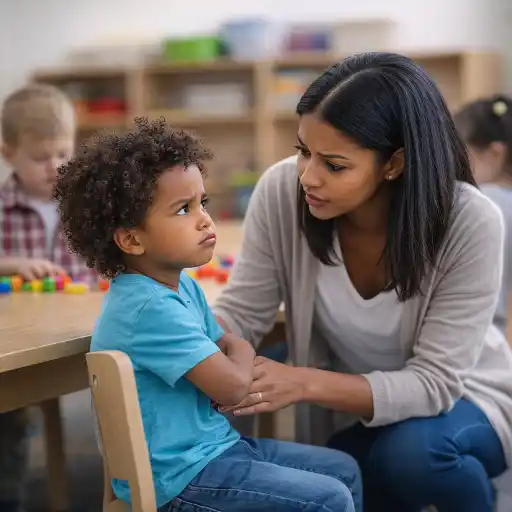
Prevention means making appropriate actions clear, achievable, and socially visible. Children benefit when adults model communication, cooperation, regulation, and repair throughout the day—not only after something goes wrong. Predictable #routines, accessible materials, and clear expectations can reduce the situations in which challenging behavior gets copied.
- Teach a few positively worded expectations with pictures, demonstrations, and practice.
- Use visual schedules and transition warnings to help children anticipate changes.
- Provide duplicates or turn-taking tools for highly sought-after materials.
- Arrange the room so adults can supervise busy areas and support play early.
- Offer movement, quiet, and small-group options as part of the regular day.
- Use puppets, stories, and role-play to practice asking, waiting, stopping, and seeking help.
Make prosocial behavior worth noticing. For instance, say, “I see Ana showing the turn card. Malik is waiting with his hands in his lap.” This gives peers a useful example to imitate. Keep praise descriptive and inclusive; avoid comparing children or naming one child as the class’s “good example.” Peer modeling should be intentional and respectful. An adult remains responsible for teaching and supervision, and no child should be assigned to manage another child’s behavior.
How should teams teach replacement skills and work with families?
A replacement skill should help a child meet the same need more safely and effectively. If grabbing gains access to a toy, teach the child to request a turn using words, a gesture, sign, or picture. If yelling brings adult attention, teach a way to call an adult or use an attention card. If refusal delays a transition, practice asking for help, a short extension, or a break when appropriate.
- Teach the skill when the child is calm, then prompt it before a predictable trigger.
- Respond promptly when the child tries the new skill, with specific feedback: “You asked for a turn; I heard you.”
- After an incident, support repair without forcing a public apology. Children might help rebuild, return materials, or check on a peer with adult support.
- Share objective observations with families, invite their insights, and protect every child’s confidentiality.
Families may offer helpful context about communication, routines, preferences, stress, and successful approaches at home. Begin with a strength and a concrete observation: “We’ve noticed cleanup is hard for several children. We’re trying a visual warning and teaching children to ask for help. What tends to make transitions easier at home?” Avoid naming another child or assigning blame. If the behavior is persistent, intense, or unsafe, directors and educators can develop a shared plan with the family and appropriate consultants. A useful plan identifies the behavior, prevention steps, replacement skill, adult response, observation method, and date to review progress.
What common mistakes should providers avoid?
When behavior spreads, inconsistent or overly dramatic responses can give it more social power. Teams can reduce that risk by agreeing on concise scripts and focusing attention on safety and the skills they want children to learn.
- Turning the behavior into a show: Avoid extended negotiations or public lectures. Stay calm, brief, and attentive to safety.
- Blaming the child who acted first: Focus on observable actions and classroom conditions, not fault or identity.
- Only saying what not to do: Pair each limit with a clear alternative children can practice.
- Assuming imitation has one cause: Observe what happens before and after; attention, access, escape, peer connection, and sensory needs may all matter.
- Using a peer as a behavior manager: Adults must retain responsibility for instruction, support, and supervision.
When a pattern continues despite consistent prevention and teaching, review observations with the family and program team. Consider whether individualized support or consultation is appropriate. Keep documentation factual and confidential, and check local policies and licensing rules.
Conclusion: What is the most helpful response when a child copies challenging behavior?
When a child copies a peer’s challenging behavior, respond first to safety, then look at what the behavior may be accomplishing and what peers are learning from the adult response. Calm limits, concise redirection, ABC observation, predictable routines, and functional replacement skills can help interrupt imitation while preserving children’s dignity. Give positive peer behavior the visibility and attention you want it to receive.
Start with one recurring situation: agree on a brief staff script, teach one practical alternative, and record what happens before and after. Partner with families and review progress together. Consistent, thoughtful guidance helps children learn not only what to stop doing, but what they can do instead.
What courses can help educators build these skills?
- The ABCs of Behavior: Turning Challenges into Learning Opportunities Buy Now $55.00 — practice using ABC observation and positive guidance.
- Turning Behavior Around for Toddlers and Preschoolers Buy Now $25.00 — explore strategies for understanding and responding to challenging behavior.
- Social Foundations and Responsive Classrooms Buy Now $24.00 — strengthen approaches to self-regulation, peer relationships, and conflict resolution.
- 45 Hour Child Growth and Development
- Turning Behavior Around for Toddlers and Preschoolers
- The ABCs of Behavior: Turning Challenges into Learning Opportunities
- Bienvenido! Welcoming All Families
- Pediatric RSV First Aid & CPR/AED
- Ouch! Biting & Hitting Hurts
- Texas Director Credential Renewal
- Texas Director Credential
- Ouch! Biting & Hitting Hurts
- CDA Certification en Español: Recursos y Consejos para Educadores Bilingües
- 🤯 ¿Por qué este niño está teniendo un comportamiento difícil de repente?
- 🏡🗣️ ¿Cómo hablo con los padres sobre los comportamientos que su hijo aprendió en casa?
- 🥺👋 ¿Por Qué la Despedida de la Mañana es Tan Emocional?
- 👶😴¿Es Normal que los Niños Griten o Lloren al Despertarse?
- 😅❌ ¿Cómo Puedo Manejar a un Niño que Dice “¡NO!” a Todo en el Aula?
- 😫🧸 ¿Qué hacer cuando un bebé no quiere dormir la siesta en el aula?
- Recursos en Español sobre el Sueño Seguro del Bebé
- ¿Cuál es la Diferencia Entre la Crianza Respetuosa y la Crianza Permisiva?
- Lista para Guardería en Casa en California: Cómo Iniciar una Guardería en el Hogar
- Retraso del Habla en la Guardería: Cómo Pueden Ayudar los Proveedores
- Cómo Trabajar en el Cuidado Infantil en California: Requisitos y Pasos
- Cómo Ser Maestra de Preescolar en Dakota del Norte
- Capacitación Previa al Servicio para Proveedores de Cuidado Infantil en Dakota del Norte
- Why Do Classroom Management Strategies Fail With 3-Year-Olds—and What Works Instead?
- How Can Smoother Classroom Transitions Reduce Challenging Behavior?
- How Can Child Care Providers Handle Challenging Behaviors Without Losing Control of the Classroom?
- What Should Providers Do When Children Copy Each Other’s Challenging Behaviors?
- What Should Educators Do When a Child Constantly Seeks Adult Attention?
- What Should Educators Do When a Child Copies Another Child’s Challenging Behavior?
