When one child’s hitting, yelling, or refusal quickly becomes a group pattern, providers need a response that protects safety without giving the behavior more attention or social power. The ABCs of Behavior: Turning Challenges into Learning Opportunities  Buy Now $55.00 helps providers examine antecedents, behaviors, and consequences while building consistent positive-guidance practices that can be applied across the classroom. For a practical next step, pair that training with Mysteries of Challenging Behavior Solved Buy Now
 $24.00$18.00 to strengthen your team’s confidence in responding to behavior patterns.
Why does challenging behavior spread among children?
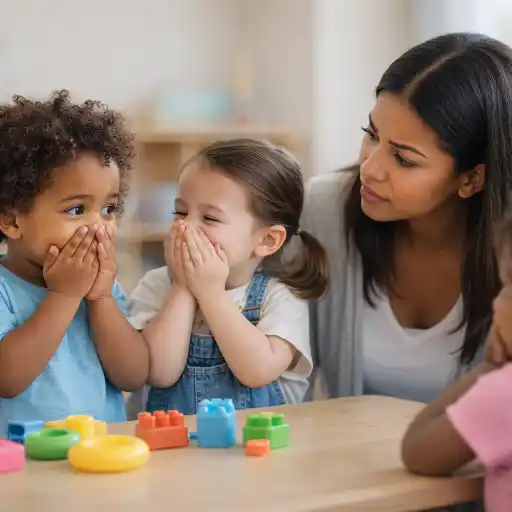
Children are highly attentive observers. They watch peers to learn how materials work, how adults respond, and which actions produce attention, access, escape, or excitement. Copying may reflect ordinary social learning rather than deliberate defiance. A child who sees a peer shout and receive extended adult negotiation may experiment with shouting; another may imitate pushing because the action appears to secure a toy or draw an audience.
This does not mean providers should blame the child who acted first or ignore unsafe behavior. It means the team should examine the social and environmental conditions surrounding the pattern. Behavior can be influenced by imitation, reinforcement, sensory stimulation, language limitations, stress, developmental expectations, and the need to belong.
The central question is not, “Which child started it?” but, “What is making this behavior attractive, understandable, or effective for other children?” That shift supports #empathy and helps providers respond to the classroom system rather than singling out one child.
- Notice whether peers are watching, laughing, joining, or receiving adult attention.
- Ask whether the copied behavior produces access to an object, activity, or adult.
- Consider whether the room, routine, or transition creates repeated opportunities for imitation.
- Look for missing skills, such as requesting, waiting, entering play, or seeking help.
NAEYC describes positive behavior support as a continuum that includes strong relationships, predictable environments, explicit teaching, and individualized support. When a behavior spreads, the response should include all four elements.
How should providers respond when several children begin copying the behavior?
Start with safety and brevity. If children are hitting, biting, throwing, or damaging materials, calmly interrupt the action, create space, and follow program safety procedures. Avoid turning the incident into a dramatic performance. Lengthy lectures, repeated questions, public labels, and visible frustration may unintentionally increase the audience and attention that sustain imitation.
- 🛡️ Ensure immediate safety and position yourself so you can supervise the whole group.
- Use one concise limit: “I will not let you hit. Hitting hurts.”
- Name the expected action: “Hands stay on your own body.”
- Offer a replacement: “Say ‘my turn,’ show the card, or ask me for help.”
- Attend to children who were hurt and provide calm support to children who need regulation.
- Return attention to appropriate participation as quickly as safety allows.
When multiple children are involved, avoid addressing each child with a long individual correction. Use a shared reset: pause the activity, reduce stimulation, restate the expectation, and briefly practice the replacement behavior. For example: “Several children are grabbing the trucks. We will practice asking for a turn. Watch me: ‘Can I have it when you are done?’”
Respond proportionately. A copied gesture or silly phrase may require a quiet redirection, while aggression requires immediate intervention. State requirements vary - check your state licensing agency, particularly regarding supervision, incident documentation, restraint, exclusion, and behavior guidance.
How can the ABC framework reveal what is maintaining the pattern?
The ABC framework—antecedent, behavior, consequence—helps teams study the sequence rather than rely on assumptions. Record what occurred immediately before the behavior, what each child objectively did, and what followed. Include peer reactions, adult attention, changes to the activity, access to materials, and whether a demand was delayed or removed.
For example, during cleanup, one child throws blocks. The teacher pauses the routine and negotiates at length. Two peers begin throwing blocks and receive similar one-to-one attention. The possible maintaining consequence is not simply “the children wanted to misbehave”; throwing may have produced adult interaction and delayed cleanup.
A team might test a different plan: give a visual warning, assign clear cleanup jobs, use a short script, reinforce children who begin, and minimize attention to safe redirection. This is a working hypothesis, not a diagnosis.
- Antecedent: What demand, transition, peer interaction, material, or sensory condition came first?
- Behavior: What could an observer see or hear?
- Consequence: What changed afterward for the child, peers, adults, and activity?
- Pattern: Does the behavior occur at a particular time, location, or routine?
Document successful moments too. If children use a turn card when an adult is nearby, that information identifies a protective condition. Objective documentation reduces labels such as “copycat” or “attention-seeking” and supports more equitable decision-making. ChildCareEd’s ABC behavior guidance similarly emphasizes observing context and consequences before selecting an intervention.
How can providers prevent imitation and teach positive peer influence?
Prevention involves making appropriate behavior more visible, effective, and socially rewarding than challenging behavior. Children need repeated opportunities to watch adults and peers model communication, cooperation, regulation, and repair. Do not wait until a crisis to teach these skills.
- Teach three to five positively worded expectations with photographs, demonstrations, and practice.
- Use visual schedules, transition warnings, and first-then language to reduce uncertainty.
- Provide duplicates, turn-taking tools, and clear access to highly desired materials.
- Arrange the room so adults can see high-conflict areas and intervene early.
- Offer movement, sensory, quiet, and small-group options throughout the day.
- Use role-play, puppets, and stories to practice asking, waiting, stopping, and seeking help.
Make positive peer behavior socially noticeable. Say, “I see Maya showing the turn card. Jordan is waiting with hands in his lap.” This provides attention for the behavior you want copied. Invite children to notice helpful actions without creating a competition for praise.
Peer modeling should be intentional and respectful. Pair children thoughtfully, avoid assigning a child the role of “good example,” and never use one child to manage another. A peer buddy can demonstrate a routine, but the adult remains responsible for supervision and instruction. Children with different communication, sensory, or developmental needs should have multiple ways to participate.
When challenging behavior begins, redirect the group toward a shared skill: “We are practicing safe ways to get attention. Tap my shoulder, say my name, or use the help card.” Consistent practice changes the classroom culture from copying disruption to copying competence.
How should teams reinforce replacement behaviors and partner with families?
A replacement behavior must be functional: it should help children achieve the same purpose more safely. If grabbing gains access to a toy, teach a phrase, gesture, sign, or card for requesting a turn. If yelling brings adult attention, teach children to tap, call the provider’s name, or use an attention card. If refusal delays a transition, teach “one more minute,” “help,” or “break.”
Teach the replacement when children are calm, prompt it before predictable triggers, and reinforce attempts immediately. Specific feedback is more informative than general praise:
- “You asked for a turn, and I heard you.”
- “You saw your friend get upset and moved back.”
- “You used the help card instead of throwing.”
After an incident, support repair without forcing an apology or public confession. Children may help rebuild a structure, check on a peer with adult support, return materials, or practice the alternative phrase. The goal is accountability and reconnection, not humiliation.
Families can provide valuable information about imitation, stressors, language, sleep, sensory preferences, and successful strategies at home. Begin with a strength, describe observable facts, and invite collaboration: “We notice that several children are shouting during cleanup. We are using a visual warning and teaching ‘help.’ What cues work during transitions at home?” Use culturally and linguistically responsive communication, protect confidentiality, and avoid identifying another child.
For persistent concerns, create a brief team plan that identifies the target behavior, prevention steps, replacement skill, adult script, data method, family communication, and review date. Consider Social Foundations and Responsive Classrooms Buy Now $24.00 for additional learning about self-regulation, peer relationships, conflict resolution, and positive guidance.
What common mistakes should providers avoid when behavior spreads?
Imitation patterns can intensify when adult responses are inconsistent or unintentionally rewarding. Teams benefit from identifying common pitfalls before the next incident.
- Giving the behavior a large audience: Use calm, brief responses and redirect attention toward safety and appropriate participation.
- Labeling children: Describe actions and context instead of calling a child disruptive, manipulative, or a copycat.
- Correcting without teaching: Pair every limit with a replacement skill children can practice.
- Expecting identical responses from every child: Adapt cues, language, sensory supports, and wait time to individual needs.
- Changing strategies too quickly: Implement the plan consistently while monitoring safety and meaningful data.
- Ignoring peer dynamics: Observe who is watching, joining, laughing, escaping, or receiving attention.
- Using exclusion as the main solution: Maintain belonging whenever safely possible and seek individualized consultation when needed.
Directors should review patterns across race, disability, language, gender, and age. If some children are corrected more often or removed more quickly, examine adult assumptions, classroom accessibility, and the behavior policy. A strengths-based review asks whether the environment is teaching children how to succeed.
Seek additional support when behavior is frequent, intense, dangerous, or significantly limits participation despite consistent prevention and instruction. Collaborate with families, mental health consultants, inclusion specialists, or other qualified professionals according to program procedures.
Summary: What should providers do when children copy challenging behaviors?
When children copy one another’s challenging behaviors, providers should respond calmly, protect safety, reduce the social payoff, investigate the ABC pattern, and teach a replacement that works. The goal is not to identify a “bad influence” or stop every imitation through punishment. The goal is to make safe communication, regulation, cooperation, and repair more effective—and more visible—than disruption.
Begin with a shared staff script, predictable routines, visual supports, intentional peer modeling, and specific reinforcement. Document patterns without labels, partner with families, and revise the plan based on observations. With consistent support, children can learn that peers are not only sources of copied challenges; they can also be powerful models of #communication, #selfregulation, #guidance, and belonging.
- Prevention and Solutions To Challenging Behaviors
- CDA Certification en Español: Recursos y Consejos para Educadores Bilingües
- Recursos en Español sobre el Sueño Seguro del Bebé
- Capacitación en Salud y Seguridad Preventiva en Línea para Proveedores de Cuidado Infantil
- Proporciones de Cuidado Infantil y Tamaños de Grupo por Edad en Maryland (Guía Rápida para Centros y Hogares)
- Lista para Guardería en Casa en Illinois: Cómo Iniciar una Guardería en el Hogar
- Lista para Guardería en Casa en Texas: Cómo Iniciar una Guardería en el Hogar
- Retraso del Habla en la Guardería: Cómo Pueden Ayudar los Proveedores
- Capacitación Previa al Servicio para Proveedores de Cuidado Infantil en Dakota del Norte
- Self-Control Activities for Preschoolers: 10 Games That Teach Stop, Wait, and Try Again
- How Can You Create an Individual Behavior Support Plan That Staff Can Follow?
- Why Is This Child Acting Out? How Can Providers Find the Need Behind Challenging Behavior?
- How Can Child Care Providers Handle Difficult Conversations with Families Professionally?
- How Can Child Care Providers Respond Effectively to Challenging Behaviors?
- How Can Child Care Providers Handle Challenging Behaviors Without Losing Control of the Classroom?
- Why Is My Preschooler Suddenly Aggressive, and How Can Child Care Providers Help?
- What Should Providers Do When Children Copy Each Other’s Challenging Behaviors?
- How Can Child Care Providers Help Children Develop Self-Control?
- How Should Child Care Providers Respond to and Document Biting Incidents?
