Children’s play becomes richer when adults protect children’s ownership while adding thoughtful support at the right moment. To strengthen observation, scaffolding, and play-based planning, explore From Play to Planning: Building Culturally Competent, Child-Centered Curriculum  Buy Now $55.00 and The Best Promotion is Play Buy Now $35.00; these courses can help you translate children’s interests into meaningful classroom experiences and professional learning goals.
Why does extending play matter?
Play is not separate from learning; it is one of the primary contexts in which young children investigate, communicate, create relationships, and develop theories about the world. Research summarized by NAEYC’s discussion of playful learning describes play as a spectrum that includes child-directed play, guided play, and structured games. Each form can support development when it preserves children’s engagement, agency, and sense of purpose.
For providers, extending play means noticing what children are already doing and making a small, well-timed contribution. That contribution might be a new material, a descriptive word, a question, or assistance with a social problem. It should open possibilities rather than replace the child’s idea.
When adults extend rather than control play, children have more opportunities to practice:
- #creativity and symbolic thinking;
- language, storytelling, and explanation;
- persistence, flexibility, and problem-solving;
- cooperation, negotiation, and perspective-taking; and
- planning, motor coordination, and self-regulation.
How can educators observe before they intervene?
Observation is the foundation of responsive play support. Before entering a play episode, pause long enough to understand the children’s purpose, relationships, strategies, and emotions. The same tower, pretend scenario, or sensory investigation may serve different developmental goals for different children.
Look for patterns rather than isolated behaviors:
- What materials does the child select repeatedly?
- What problem is the child trying to solve?
- What language, gestures, drawings, or movements communicate the child’s plan?
- Who is included, excluded, leading, or waiting?
- What has the child already tried?
Brief documentation can make observations useful. Record a child’s exact words, photograph a construction, or note the sequence of attempts. Then ask what the evidence suggests about a possible next step. The aim is not to interrupt play with constant assessment, but to use authentic play as a window into children’s thinking.
Directors can support this practice by giving staff simple observation templates and time to reflect together. A team might discuss one question: “What did the child understand, and what could we offer next without taking ownership away?”
Which adult strategies extend play effectively?
Effective extension is usually brief, specific, and responsive. The adult joins the child’s line of thought instead of introducing an unrelated lesson.
Useful strategies include:
- Describe: “You placed the wide block underneath the narrow one.”
- Wonder: “I wonder what might happen if the bridge becomes longer.”
- Invite explanation: “How did you decide where that piece belongs?”
- Offer vocabulary: Introduce words such as stable, balance, compare, predict, flexible, and investigate.
- Add a resource: Place measuring tools, clipboards, puppets, books, or additional loose parts nearby.
- Present a manageable challenge: “How could you make the shelter strong enough for two animals?”
Use wait time after questions. Children may need to process language, formulate an idea, or communicate through a home language, gesture, or demonstration. A response does not need to be verbally sophisticated to show complex thinking.
How can questions deepen children’s thinking?
Questions extend play when they arise from children’s actions and invite genuine investigation. NAEYC’s article Conversations with Children adapts Bloom’s Taxonomy for young children, moving from remembering and understanding toward applying, analyzing, evaluating, and creating.
Try questions such as:
- “What do you notice?”
- “What do you think will happen next?”
- “How are these materials alike or different?”
- “What could we change and test?”
- “Which plan might work best, and why?”
- “Can you show another way?”
Questions should not become a quiz. If children sense that adults already know the “correct” answer, they may focus on guessing instead of reasoning. Use tentative language—“maybe,” “I wonder,” or “I am not sure”—to communicate that ideas can be explored together. This approach supports sustained shared thinking, in which adults and children work as partners to clarify an idea, solve a problem, or develop a narrative.
For infants and toddlers, extension may look like reciprocal sounds, imitation, naming an object, or following a child’s gaze. For preschoolers, it may involve comparing plans, negotiating roles, revising a structure, or creating a story with multiple events.
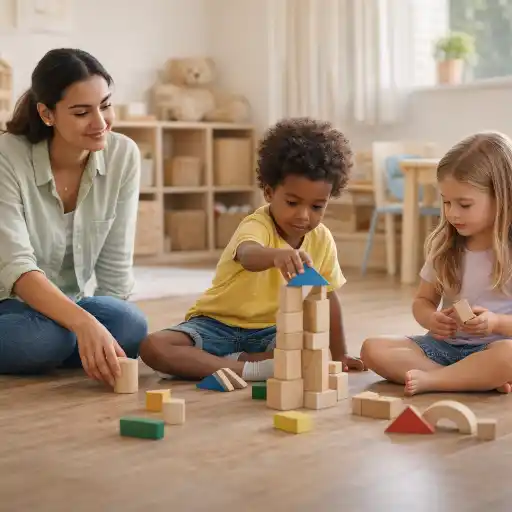
How should environments and schedules support extended play?
Children cannot develop complex play if the environment constantly interrupts, restricts, or overwhelms them. The educator’s preparation matters: materials should be accessible, open-ended, culturally responsive, and organized so children can make choices independently.
Consider these environmental supports:
- Protect uninterrupted blocks of play whenever possible.
- Offer fewer, purposeful materials instead of overcrowded shelves.
- Place related resources together, such as tubes near blocks or menus near dramatic-play props.
- Include natural, recycled, sensory, and representational materials.
- Provide visual labels, accessible pathways, and adaptive tools.
- Rotate materials in response to children’s interests, not only according to a calendar.
Open-ended materials are especially valuable because children can move, combine, redesign, and reinterpret them. A box may become a bus, a home, a boat, or a scientific object. The possibilities invite #problem-solving and sustained engagement.
State requirements vary - check your state licensing agency when changing schedules, room arrangements, supervision plans, or documentation procedures. Safety remains non-negotiable: inspect materials, remove choking hazards for younger children, and position adults so they can see and hear play.
How can providers avoid common mistakes and plan next steps?
Even caring educators can unintentionally shorten play by correcting too quickly, asking too many questions, or demonstrating a preferred product. Extending play requires restraint as well as intentionality.
- ❌ Taking over: Pause and offer one prompt before touching the child’s materials.
- ❌ Over-questioning: Balance questions with descriptive observations and quiet attention.
- ❌ Rushing frustration: Provide emotional support while allowing safe productive struggle.
- ❌ Expecting one outcome: Value multiple solutions and representations.
- ❌ Ignoring communication differences: Accept home languages, gestures, drawings, and assistive communication.
Use a simple observe-plan-extend-reflect cycle:
- Observe: Identify interests, strengths, strategies, and barriers.
- Plan: Choose one material, word, question, or challenge.
- Extend: Join briefly and follow the child’s direction.
- Reflect: Note what changed and decide whether to continue, adapt, or step back.
Additional professional learning can make this cycle more consistent across a teaching team. Consider Tailoring Instruction to Children’s Needs Buy Now $24.00 for practical scaffolding and differentiation strategies, Language Development in Early Childhood Buy Now $16.00 for language-rich interactions, and Project-Based Learning for Children Buy Now $16.00 for extending children’s questions into sustained investigations. Course availability, language options, and training-hour acceptance should be confirmed for your setting.
Conclusion
Childcare providers extend children’s play most effectively by protecting children’s agency while offering carefully timed support. Observe first, provide open-ended materials, use thoughtful questions, model language, and step back when children are productively engaged. The goal is not to make play look like a lesson; it is to create conditions in which children can pursue ideas deeply, revise their thinking, communicate with others, and experience themselves as capable learners.
When teams consistently use the observe-plan-extend-reflect cycle, everyday play becomes a powerful source of curriculum, assessment, and relationship-building. The central question—how can adults extend play without taking over?—is answered through responsive presence: be close enough to notice, intentional enough to support, and humble enough to let children lead.
- CDA Home Visitor Subject Area 3 Part 3 Birth to 5
- CDA Home Visitor Subject Area 2 Part 3 Birth to 5
- From Play to Planning: Building Culturally Competent, Child-Centered Curriculum
- Children at the Wheel: Emergent Curriculum
- Pediatric RSV First Aid & CPR/AED
- The Best Promotion is Play
- Emergent Learning & Development
- Play, Learn, Grow
- Creating Engaging and Meaningful Learning Experiences
- Creating Environments that Nurture Growth and Community
- CDA Certification en Español: Recursos y Consejos para Educadores Bilingües
- 10 Ejemplos de Cómo la Cultura Influye en el Desarrollo Infantil
- Proporciones de Cuidado Infantil y Tamaños de Grupo por Edad en Maryland (Guía Rápida para Centros y Hogares)
- Proporciones de Cuidado Infantil y Tamaños de Grupo por Edad en Virginia (Guía Rápida para Centros y Hogares)
- Cómo Trabajar en el Cuidado Infantil en Carolina del Norte: Requisitos y Pasos
- Celebrando la amistad en el cuidado infantil durante el Día de los Mejores Amigos
- Canciones, juegos y preguntas de círculo para niños
- What Does Bluey Get Right About Play and Parenting?
- Why Do Children Repeat the Same Actions? Understanding Play Schemas and the 'Why' Behind Repetitive Play
- How can I encourage child-led learning without losing structure?
- How Can Child Care Providers Nurture Critical Thinking in Young Children?
- How Can Childcare Providers Extend Children’s Play Without Taking Over?
- How Do Children Learn Through Play?
- How Can Providers Show Families the Learning Behind Play?
- What Is Child-Led Play, and Why Does It Matter?
- How Can You Keep a Learning Center Useful After the Novelty Wears Off?
- How Can Child Care Programs Protect Preschool Playtime When the Schedule Gets Crowded?
- How Can Teachers Turn Everyday Play Into Learning Opportunities?
- How Can Child Care Providers Encourage More Meaningful Conversations During Play?
- How Much Correction Is Too Much During a Preschool Literacy Game?
