A tub of water, a few toy animals, and a child-sized brush can become a rich learning experience—not just a way to explore bubbles and textures. Use this simple routine to strengthen fine-motor coordination, purposeful pretend play, and children’s sense of responsibility; for a ready-to-use activity plan, explore ChildCareEd’s Muddy Animal Spa teaching guide for ages 3–5 Buy Now $1.75. If you want to build broader skills in planning developmentally appropriate preschool experiences, the Lesson Planning for Preschoolers course  Buy Now $24.00 offers a practical next step.
Why does washing toy animals matter beyond the sensory experience?
Water play naturally invites children to touch, splash, squeeze, and notice what changes. When educators frame animal washing as a meaningful care routine, those sensory experiences become connected to intention: children can imagine an animal has returned from a muddy walk, decide what it needs, and help complete a sequence of care. This combination respects children’s curiosity while giving the activity a clear purpose.
Purposeful play is not the same as directing every move or expecting a single correct result. Children need room to choose which animal to wash, how long to scrub, and whether to invent a story around the station. At the same time, an educator can introduce a simple goal—such as practicing a sequence, using a brush with control, or taking turns—and offer prompts that extend thinking without taking over. This balance of choice and guidance reflects the value of play as a context for exploring, experimenting, communicating, and problem-solving.
The activity can also make care visible in a way young children understand. Washing, rinsing, drying, and returning the toy to its place are concrete actions children can carry out and repeat. The ChildCareEd Muddy Animal Spa guide Buy Now $1.75 connects the steps with sequencing, animal recognition, pretend self-care, and small-hand coordination. In other words, the fun is real—and so is the learning.
How does scrubbing and drying build fine-motor practice?
Fine-motor development involves coordinating the small muscles of the hands and fingers with visual attention and purposeful movement. In an animal-washing station, a child may grasp a brush, press it against a toy, move it in short strokes, stabilize the animal with the other hand, squeeze a cloth, or carefully pat the toy dry. These actions give children repeated, practical opportunities to coordinate both hands and adjust pressure and movement.
There is no need to turn the experience into a test. Notice the process: Does a child try a new grip? Use one hand to steady the animal? Persist with a tricky spot? Choose a smaller cloth or a different tool? These observations can help you decide whether to simplify the task, offer another tool, or invite a new challenge. Fine-motor control supports many everyday actions, including manipulating objects, eating, and dressing, so playful practice can connect naturally with growing independence.
- Offer a few accessible tools, such as a soft brush, sponge, and small towel.
- Use large, sturdy animals that are easy to grasp and clean.
- Model one action at a time, then give children time to experiment and repeat.
- Adjust the challenge: a sponge may be easier to squeeze than a cloth, while a small brush may invite more precise movements for children who are ready.
Keep expectations flexible. Some children may wash with broad strokes, while others may carefully clean each paw. Both approaches offer practice. Celebrate effort and strategies rather than speed or a spotless toy, and remember that watching first or choosing to dry instead of scrub are also valid ways to participate.
How can the activity encourage purposeful pretend play?
A pretend animal spa provides a familiar storyline that children can shape: an animal is muddy, the caregiver prepares a bath, the animal is washed and dried, and then it returns home or rests. The routine offers a starting point, not a script children must follow. A child may decide that a bear needs a towel, that a puppy is visiting the veterinarian, or that several animals are waiting for a turn.
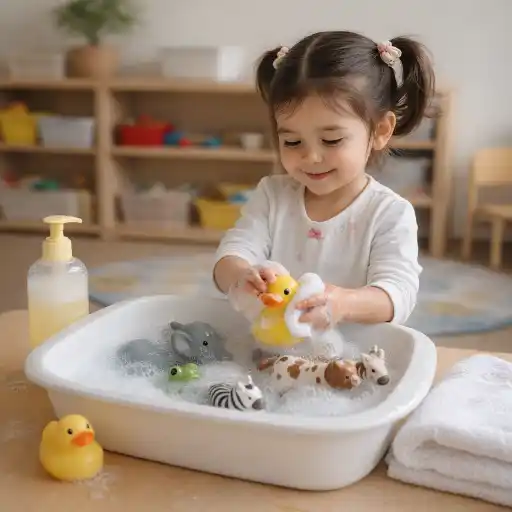
Educators can enrich the play with a small number of props: a basket for animals, a towel, a pretend appointment card, or a picture showing the care steps. Add materials gradually, based on children’s interests. Too many props at once can make it harder for children to focus on the play or share the space. A few open-ended questions can extend the storyline and invite reasoning:
- “What do you think this animal needs after its muddy walk?”
- “How will you know when it is clean and ready to dry?”
- “Where should the animal rest when its spa visit is finished?”
- “What could we do while we wait for the brush?”
As children negotiate roles—washer, towel helper, animal owner, or station organizer—they practice communication, turn-taking, and flexible thinking. If interest grows, connect the play to books, animal homes, or a pretend vet clinic. Keep the experience child-led enough that children’s ideas remain at its center; purposeful play works best when the adult supports the story rather than writing it for them.
How can washing toy animals support responsibility and care?
Responsibility develops through meaningful participation in manageable tasks. Children can help gather the animals, choose a tool, follow the care sequence, dry the toys, and return materials to a designated place. These jobs give the activity a beginning, middle, and end—and help children see that their actions contribute to the classroom community.
Use respectful language that connects the task to care rather than obligation: “You noticed the horse was muddy, so you chose to help,” or “You put the towel back where our group can find it.” Invite children to make age-appropriate choices and allow enough time for them to complete steps themselves. If a child needs support, demonstrate or offer a simple choice instead of rushing to finish the task for them.
The activity can also open gentle conversations about how people care for animals. For example, children can talk about keeping a pet comfortable, using kind hands, and asking an adult for help when an animal needs something. Keep the discussion grounded in pretend play; toy-animal care should not be treated as a substitute for safe, informed care of real animals.
- Assign optional roles so children can contribute in different ways.
- Use a simple picture sequence: wash, rinse, dry, return.
- Make cleanup part of the routine, with a clear place for used towels and tools.
- 😃 Notice helpful actions specifically: “You waited while your friend finished with the brush.”
Children will participate at different levels. Some may complete the full sequence; others may hand over a towel, observe, or choose one small job. Treating these contributions as meaningful helps build belonging and confidence.
How can providers set up the station safely and inclusively?
Plan the space before inviting children to begin. Use a stable, shallow basin on a surface that is easy to supervise and clean. Select durable, washable toys and age-appropriate tools; inspect them for loose parts, cracks, or other hazards. Use only the amount of water needed for the activity, and keep the surrounding floor dry to reduce slipping. Water play calls for active supervision: stay close, keep children in sight, and give the activity your attention. Federal child care technical-assistance guidance recommends touch supervision within arm’s reach during wading or water play; review your program’s policies and applicable standards as you plan.
Hygiene is part of the learning environment too. Follow your program’s procedures for cleaning and sanitizing toys and tools, and do not share items that cannot be cleaned appropriately. Use separate towels or a clear towel routine, and wash children’s hands after the activity. Avoid products or additives that may irritate skin or create allergy concerns; plain water is often enough for imaginative play. State requirements vary - check your state licensing agency.
Inclusion means offering more than one way to join. A child who dislikes getting wet might dry the animals, choose a tool, tell the story, or use a dry pretend-washing station. Children who benefit from additional support may do well with larger handles, a nonslip mat, picture cues, fewer steps, or extra time. Avoid assuming that every child will enjoy wet textures or use tools in the same way.
- Set a clear boundary for where water and tools stay.
- Position yourself to see and respond to every child at the station.
- Provide dry alternatives and role choices for children who prefer not to touch water.
- Clean and store materials according to your center’s health and safety procedures.
How can you observe learning and avoid common pitfalls?
Use brief, objective notes to capture what children actually do and say. For example: “Maya steadied the turtle with one hand, brushed its shell, then asked for a towel.” This note shows coordination, sequencing, communication, and initiative without judging the child’s performance. Look for changes over time: a child may begin by watching, later try the sponge, and eventually complete several steps independently. Share strengths-based observations with families when appropriate, and use what you notice to plan a next step.
Common pitfalls include making the activity too adult-directed, setting out too many materials, or expecting every child to complete the same sequence. A long demonstration can take the energy out of play; show only what children need to get started. Avoid correcting imaginative details that do not create a safety concern. A toy animal can have a very serious spa appointment—or a silly one. The child’s story is part of the learning.
Another risk is treating the station as a substitute for intentional supervision or established hygiene procedures. The learning value does not reduce the need for safety planning, active supervision, and proper cleaning. Keep goals realistic: one activity does not need to address every developmental domain at once. Choose a focus, such as tool use, sequencing, or cooperative care, and observe how children engage.
For further professional learning, consider ChildCareEd’s How Preschoolers Develop Buy Now $32.00, The Best Promotion is Play Buy Now $24.00, and Effective Supervision in Child Care Buy Now $25.00. These courses connect to preschool development, play-based learning, and safe supervision. Check course details and your local requirements to determine whether a training meets your professional learning needs.
Conclusion: What does an animal-washing station teach?
Washing toy animals can be much more than sensory play when providers make space for children to explore, imagine, practice, and help. A simple care routine offers opportunities to use brushes and cloths with control, sequence familiar steps, develop a pretend storyline, and take on meaningful classroom responsibilities. These skills emerge through children’s participation—not through a perfect finished result.
Keep the setup simple, use safe and washable materials, supervise water play actively, and offer multiple ways for children to join. Model only what is needed, follow children’s ideas, and observe specific actions that can guide your next invitation. With thoughtful planning, a muddy toy animal can inspire a whole lot of learning—one brushstroke, towel, and caring choice at a time.
- Early Mathematics Through Play
- Effective Approaches for Autism and Inclusion
- CDA Home Visitor Subject Area 3 Part 3 Birth to 5
- From Play to Planning: Building Culturally Competent, Child-Centered Curriculum
- What Makes Me Special: An Overview of Autism and ADHD
- Spaces that Support Discovery
- Using Toys to Support Learning
- Play with Purpose: Supporting Children with Autism
- Creating Engaging and Meaningful Learning Experiences
- Pumpkin Spice and Sensory Delight: Easy Autumn Sensory Bins for Early Learners
- CDA Certification en Español: Recursos y Consejos para Educadores Bilingües
- 💛🧩 ¿Cómo puedo hacer que mi enseñanza sea inclusiva para los niños con autismo?
- Cuáles Son las Señales de Alerta en el Desarrollo Infantil que Todo Educador Debe Conocer?
- ¿Cuáles son las mejores actividades del Día de la Tierra para niños en casa o en el aula?
- ¿Cómo puedo usar escenarios de juego de roles de primeros auxilios en mi aula?
- 10 Ejemplos de Cómo la Cultura Influye en el Desarrollo Infantil
- Actividades de Otoño Fáciles para Preescolares esta Temporada
- Which Oklahoma Farms and Ranches Offer Preschool Field Trips That Teach About Animals and Community?
- Celebrando la amistad en el cuidado infantil durante el Día de los Mejores Amigos
- Canciones, juegos y preguntas de círculo para niños
- Cómo simplificar la capacitación para sus empleados de daycare
- In-House Field Trips for Kids: Fun Ideas for Daycare
- How Can Farm-to-Table Experiences Teach Toddlers Where Food Comes From?
- What Can Providers Learn From the Toys Children Choose Repeatedly?
- How Should Providers Review Loose Parts Before They Enter a Toddler Play Area?
- How Can You Help a Preschool Group Include the Child Who Is Often Left Out?
- How Can You Teach Action Words Through Everyday Preschool Routines?
- Why Can Washing Toy Animals Be More Than Just Sensory Play?
- How Can Michigan Child Care Providers Support Children With Autism in Everyday Activities?
