When play is full of children’s ideas, a thoughtful comment or well-timed question can turn a passing moment into a rich exchange—without taking over. The Language Development in Early Childhood  Buy Now $16.00 course offers practical ways to support verbal and nonverbal communication, helping you strengthen everyday classroom interactions and deepen your professional knowledge. Read on for simple strategies you can put to work in play today.
Why do meaningful conversations during play matter?
Play gives children a reason to communicate: they plan, imagine, explain, negotiate, tell stories, and solve problems. When an adult responds with genuine interest, children have opportunities to share ideas and hear new words in a context that matters to them. T
Meaningful talk is not measured only by how many words adults say or how many questions they ask. Quality comes from attending to the child’s focus, listening to the response, and allowing the conversation to develop across several turns. A child who explains how a block bridge stays up is practicing observation and reasoning; a child who assigns roles in a pretend restaurant is using language to coordinate with peers.
These exchanges also help educators learn what children already know, what interests them, and where a small prompt could extend their thinking. The aim is not to interrupt every play episode with a lesson. It is to notice when an invitation would support the child’s idea—and when quiet observation is the better response.
How can you follow children’s lead without directing the play?
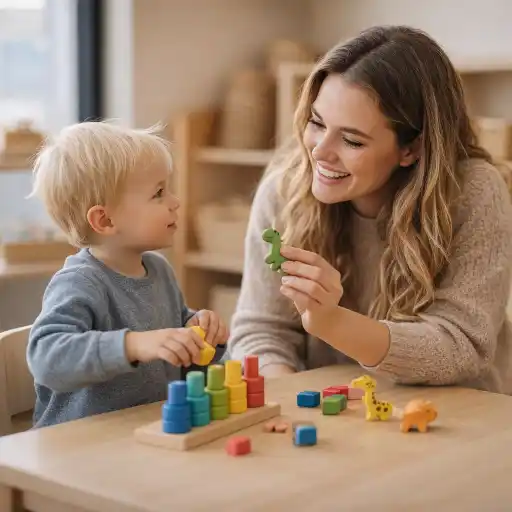
Begin by watching and listening. Notice what the child is doing, looking at, repeating, or trying to figure out. Join at the child’s level and comment on the play before introducing a new direction. A comment such as “You put the long block across the two boxes” shows attention and gives the child a natural opening to explain or continue.
Try a simple interaction sequence: observe, connect, then wait. If children are making a pretend bakery, you might say, “The baker is putting the rolls in a basket.” Pause. If a child responds, build on that contribution: “You’re saving some for the customers. How will they know what’s fresh?” A comment can be just as inviting as a question, and it lets children decide whether to continue talking.
Follow the child’s purpose rather than steering toward a predetermined answer. If their block structure becomes a spaceship, stay with the imaginative idea instead of insisting it become a house. NAEYC’s guidance on playful learning emphasizes children’s agency alongside intentional teaching: adults can enrich play while leaving room for choice, curiosity, and joy.
- Move close enough to share attention, while keeping the play space comfortable for children.
- Describe what you notice rather than evaluating the result: “You tried three ways to balance that piece.”
- Join briefly, then step back when children are sustaining the exchange themselves.
Which questions and comments help conversations deepen?
Open-ended prompts can invite more than a one-word answer, but they work best when they are connected to the child’s current play. Try “Tell me about what you’re making,” “What might happen next?” or “How could we make this tower steadier?” These questions give children room to describe, predict, compare, explain, or invent. NAEYC’s discussion of questions that stretch children’s thinking encourages educators to use varied question types in ways that fit each child and moment.
Balance questions with attentive comments and genuine follow-up. If a child says, “The baby is sick,” you might respond, “You’re taking the baby to the doctor. What do you think the doctor will check?” Then listen, reflect the child’s idea, and add a useful word naturally: “A stethoscope helps a doctor listen to a heartbeat.” Avoid turning play into a quiz by asking a rapid series of questions without responding to the answers.
Give children time to formulate a reply. A pause of several seconds can be especially helpful for children who are processing, communicating nonverbally, or using more than one language. When a response comes, acknowledge it and extend it by adding a word or idea—not by correcting every phrase.
- Instead of “Is that a bridge?” try “What are the cars crossing?”
- Instead of “What color is it?” try “Tell me about the colors you chose.”
- For deeper thinking, ask “What could you try next?” or “Why do you think it tipped?”
How can the play environment invite conversation?
Children are more likely to talk when materials make room for shared plans, roles, and discoveries. A small-group block area, a pretend shop with signs and notepads, or a water table with cups and funnels can prompt children to exchange ideas. Defined play spaces can make it easier to stay together around an activity, while familiar props and accessible materials give children something meaningful to discuss.
Build on children’s interests and lived experiences. If they have been talking about a bus ride, add route maps, tickets, and seats to dramatic play. Invite families to share songs, stories, words, or topics children enjoy, and represent home languages and cultures respectfully.
Small groups often give each child more room to enter a conversation than a large group does. Pair an appealing shared task with flexible roles, and make space for peer talk rather than positioning the adult as the only conversation partner. Visuals, photographs, picture cards, and communication devices can make participation more accessible.
- 🧱 Add clipboards, paper, and markers to construction play so children can draw plans or make signs.
- Place familiar objects and books in play centers to prompt storytelling and connections.
- Offer picture choices or communication supports so children can contribute in different ways.
How can you include every child in play-based conversations?
Children communicate in many ways: speech, gestures, facial expressions, signs, movement, drawing, home languages, and augmentative or alternative communication. Treat these as meaningful contributions. An infant’s gaze or babble, a toddler’s point, and a preschooler’s detailed story can all begin an exchange. Responding to a child’s cue and adding language gently helps establish a shared rhythm.
Make prompts accessible and adjust your support to the individual child. Use short phrases, gestures, objects, photos, or picture symbols; pause long enough for a response; and accept words in a home language or a combination of languages. Pairing a child with a receptive peer or modeling a simple way to enter play—“Can I build with you?”—may help, but do not pressure a child to speak or perform.
Children who need additional communication support benefit when educators plan opportunities rather than relying on chance. Consider which play areas, materials, partners, and times of day offer the best openings. Include families in decisions about familiar words, interests, and useful communication tools. The goal is belonging and shared participation, not a particular number of spoken words.
Observe strengths as well as needs: persistence, humor, imitation, curiosity, and problem-solving are valuable starting points. If you have ongoing developmental concerns, share objective observations with the family and follow your program’s referral procedures. State requirements vary - check your state licensing agency.
What common pitfalls can providers avoid?
Even warm, well-intentioned adults can unintentionally crowd out children’s ideas. A stream of questions can make play feel like an interview; frequent corrections can discourage attempts to communicate; and taking over materials or assigning every role can shift ownership from children to adults. The remedy is purposeful restraint: notice the child’s engagement, contribute only when your presence can enrich the exchange, and give children time to respond or carry on together.
Another pitfall is assuming meaningful conversation must be verbal or lengthy. A shared glance, gesture, exchanged object, or brief phrase can be a genuine conversational turn. Likewise, a quiet child may be learning through observation or may need a different entry point. Avoid comparing children’s participation without considering their developmental stage, communication style, language experience, and comfort in the group.
Try a brief team reflection after play: Which children had opportunities to initiate? Who was included in peer exchanges? Did adult prompts extend children’s ideas or redirect them? What material or support might help next time? This kind of observation can guide planning without turning children’s play into a checklist. For deeper professional learning, explore ChildCareEd’s Building Vocabulary Buy Now $16.00, Reading Aloud and Storytelling Buy Now $16.00, Building Bridges for Dual Language Learners Buy Now $16.00, and The Best Promotion is Play Buy Now $35.00 courses. Each connects to a different part of language-rich, inclusive play practice.
Conclusion: What makes play conversations meaningful?
Providers encourage meaningful conversations during play by following children’s interests, noticing and responding to their communication, and allowing ideas to unfold over multiple turns. Open-ended questions, thoughtful comments, new words, and quiet wait time can all extend a child’s thinking—but the best choice depends on the child and the moment.
Prepare inviting materials, support peer interaction, and welcome every communication mode and home language. Most of all, balance intentional guidance with children’s ownership of their play. When educators listen closely and contribute with care, ordinary play can become a place for connection, language, problem-solving, and shared discovery.
For a more complete learning experience, consider the linked Language Development in Early Childhood Buy Now $16.00 course and the additional targeted trainings above. Check your local requirements if you are seeking professional development hours, since state requirements vary.
- Language Development in Early Childhood
- Balancing Physically Active Play in Child Care
- From Play to Planning: Building Culturally Competent, Child-Centered Curriculum
- Pediatric RSV First Aid & CPR/AED
- CDA Bridge Bundle: Family Child Care without Portfolio Review
- Creating Environments that Nurture Growth and Community
- Texas Director Credential
- Balancing Active Play in Child Care
- Montessori Cultural Activities: Exploring the World Through Play and Learning
- Gift of Gratitude: Fostering Emotional Intelligence in Children through Acts of Kindness
- CDA Certification en Español: Recursos y Consejos para Educadores Bilingües
- 10 Ejemplos de Cómo la Cultura Influye en el Desarrollo Infantil
- Proporciones de Cuidado Infantil y Tamaños de Grupo por Edad en Maryland (Guía Rápida para Centros y Hogares)
- Proporciones de Cuidado Infantil y Tamaños de Grupo por Edad en Virginia (Guía Rápida para Centros y Hogares)
- Consejos de Supervisión Activa para Salones de Preescolar y el Juego al Aire Libre
- Canciones, juegos y preguntas de círculo para niños
- What Makes a Great Home Daycare? 10 Things Parents Notice First
- How Can Child Care Providers Support Preschool Development Across the Whole Child?
- How Can Child Care Providers Plan Infant Activities Around Developmental Milestones?
- How Can Emergent Readers Support Vocabulary Growth?
- How Can Child Care Providers Help Families Understand Play-Based Learning?
- How Can Child Care Providers Strengthen Language and Literacy Development?
- What Are the Best Ways to Support a Child’s Speech Development?
- How Can Child Care Providers Understand and Support Speech and Language Development?
- What Speech and Language Milestones Should Child Care Providers Know?
- How Can Visual-Motor Practice Strengthen Alphabet Order?
- How Can a Picture Label Become a Real Conversation with a Preschooler?
- How Can You Teach a New Word So Children Use It Beyond the Activity?
- How Can Child Care Providers Encourage More Meaningful Conversations During Play?
