A single scarf, block, or cardboard tube can become a microphone, a telescope, or something no adult expected—if children have room to imagine. Try the Theory of Learning course  Buy Now $24.00 to deepen your understanding of how play supports learning; this three-hour course explores influential learning theorists and the role of play in early childhood. Then use the simple Play Passport approach below to notice and document children’s ideas as they unfold.
Why invite children to transform one prop?
When a child turns a wooden block into a phone or a spoon into a paintbrush, the object’s familiar purpose gives way to a new idea. This kind of symbolic representation is a meaningful part of pretend play: children use one thing to stand for another, while holding both the real object and the imagined idea in mind. As the ECE Resource Hub explains in its overview of imitation and symbolic representation, pretend play lets preschoolers imitate familiar actions and explore symbols together.
A “What Did This Become?” Play Passport gives that thinking a visible, low-pressure structure. It is not a test, and there is no correct list of identities to complete. Instead, it invites children to revisit an open-ended prop, invent different meanings, and share their interpretations through drawing, marks, gestures, or words. The educator’s role is to make the invitation accessible, follow children’s lead, and keep the play safe and welcoming.
Pretend-play experiences can involve language, perspective taking, social negotiation, and problem solving. Research reviews describe connections between high-quality pretend play and cognitive, social, and linguistic development, while also noting that these relationships are complex and continue to be studied. The practical takeaway is not to promise a particular outcome, but to give children ample time and thoughtful materials to explore their ideas. For a deeper professional learning experience, explore ChildCareEd’s Role of Play in Learning Buy Now $16.00 course, which focuses on how play relates to child development and learning.
What is a Play Passport, and what materials do you need?
A Play Passport is a small booklet or page set where children record the different pretend identities they give to one selected prop. It follows one object through five transformations, making children’s imaginative thinking easy to revisit without prescribing what they must imagine. The passport can be folded from paper or made with five simple pages; children can draw, dictate a caption, add a photo, or choose a picture symbol for each idea.
Choose a sturdy, safe, open-ended prop that is easy for children to hold and reinterpret. A large fabric square, cardboard tube, wooden block, or clean plastic container may work well. A familiar object can help children begin, while an object without a single fixed purpose may invite varied ideas. Offer only materials that suit the ages and abilities of the children in your care, and inspect them before use.
- One shared prop or a small number of identical props.
- Five passport spaces, plus crayons, pencils, stickers, or picture symbols.
- Optional props that support play without dictating a story, such as a basket, clipboard, or a few dress-up items.
- A safe, accessible area with enough time for children to explore and return to their ideas.
Consider children’s interests, family experiences, home languages, and access needs as you choose materials. Children may communicate an idea by speaking, pointing, moving the prop, using a communication device, or drawing. Treat each response as a valid contribution. In a thoughtful play environment, the passport documents children’s thinking; it does not set the limits of their imagination.
How can you guide the prop through five pretend identities?
Introduce the activity with an inviting prompt: “This object can be many things in our pretend world. What might it become?” Explain that children may invent their own ideas, repeat an idea, or pass on a turn. Keep the prop in view and let the children determine its meaning. The five spaces in the passport are opportunities, not a requirement that each child produce exactly five answers.
As ideas emerge, record them in the child’s own words or with a quick drawing, photo, or symbol. Ask permission before writing down a child’s words or photographing their play, and follow program policies for documentation. If children are playing together, invite them to build on or negotiate ideas: “Can the block be a phone for one character and a map for another?” Shared pretend play can include planning, role taking, and conversation, as described in research on the role of pretend play in children’s cognitive development.
- 🧣 “What could this scarf be in your story?” Give children time to respond before offering examples.
- 🧱 “You said the block is a bus. Where is it going?” Follow the child’s plot rather than supplying a script.
- 📄 “Would you like to draw it, tell me about it, or show me?” Offer ways to contribute beyond spoken language.
- 🔁 “What else could it become?” Invite another possibility without suggesting that the first idea was incomplete.
- ⭐ “Which idea would you like to remember in your passport?” Let the child choose what to document.
Children may invent identities such as a bridge, a pet’s bed, a bakery tray, a spaceship, or something entirely original. Avoid insisting that every idea fit an adult’s category. Preschoolers’ symbolic play develops over time, and different children may engage in different ways. The goal is meaningful exploration, not a polished product or a tally of imaginative answers.
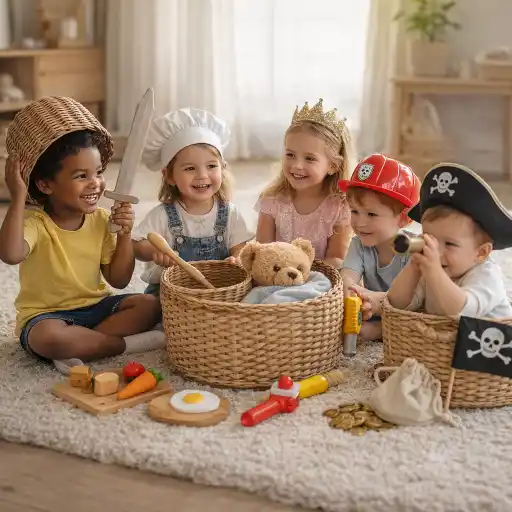
What does the educator do while children play?
Start by observing. Notice how a child approaches the prop, what they say or show, whether they invite peers, and what helps them stay involved. Give children space to test an idea before stepping in. When support would extend the play, use a short open-ended question or a responsive comment: “You’re holding it like a steering wheel,” or “I wonder where your spaceship is heading.” This follows the child’s meaning instead of taking over the story.
Offer language and materials as helpful tools, not instructions. You might label an action, describe a property, or add a relevant item when children seem ready. For example, if children turn a container into a shop, a few safe play coins or a picture sign could extend their scenario. The National Association for the Education of Young Children describes playful learning as including child-directed play and guided play, with educators supporting learning while preserving children’s agency. Its discussion of playful learning in early childhood settings is a useful reminder that adult guidance can be intentional without making play overly adult-directed.
Plan for participation and belonging. Put materials within reach, allow extra response time, and offer alternatives such as eye gaze, gesture, drawing, or assistive communication. Respect children who prefer to watch before joining or who choose not to share an idea with the group. Adapt the passport’s format—large pages, high-contrast images, tactile symbols, or adult scribing—to meet individual needs. A flexible invitation supports children’s #creativity, #language, and social connection without requiring everyone to play in the same way.
How can you document learning and avoid common pitfalls?
Use the passport as a record of children’s ideas, not a scorecard. Alongside each identity, you might note a brief child quote, a sketch, or a date. Keep observations descriptive: “Maya held the tube to her eye and called it a telescope,” rather than “Maya is highly imaginative.” Descriptive notes make it easier to plan a next step while avoiding broad conclusions from one play episode.
After play, revisit the pages with children if they are interested. They may remember the story, add a new identity, or explain how an object changed meaning. These conversations can reveal what children found engaging and help you decide whether to leave the prop available, add a related material, or offer the invitation again later. Documentation can also support communication with families when shared in line with program policy and family preferences.
- Don’t prescribe the five identities. Use open prompts and let children’s ideas lead.
- Don’t turn the passport into a competition. Value the process, including watching, repeating, or making one idea.
- Don’t over-question. A pause, a descriptive comment, or quiet observation can support play better than a rapid series of prompts.
- Don’t overlook safety or access. Check the prop’s condition, supervise appropriately, and adapt the materials for children’s developmental and individual needs.
Keep small parts and materials that present hazards away from children who may mouth them. Check your program’s procedures and current guidance when selecting props; state requirements vary - check your state licensing agency. The purpose of safety planning is not to reduce imaginative possibility, but to make exploration safer and more accessible.
How can you extend the idea beyond one activity?
One prop can become a recurring classroom invitation rather than a one-time activity. Leave the passport and prop in an accessible dramatic-play or literacy area, then observe whether children return to earlier identities or create new storylines. You can add children’s own drawings, dictated captions, or photos to a shared display, provided documentation follows family permissions and program policy.
Connect children’s pretend identities to other areas of the curriculum without turning play into a worksheet. If the block becomes a bridge, children might build a route in the block area. If a scarf becomes a river, they might move small figures across it and describe the journey. A child’s idea can create opportunities for spatial language, storytelling, collaboration, or representation. The National Head Start resource Let Your Imagination Loose with Loose Parts offers practical ideas for using open-ended materials to connect language, objects, actions, and pretend play.
Families can also contribute familiar, safe objects or suggest ways children use everyday materials at home. Keep sharing optional and avoid asking any child or family to represent an entire culture or community. The resource Passport to Fun: Around the World Classroom Activities offers a separate example of using a passport format for classroom exploration; the pretend-play passport described here focuses on one prop’s changing identities. For broader professional development in play and learning theory, the The Best Promotion is Play Buy Now $24.00 course explores types of play and ways to support play in child care settings.
Conclusion: What can one prop and a passport help children explore?
One simple object can open a surprisingly rich pretend-play conversation. A Play Passport gives children a way to revisit and represent five possible identities for that prop, while leaving the ideas, roles, and storylines in children’s hands. The educator prepares safe, accessible materials; observes carefully; and offers responsive support without taking over.
Remember the main principles: symbolic play invites children to make one thing stand for another; open-ended prompts protect children’s ownership of the story; documentation can make their thinking visible without judging it; and flexible participation helps more children contribute. Begin with one prop, five blank spaces, and plenty of time. Then follow the children’s ideas—because the most meaningful transformation may be the one no adult anticipated.
- 45 Hour Child Growth and Development
- 45 Hour Preschool Methods and Materials
- Birth to Five CDA Credential with Portfolio Review
- 45 Hour Infant and Toddler Methods and Materials
- Pediatric RSV First Aid & CPR/AED
- 45 Hour School Age Methods and Materials
- Texas Director Credential
- 45 hour Growth and Development Birth-age 12 ONLINE
- Requisitos Para Ser Maestra Principal En Un Daycare: Lo Que Necesitas Para Empezar
- 10 Ejemplos de Cómo la Cultura Influye en el Desarrollo Infantil
- Proporciones de Cuidado Infantil y Tamaños de Grupo por Edad en Virginia (Guía Rápida para Centros y Hogares)
- Lista para Guardería en Casa en Texas: Cómo Iniciar una Guardería en el Hogar
- Cómo Ser Maestra de Preescolar en Maryland
- Celebrando la amistad en el cuidado infantil durante el Día de los Mejores Amigos
- Canciones, juegos y preguntas de círculo para niños
- La mejor manera de hacer seguimiento a la capacitación de su equipo de daycare How to Organize Staff Training for Your Child Care Center Cómo organizar la capacitación del personal para su centro de cuidado infantil
- Cómo simplificar la capacitación para sus empleados de daycare
- Do Toys Come Alive: How Can Pretend Play Spark Creativity in Your Daycare?
- How can dress-up and pretend play support young children’s identity and self-expression?
- How can we host a Costume & Character Day that truly builds imagination and learning?
- How Can You Tell If an Activity Is Developmentally Appropriate?
- How Can You Turn a Superhero Theme Into a Full Week of Preschool Learning Centers?
- Social Studies Activities for Toddlers: Start With Home, Helpers, and Their Little World
- How Can Providers Create an Inclusive Classroom for Every Child?
- How Can You Plan Patriotic Crafts Without Limiting Children’s Creativity?
- How Can Child Care Providers Encourage Creative Play Without Giving Too Many Instructions?
- How Can Teachers Turn Everyday Play Into Learning Opportunities?
- How Can One Prop Become Five Pretend-Play Identities?
