Preschool development is complex, observable, and wonderfully individual—and your daily interactions can make learning more meaningful. For a comprehensive foundation in milestones, developmental domains, and developmentally appropriate practice, explore How Preschoolers Develop  Buy Now $32.00, a focused course that can strengthen classroom planning and professional knowledge.
Why Does Understanding Preschool Development Matter?
Preschoolers are building skills across several domains at once. They are learning to communicate, manage emotions, coordinate movement, solve problems, form relationships, and participate in increasingly complex play. Development is not a race or a single ladder; it is an interconnected process shaped by biology, relationships, culture, health, opportunity, and individual experience. For a broader overview of developmental stages and ways to support the whole child, see this guide to growth and development.
Responsive educators notice these changes and use them to guide curriculum rather than forcing every child into the same timetable. NAEYC explains that development and learning reflect an ongoing interaction between children’s biological characteristics and their environments. Warm, consistent relationships are therefore not separate from instruction—they are part of the conditions that make learning possible.
Understanding development also helps directors support consistent practice across classrooms. Staff can use shared language when discussing observations, planning adaptations, and communicating with families. State requirements vary - check your state licensing agency.
Which Developmental Domains Should Providers Observe?
A whole-child approach considers physical, cognitive, language, and social-emotional development, while also recognizing approaches to learning such as curiosity, attention, initiative, and self-regulation. These domains overlap continuously. For example, a child’s growing language may help them negotiate a turn, while improved balance may give them greater access to outdoor exploration.
- Physical development: gross-motor abilities such as running and balancing, and fine-motor skills such as drawing, fastening, and manipulating tools.
- Cognitive development: memory, flexible thinking, problem solving, classification, prediction, and symbolic thinking.
- Language and communication: understanding directions, expressing ideas, building vocabulary, participating in conversations, and developing early literacy.
- Social-emotional development: forming relationships, expressing feelings, cooperating, taking turns, showing empathy, and developing self-regulation.
The CDC’s developmental milestones guidance can help providers organize observations by age. Milestones describe skills that most children demonstrate by a particular age; they are useful conversation tools, not pass-or-fail tests. The ChildCareEd Developmental Milestones Checklist Buy Now $0.00 can also support systematic documentation.
How Can Play Strengthen Preschool Development?
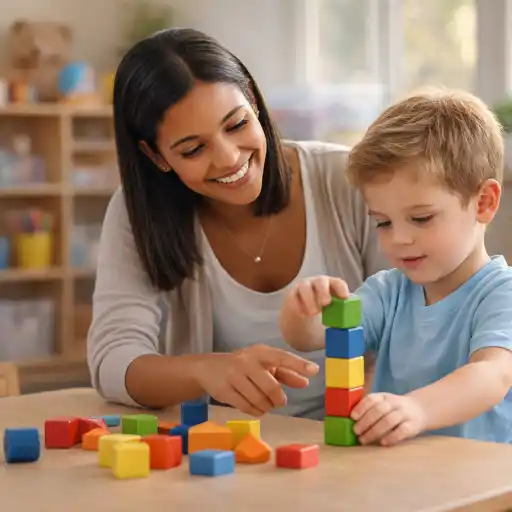
Play is a primary context for preschool learning because it integrates movement, language, imagination, social negotiation, and problem solving. NAEYC identifies play as a central teaching practice that supports self-regulation, communication, cognitive growth, peer relationships, and physical competence.
Provide sustained opportunities for both child-directed and guided play. The adult’s role is to prepare an inviting environment, observe children’s intentions, introduce vocabulary, model strategies, and extend thinking without taking over.
- 🧱 Construction play: Offer blocks, recycled materials, and drawing tools to encourage planning, spatial reasoning, fine-motor coordination, and collaboration.
- Pretend play: Add props for homes, stores, clinics, or transportation. Invite children to assign roles, develop stories, and consider different perspectives.
- Outdoor play: Include climbing, balancing, running, digging, and nature exploration to support physical development and scientific thinking.
- Games with rules: Use simple games to practice turn-taking, memory, counting, flexibility, and coping with disappointment.
Open-ended questions such as “What is your plan?” or “What could we try next?” encourage children to explain their thinking. The goal is not to turn every play moment into a lesson, but to recognize the rich learning already occurring.
How Should Educators Observe and Document Progress?
Effective assessment is ongoing, purposeful, culturally responsive, and connected to curriculum decisions. NAEYC recommends using multiple sources of information, including observations, conversations, work samples, and authentic activities. A single observation may reflect fatigue, unfamiliarity, language differences, or context rather than a child’s full capability.
Use a manageable documentation cycle:
- Choose one child, routine, or developmental focus.
- Record the date, setting, materials, and observable behavior.
- Interpret cautiously by considering the child’s language, culture, interests, and prior experiences.
- Plan one responsive next step, such as adding a prop, modeling a phrase, or adjusting the level of challenge.
- Revisit the observation after additional opportunities and share strengths with the family.
Screening and assessment are not the same. Screening identifies whether further evaluation may be useful; it does not diagnose or label a child. If concerns persist, document objectively, consult your program’s procedures, and partner respectfully with the family. The CDC advises acting early when a child is missing milestones, loses previously acquired skills, or when caregivers have concerns. Consider the course Tracking Progress, Shaping Futures: Observation & Assessment Skills Buy Now $55.00 for deeper training in documentation, screening, and goal setting.
How Can Classrooms Become More Inclusive and Responsive?
Inclusive practice begins with the expectation that variation is normal and every child belongs. Rather than waiting for a child to struggle, design environments with multiple ways to participate, communicate, move, and demonstrate knowledge. Universal Design for Learning principles can support this work through varied materials, visual supports, movement options, and flexible grouping.
- Offer large-grip tools, adaptive scissors, picture schedules, and accessible storage.
- Use gestures, objects, visuals, home-language words, and spoken language to support communication.
- Break complex routines into smaller steps and model them consistently.
- Provide quiet spaces and sensory choices without treating regulation needs as misbehavior.
- Represent children’s families, cultures, languages, and abilities in books, dramatic-play materials, music, and displays.
Cultural responsiveness requires curiosity rather than assumptions. Ask families about children’s interests, routines, communication styles, and strengths. For dual language learners, continuing to develop the home language supports belonging and gives children additional resources for thinking and connecting. When a child may need specialized support, collaborate with families and qualified professionals; educators should not diagnose based on classroom observation alone.
Directors can strengthen inclusion by reviewing enrollment practices, coaching staff, examining discipline data for patterns, and ensuring that adaptations are treated as ordinary components of quality teaching. Building Equity: Inclusionary Practices in Preschool Buy Now $10.00 offers practical professional learning for creating more welcoming environments.
How Can Providers Partner With Families?
Families hold essential knowledge about children’s development, culture, communication, health, and experiences. Strong partnerships are reciprocal: educators share observations and classroom strategies, while families contribute priorities, context, and insights from home. NAEYC emphasizes respect, responsiveness, relationship, reciprocity, and reflection as foundations for family engagement.
Use strengths-first communication. Begin with a specific success—“Amaya invited a peer into her block game today”—before discussing a question or concern. Describe what you observed rather than applying labels. Invite the family’s perspective: “What do you notice at home?” and “What helps during this routine?” Offer a small, realistic next step, such as reading a familiar book, practicing a turn-taking phrase, or counting objects during cleanup.
- Communicate in families’ preferred languages and arrange interpretation when needed.
- Share brief updates regularly rather than waiting for a formal conference.
- Protect confidentiality when discussing observations, photographs, or developmental concerns.
- Coordinate referrals through established program and community processes.
When concerns arise, present documentation as an invitation to collaborate—not a verdict. Early conversations can connect children with appropriate screening or evaluation while preserving dignity and trust.
Conclusion: What Is the Central Goal of Preschool Development Practice?
The central goal is not to make every preschooler look alike. It is to understand development well enough to notice each child’s strengths, provide meaningful challenge, respond to individual variation, and connect families with support when needed.
Effective practice combines four habits:
- Observe development across interconnected domains.
- Use play, relationships, and routines as powerful learning contexts.
- Document objectively and use observations to plan responsive experiences.
- Partner with families through respectful, culturally and linguistically responsive communication.
Milestone resources, including the CDC guidance and ChildCareEd’s preschool checklist Buy Now $0.00, can support organized observation. They should complement—not replace—professional judgment, family knowledge, and qualified developmental evaluation. Your careful attention, warm relationships, and intentional planning give children repeated opportunities to grow with confidence.
Professional Learning Options
- How Preschoolers Develop Buy Now $32.00 — focuses on preschool development, atypical development, and age-appropriate planning.
- 45 hour Growth and Development Birth-age 12 ONLINE Buy Now
$399.00$275.00 — provides broader training in child growth and development. - Role of Play in Learning Buy Now $16.00 — examines how play supports children’s development and learning.
- Tracking Progress, Shaping Futures: Observation & Assessment Skills Buy Now $55.00 — develops observation, assessment, documentation, and goal-setting skills.
- Building Equity: Inclusionary Practices in Preschool Buy Now $10.00 — supports inclusive and equitable preschool environments.
- 45 Hour Child Growth and Development
- 45 Hour Preschool Methods and Materials
- The Science of Growing Up: Typical and Atypical Development
- 24 Hour Texas Pre-Service
- CDA Bridge Bundle: Preschool without Portfolio Review
- Texas Director Credential
- CDA Infants/Toddlers: Brain Development and Gene Expression
- CDA Infants/Toddlers: Stages of Development
- CDA Home Visitor Subject Area 8 Part 1 Birth to 5
- Supporting the Nevada Childcare Workforce
- Why take CDA training with ChildCareEd? Free Resources
- Bye Bye Winter: The Role of Outdoor Play in Early Childhood Development
- The Value of Child Care Providers Earning their CDA Credential in Delaware
- CDA in South Dakota and how ChildCareEd can help!
- Mathematical Skill Development
- CDA Certification en Español: Recursos y Consejos para Educadores Bilingües
- 🔍 ¿Qué ves cuando observas a un niño aprender?
- 💛🧩 ¿Cómo puedo hacer que mi enseñanza sea inclusiva para los niños con autismo?
- Cómo usar tu certificación de 90 horas en Maryland para completar tu CDA
- Proporciones de Cuidado Infantil y Tamaños de Grupo por Edad en Maryland (Guía Rápida para Centros y Hogares)
- Proporciones de Cuidado Infantil y Tamaños de Grupo por Edad en Virginia (Guía Rápida para Centros y Hogares)
- Cómo Ser Maestra de Preescolar en Maryland
- Capacitación CDA gratuita en Illinois
- Online CDA Classes: A Flexible Path Toward Your CDA Credential
- How Can Child Care Providers Support Preschool Development Across the Whole Child?
