When children become the classroom’s fall weather reporters, a glance at the sky can spark rich conversation, careful listening, and joyful pretend play. A simple weather studio gives every child a meaningful reason to share ideas—and the Language Development in Early Childhood course  Buy Now $16.00 offers practical strategies for supporting verbal and nonverbal communication as you build the routine. Explore it as a helpful next step for strengthening your language-support practice while you discover how to turn daily weather observations into child-led reports.
Why does a weather reporter routine support speaking and listening?
Fall weather is close to children’s everyday experience: they feel a cool breeze, hear rain on the window, notice leaves moving, or decide whether a jacket is needed. Reporting on these observations gives children a genuine purpose for communicating. They are not merely repeating weather words; they are sharing something they noticed with an audience that can respond.
A weather studio can bring together expressive language—words, signs, gestures, or other ways of sharing an idea—and receptive language, including attending to and making sense of another person’s message. Children practice waiting for a turn, listening to a peer, asking a question, and responding to what someone else noticed. The routine also invites them to explain their thinking: “The leaves are moving, so I think it’s windy.”
These experiences align with the view that early science inquiry can also foster language, collaboration, and mathematical thinking, as described in Science in Early Childhood Classrooms: Content and Process. Keep the goal approachable: curiosity and communication matter more than a technically accurate forecast.
- Children gain meaningful practice using weather words in context.
- Listening has a real purpose: learning from a classmate’s observation.
- Shared reporting supports confidence, turn-taking, and a sense of belonging.
How can you set up a welcoming weather studio?
You do not need a broadcast-ready set. A small, supervised area with a few open-ended materials can signal that children are welcome to observe, record, and report. Keep resources reachable and simple enough for children to use independently, while making room for different communication styles and abilities.
- Offer a pretend microphone, clipboard, paper, and chunky crayons or pencils.
- Display clear picture symbols for sunny, cloudy, rainy, and windy conditions, plus words children can revisit.
- Add a weather chart or journal where children can draw, mark a symbol, or dictate an observation.
- Include a simple “on air” sign, a cardboard camera, or dress-up clothing if these props extend children’s play.
- Use locally relevant visuals and invite children to help organize the materials.
The classroom weather desk guide offers practical suggestions for creating a center with accessible props and picture cues. For a fall-specific visual, the Fall Weather Look, Say, Choose chart Buy Now $0.00 can prompt children to observe, describe, and connect conditions to everyday clothing choices. Adapt the display with large visuals, tactile symbols, or communication supports as needed.
Before adding props, check that materials are age-appropriate, intact, and free of choking hazards. Keep the center within active staff supervision and avoid making electronic recording a requirement for participation.
What does a short, child-led weather report look like?
Make the report brief and predictable—two or three minutes is a reasonable starting point. A simple sequence helps children know what to expect without requiring them to memorize a script:
- Observe the sky safely from a window or, when appropriate, with an adult outdoors.
- Choose a picture, symbol, or word that matches something noticed.
- Share one observation, question, or idea with the group.
- Invite peers to listen and add a related thought.
- Record the class observation with a drawing, mark, symbol, or dictated words.
Try flexible prompts such as “I notice…,” “The sky looks…,” or “I wonder….” A child might say, “The branches are moving,” point to a windy-weather card, sign a key word, draw the gray sky, or dictate a sentence to an adult. Each is a meaningful contribution. Children who prefer to watch first can join when they feel ready; avoid pressuring anyone to perform.
Rotate roles so reporting is not limited to the most talkative children. One child might be the reporter, another the symbol chooser, and another the chart helper. Ask open-ended questions that invite observation rather than test for a single right answer: “What do you notice?” “What changed since yesterday?” “What makes you think it might rain?”
Listening becomes more purposeful when classmates can respond: “I noticed that too,” or “My leaf moved differently.” The ChildCareEd guidance on strengthening listening skills offers additional ideas for warm, responsive exchanges and accessible participation.
How can providers help children listen and respond to one another?
Young children are still developing the ability to manage attention, interpret spoken language, and wait through a conversation. Support these skills by modeling the listening you hope to encourage. Face the group naturally, use a calm voice, keep the message concise, and give children time to process before expecting a response. Listening does not require stillness or eye contact; a child may show attention by pointing, moving closer, signing, or responding through a communication device.
Teach a few simple conversational moves and use them consistently:
- “I heard you say…” to reflect a classmate’s idea.
- “I noticed something different…” to offer another observation respectfully.
- “Can you tell me more?” to invite a reporter to elaborate.
- “Let’s listen, then we’ll add our ideas” to support turn-taking.
Model expanding, rather than correcting, children’s words. If a child says, “Wind make leaves go,” you might respond, “You noticed the wind making the leaves move.” This affirms the message and provides a fuller language model without turning play into a test.
Noise, group size, unfamiliar vocabulary, language learning, or sensory needs can affect participation. Reduce competing sounds, use picture cues, provide wait time, and accept responses in a child’s home language when possible. The ChildCareEd article on supporting language development describes how responsive routines and varied communication modes help create an inclusive language environment.
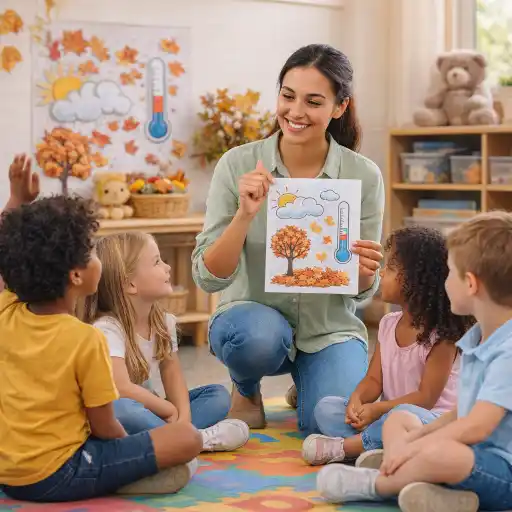
How can weather reporting connect language, science, and early math?
A weather report can extend beyond the microphone when children revisit what they observed. Start with real evidence and follow the children’s questions. If they notice leaves fluttering, offer a ribbon or windsock for a safe comparison. If they wonder whether the sky changes, return to the window later and discuss what stayed the same or shifted.
- Language: Build a small word bank—breezy, chilly, cloudy, drizzle, rustling—and invite children to use words in reports, drawings, or pretend play.
- Science: Compare observations, notice changes, and ask what evidence supports an idea.
- Math: Mark one weather symbol each day, count the symbols, and compare which appeared more often.
- Literacy: Dictate a shared class forecast, label a drawing, or revisit a weather-themed book.
- Social learning: Negotiate who reports, who records, and how the group will represent what it noticed.
Keep connections manageable. One observation can lead to a quick chart or a few minutes of discussion; children do not need a packed lesson or technical meteorology vocabulary. Their questions and representations—spoken words, pictures, gestures, or symbols—are valuable evidence of thinking. For further professional learning about oral language and classroom communication, consider the English-language Language and Literacy Foundations in Pre-K course Buy Now $16.00.
How can you keep the routine safe, inclusive, and enjoyable?
Weather observation does not require going outdoors. A window, photograph, classroom chart, or children’s recollections can support the same conversation. If an outdoor observation is appropriate, follow program supervision procedures and check conditions before leaving the classroom. State requirements vary—check your state licensing agency.
Make participation flexible and affirming. Some children may want the microphone; others may prefer pointing to a symbol, drawing, using a sign, speaking in a home language, or helping update the chart. Provide visual or tactile options, allow time to observe before joining, and avoid treating speaking in front of the group as the only sign of learning.
Common pitfalls are easy to prevent:
- 🧭 Keep forecasts playful and distinguish a child’s guess from an observed fact.
- Avoid calling any kind of weather “bad”; each condition offers something children can notice.
- Do not overcorrect vocabulary or pronunciation. Reflect the idea and model a useful word naturally.
- Do not let a chart replace current safety checks or program policies for outdoor plans.
- Check props for safe size and condition, and maintain active supervision during play.
As children’s interests change, refresh a few materials or prompts without dismantling a center they still enjoy. A routine that invites children to return, listen, and share fresh observations is doing meaningful developmental work.
Conclusion: What makes a fall weather studio a strong language-learning routine?
A fall weather studio gives children a real reason to speak, listen, ask questions, and respond to one another. Set up a few accessible props and picture cues, keep the reporting sequence short, and welcome communication through speech, drawing, gesture, signs, home languages, or other supports. A chart or journal can help the group revisit observations and notice change over time.
Most of all, prioritize curiosity and connection over polished broadcasts or perfect predictions. When educators model attentive listening, offer useful words without taking over, and adapt participation to children’s needs, an everyday look at the sky becomes a shared learning experience. To strengthen the language strategies behind this practice, explore ChildCareEd’s Language Development in Early Childhood course Buy Now $16.00 and Open Ears: Listening in Child Care Buy Now $16.00. For additional English-language learning, consider Building Vocabulary Buy Now $16.00, Language and Literacy Foundations in Pre-K Buy Now $16.00, and Reading Aloud and Storytelling Buy Now $16.00.
For ready-to-use dramatic-play materials, explore the Classroom Weather Studio Reporting Set on ChildCareEd. Pairing thoughtful materials with responsive facilitation can help children turn fall’s changing skies into confident reports and lively classroom conversations.
- Abuse and Neglect: Signs and Reporting
- Beyond the Classroom: Connecting Families to Essential Services
- Language and Literacy Foundations in Pre-K
- What Makes Me Special: An Overview of Autism and ADHD
- The Montessori Assistant's Toolkit
- Engaging Indoor Activities for Inclement Weather
- A Guide to Effective Communication
- Bridging Cultures: Family Communication & Collaboration
- Supporting Families and Caregivers in Language and Literacy
- CDA Certification en Español: Recursos y Consejos para Educadores Bilingües
- 🔍 ¿Qué ves cuando observas a un niño aprender?
- Curso de Comunicación de 9 Horas de Maryland
- 10 Ejemplos de Cómo la Cultura Influye en el Desarrollo Infantil
- Proporciones de Cuidado Infantil y Tamaños de Grupo por Edad en Nueva Jersey (Guía Rápida para Centros y Hogares)
- Proporciones de Cuidado Infantil y Tamaños de Grupo por Edad en Virginia (Guía Rápida para Centros y Hogares)
- Actividades de Otoño Fáciles para Preescolares esta Temporada
- Cómo Trabajar en el Cuidado Infantil en Carolina del Norte: Requisitos y Pasos
- Las Mejores Ideas de Excursiones para Guarderías en Texas
- Celebrando la amistad en el cuidado infantil durante el Día de los Mejores Amigos
- Canciones, juegos y preguntas de círculo para niños
- How Can Child Care Programs Prevent Common Playground Injuries?
- How Can Child Care Providers Make Fall Activities Inclusive for Every Child?
- How Can You Build Fall Vocabulary Beyond “Orange” Through Everyday Play?
- How Can You Start a Classroom Weather Desk for Preschool Meteorologists?
- How Can You Offer Every Child a Way to Join Fall Activities?
- How Can Fall Read-Alouds Reflect the Lives of All Children?
- How Can Fall Weather Reports Build Children’s Speaking and Listening Skills?
- How Can Child Care Providers Plan a Fall Season Where Every Family Belongs?
- How Can Preschool Group Time Turn Every Child’s Fall Story Into a Conversation?
