Seasonal themes give children a natural reason to learn and use new words. In this article, we’ll explore how tracing, picture talk, and simple conversations can strengthen vocabulary and early literacy skills, with support from Science of Reading Foundations in the Pre-K Classroom Buy Now $16.00 and the Summer Camping Words: Trace-and-Color Vocabulary Practice Buy Now $1.49.
Why does seasonal vocabulary matter for young children?
Children encounter seasonal concepts constantly: wet sidewalks, blooming flowers, warm clothing, falling leaves, or melting ice. These experiences give abstract words a concrete reference point. When educators intentionally name what children observe, children begin connecting sounds and symbols to meaning rather than memorizing isolated labels.
Seasonal learning also creates repeated opportunities for #vocabulary growth. A child may first hear “umbrella,” then see it in a photograph, use it during dramatic play, trace the word, and eventually use it in a sentence. Each encounter deepens receptive, expressive, and conceptual knowledge. Head Start describes oral language and vocabulary as developing through interactions with adults and peers who model and extend children’s language.
Picture talk is especially valuable because it welcomes different forms of participation. A child may name an image, point, gesture, use a home-language word, or describe one visible detail. Tracing then adds a visual and tactile pathway to the same concept. Together, these practices support language-rich, inclusive learning without requiring children to produce conventional writing before they are ready.
How should providers select seasonal pictures and target words?
Begin with familiar, observable vocabulary and add a few strategically chosen words that stretch children’s knowledge. Real photographs, classroom objects, and children’s own observations often provide stronger discussion prompts than decorative images because they invite comparison with lived experiences.
- Choose four to six words for a short learning cycle, such as rainy, puddle, boots, cloud, and windy.
- Include nouns, descriptive words, and action words so children can build phrases and sentences.
- Prioritize words that appear in books, routines, outdoor exploration, and play.
- Represent the season broadly rather than tying vocabulary to one holiday or cultural tradition.
- Offer photographs, objects, gestures, and translated labels when appropriate for dual language learners.
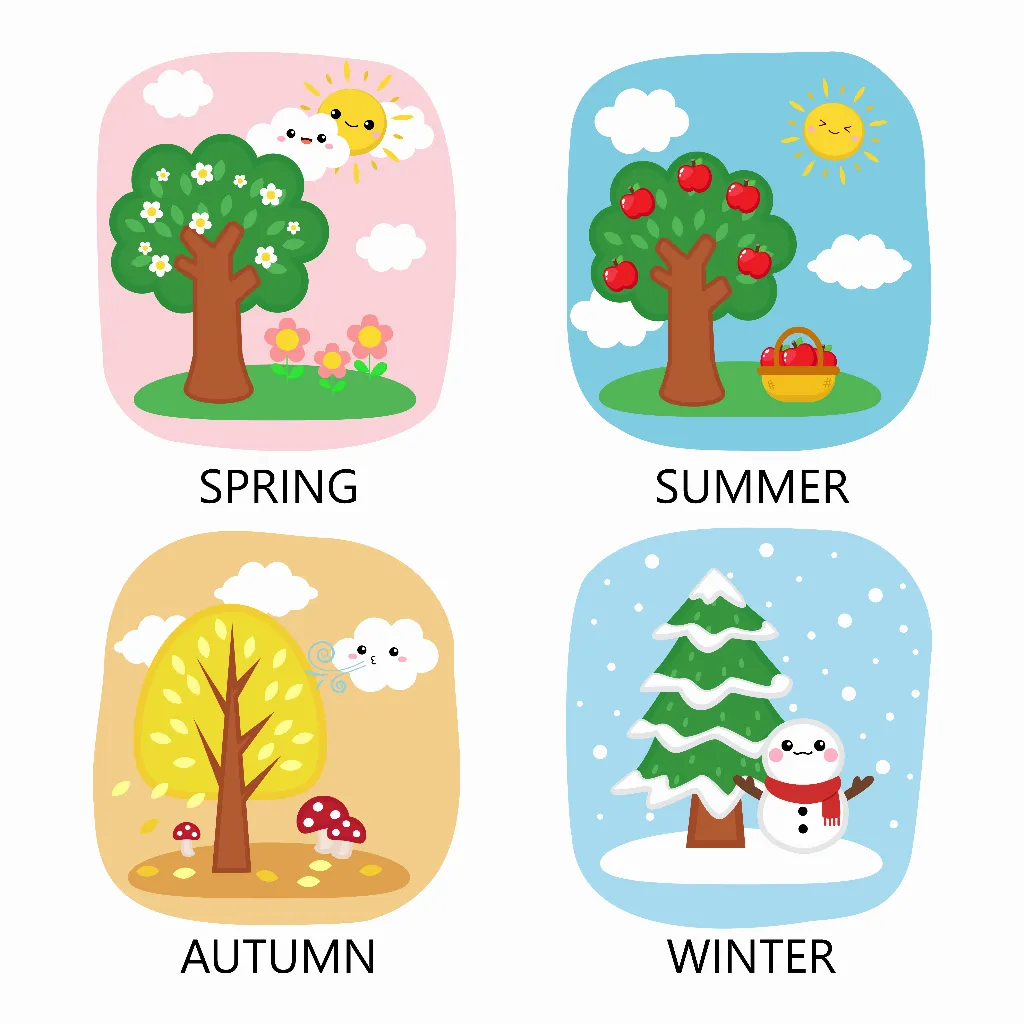
Picture cards can support sorting, matching, sequencing, and conversation. For example, children might sort images by season, explain why a jacket belongs in winter, or identify similarities between two pictures. The goal is not simply to recognize the correct card; it is to explain thinking and use words in meaningful contexts.
Keep a visible word display at children’s eye level. Add a photograph, the printed word, and a simple sentence frame such as “I see a ___” or “In fall, ___.” This turns the classroom into a print-rich environment while preserving flexibility for children who communicate through speech, gesture, drawing, or home language.
How can picture talk turn images into rich language experiences?
Picture talk works best when adults slow down, observe carefully, and build on children’s responses. Instead of testing children with rapid “What is this?” questions, describe what you notice and invite multiple interpretations. The educator’s language should be accurate, accessible, and slightly more advanced than the child’s current expression.
Try a gradual sequence:
- Notice: “I see dark clouds and drops on the window.”
- Name: “This picture shows rain.”
- Describe: “The rain is falling from the cloud.”
- Connect: “We wear boots when puddles are deep.”
- Extend: “What might happen if the sun comes out?”
Use parallel talk to describe a child’s actions: “You placed the snowflake beside the mitten.” Use self-talk to model thinking: “I am looking for a picture that shows something we wear when it is cold.” These strategies make vocabulary audible during authentic activity rather than limiting instruction to group lessons.
Allow wait time and accept approximations. If a child says “rain,” respond, “Yes, it is raining. The ground is wet.” This expansion validates the child’s contribution while offering a richer grammatical model. Aim for several back-and-forth turns around one image, using gestures, props, and repetition to support comprehension.
For children learning more than one language, invite families to share equivalent words and pronunciations. A home-language label is not a distraction from English; it can strengthen conceptual knowledge and communicate that the child’s linguistic identity belongs in the classroom.
How can tracing strengthen seasonal vocabulary and emergent writing?
Tracing should be one component of a broader literacy experience, not a test of handwriting accuracy. Children benefit when they first understand the word, hear it spoken, see it represented, and use it in conversation. Only then does tracing provide a meaningful opportunity to connect print with language.
Prepare materials at multiple levels:
- Beginning: trace seasonal lines, curves, and simple shapes; match a picture to an adult-written word.
- Developing: trace uppercase and lowercase letters or short words with a starting dot and clear spacing.
- Extending: copy a word, complete a sentence frame, or label a self-drawn seasonal picture independently.
Choose a comfortable writing tool and a stable surface. Short, frequent practice is generally more productive than a long worksheet session. Invite children to trace with a finger in sand, form letters with playdough, write outdoors with chalk, or use a dry-erase sleeve. These variations support fine-motor development and maintain playfulness.
As children trace, narrate letter formation without overwhelming them: “Start at the dot, go down, and curve around.” Avoid correcting every movement. Notice effort, visual attention, and growing control: “You kept your pencil on the line,” or “You recognized the word because of the picture.” For some children, drawing the object and dictating a sentence is a more developmentally appropriate response than tracing every letter.
Tracing resources that pair seasonal images with words can be useful additions to a writing center, but providers should review copyright permissions and adapt materials to children’s abilities. The instructional value comes from the conversation surrounding the print, not from worksheet completion alone.
How can providers differentiate the activity for every learner?
Effective differentiation begins with the same meaningful concept and offers varied ways to access and express it. A child with emerging speech may point to a picture, select between two choices, or use a communication system. A child with advanced language may compare seasons, explain cause and effect, or create a short story from three images.
- Use enlarged images, high-contrast print, textured materials, or adaptive grips when needed.
- Reduce the number of choices for children who become overwhelmed, then gradually add complexity.
- Pair children strategically so one child can model language without taking over.
- Invite movement: act out “windy,” jump over a “puddle,” or sort pictures while walking.
- Accept drawing, pointing, home-language responses, gestures, and approximated words as legitimate participation.
- Connect words to children’s cultures and local climate rather than assuming every child experiences the same season identically.
Dual language learners may understand a word before they are ready to say it in English. Continue modeling without demanding repetition. Use photographs, objects, gestures, songs, and family knowledge to build comprehension. The research on guided drawing with preschool dual language learners also illustrates how drawing can make children’s thinking visible when their English vocabulary is still developing.
Directors can support consistency by providing staff with a small seasonal vocabulary planning form: target words, visual supports, sentence frames, adaptations, and observation notes. State requirements vary - check your state licensing agency when selecting training, documentation, or curriculum expectations.
How can a seasonal tracing and picture-talk routine be planned and assessed?
A predictable routine helps staff implement the activity without adding unnecessary complexity. A 15-minute small-group experience might include a two-minute object or photo introduction, five minutes of picture talk, five minutes of tracing or multisensory letter formation, and three minutes of sharing or cleanup.
Use a simple weekly cycle:
- Introduce: present two or three words with real objects, photos, or a read-aloud.
- Explore: revisit the words during outdoor play, sensory centers, meals, and transitions.
- Represent: invite tracing, drawing, collage, or dramatic play connected to the words.
- Revisit: sort pictures, retell an experience, or use the words in a group story.
- Document: record one observable language or motor behavior for each child.
Assessment can remain play-based. Note whether a child recognizes the image, understands the word, uses it spontaneously, combines it with another word, follows a tracing path, or explains a seasonal connection. A brief note such as “Mila identified ‘blossom,’ traced the initial B, and said, ‘Flowers open in spring’” captures more meaningful progress than a completed worksheet alone.
Common mistakes include introducing too many words, requiring identical handwriting, asking only closed questions, and treating tracing as seatwork disconnected from experience. Correct these by narrowing the vocabulary set, offering choice, modeling rather than pressuring, and revisiting words throughout the day. For additional professional learning, Language and Literacy Foundations in Pre-K  Buy Now $16.00 focuses on practical ways to strengthen listening, speaking, vocabulary, and emerging literacy.
What are the main takeaways?
Building seasonal vocabulary through tracing and picture talk is most effective when children experience words repeatedly across meaningful contexts. Begin with familiar images and objects, model rich but accessible language, invite children to explain their thinking, and connect tracing to genuine communication rather than isolated handwriting practice.
- Use seasonal experiences as authentic language anchors.
- Pair pictures, objects, gestures, speech, and print.
- Offer multiple tracing and writing pathways.
- Differentiate participation for developmental, sensory, linguistic, and motor needs.
- Document vocabulary use and emerging control through brief observations.
The central question is not whether every child can trace the same word perfectly. It is whether each child is gaining a stronger connection among experience, language, pictures, and print. With intentional repetition and responsive conversation, seasonal learning can become a joyful, inclusive foundation for literacy.
Explore additional ChildCareEd courses:
- Understanding Print Knowledge in Preschool Buy Now $16.00
- Reading Aloud and Storytelling Buy Now $16.00
- Building Bridges for Dual Language Learners Buy Now $25.00
References
- Weather-themed word tracing printables.
- Season tracing worksheets.
- Seasonal tracing and fine-motor practice.
- Seasonal prewriting activities.
- Seasonal vocabulary cards with photographs.
- Picture cards and classification activities.
- Four Seasons Pre-K/K resources.
- Seasons preschool lesson plans.
- Picture books about the four seasons.
- Head Start: Oral language and vocabulary.
- Oral-language strategies.
- Communication and oral language in preschool.
- Picture-card vocabulary activities.
- Guided drawing with preschool dual language learners.
- Seasonal activities and educational goals.
- Seasonal documentation and classroom pictures.
- Everyday early literacy practices.
- Circle time, language, and connection.
- ChildCareEd: Building Vocabulary Buy Now $16.00.
- ChildCareEd: Language and Literacy Foundations in Pre-K Buy Now $16.00.
- Let's Talk: Skills for Effective Communication
- CDA Home Visitor Subject Area 3 Part 3 Birth to 5
- CDA Home Visitor Subject Area 2 Part 3 Birth to 5
- Language and Literacy Foundations in Pre-K
- Play Safe, Think Big: Literacy Through Play
- Texas Director Credential
- Building Vocabulary
- Classroom Tools for Emergent Literacy
- Let’s Talk: Effective Communication
- CDA Certification en Español: Recursos y Consejos para Educadores Bilingües
- Curso Gratis De Cuidado Infantil Con Certificado
- Cómo Trabajar en una Guardería Sin Experiencia en Cuidado Infantil
- Curso de Comunicación de 9 Horas de Maryland
- Cómo Ayudar a Niños con Retraso del Habla en el Cuidado Infantil
- Retraso del Habla en la Guardería: Cómo Pueden Ayudar los Proveedores
- Capacitación Previa al Servicio para Proveedores de Cuidado Infantil en Nevada
- Proporciones para guarderías en casa bajo el Título 22: Cómo la mezcla de edades cambia su capacidad en California
- How Can Child Care Providers Teach Beginning Sounds with Tracing, Pictures, and Repetition?
- How Can Ocean Animal I Spy Combine Counting, Visual Scanning, and Ocean Science?
- How Can Child Care Providers Move Children from Letter Recognition to Beginning-Sound Awareness?
- What Should Effective Beginning-Sound Practice Include?
- How Can Child Care Providers Teach Holiday Vocabulary with Context and Care?
- How Can Meaningful Juneteenth Vocabulary Support Early Writers?
- How Can Providers Connect Letter Formation, Sound, and Vocabulary in Phonics Instruction?
- How Can Predictable Text Reinforce Shape Concepts in Preschool?
- How Can Reading Games Build Wildlife Vocabulary in Early Childhood?
- How Can Transportation Word Searches Build Vocabulary and Spelling Skills?
- How Can One Shape Exploration Engage a Mixed-Age Montessori Group?
- How Can You Teach a New Word So Children Use It Beyond the Activity?
